
Denis O’Donovan of Ballyryan, Donohill, Co Tipperary
Search


12 Mar 2026

Please allow ads as they help fund our trusted local news content.
Kindly add us to your ad blocker whitelist.
If you want further access to Ireland's best local journalism, consider contributing and/or subscribing to our free daily Newsletter .
Support our mission and join our community now.
To continue reading this article, you can subscribe for as little as €0.50 per week which will also give you access to all of our premium content and archived articles!
Alternatively, you can pay €0.50 per article, capped at €1 per day.
Thank you for supporting Ireland's best local journalism!

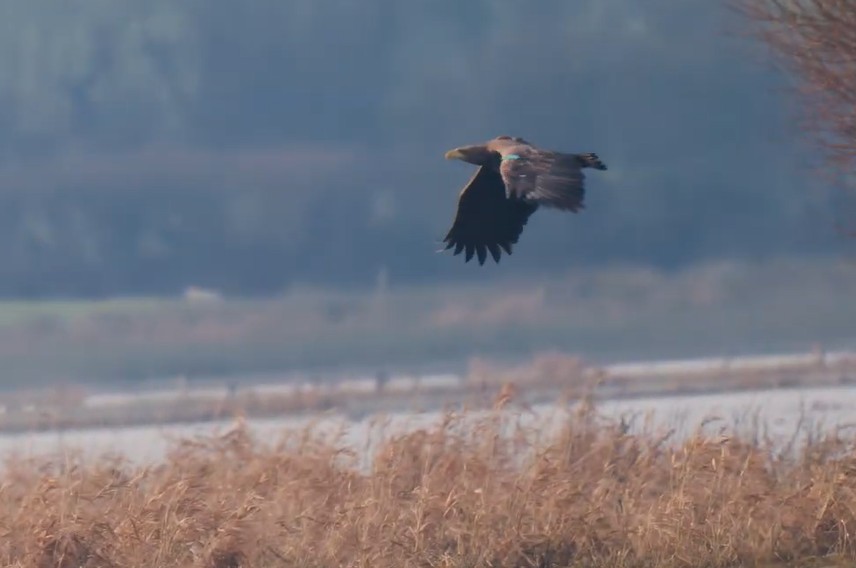
The pair of White-tailed eagles in the Little Brosna Callows last week.

A PAIR of white-tailed eagles were spotted by birdwatchers in the Little Brosna Callows near Birr and Banagher last week.
Sightings of this magnificent bird in the Callows area have been reported on a number of occasions over the years. The bird has a wing span from 6 to 8 feet.
Historically, white-tailed eagles were native across Ireland but were driven to extinction as a breeding species by the late 19th century, mainly due to persecution. Since 2007, a reintroduction programme using birds from Norway, managed by the National Parks and Wildlife Service (NPWS), has restored the species. There are now an estimated 150 individuals in the wild in Ireland, sufficient to sustain the population.
The White-tailed Eagle was persecuted in Ireland and across Europe due to the myth that it threatened livestock, particularly lambs, and game birds. As a large and conspicuous raptor, it was easily blamed for stock losses, and bounties were paid for killing birds of prey. (Below is a picture of one of the eagles flying over the Little Brosna Callows last week).
READ NEXT: Update on ten white-tailed eagles released at Offaly beauty spot
These concerns were unfounded. Scientific studies across Europe show that healthy lambs are not a typical prey item, and most reported cases involve scavenging on animals already dead rather than active predation. While they may occasionally take wildfowl, they do not pose a population-level threat to game species.
White-tailed eagles are opportunistic feeders, taking mainly fish, waterbirds, and carrion. Ecologically, they function as apex predators and scavengers, recycling nutrients and helping to maintain balanced wetland and coastal ecosystems.
The return of the white-tailed eagle, known in Irish as the ‘Iolar Mara’, restores an important native species to our wetlands and coasts and reconnects the landscape with a bird long reflected in Irish language and place names.
Despite this recovery, they remain vulnerable to illegal persecution, poisoning, disturbance, and emerging pressures such as collisions with, or displacement by, energy infrastructure, including wind turbines and power lines.
The Little Brosna Callows pair can be viewed on https://www.youtube.com/watch?v=
Km7uackU1jo
READ NEXT: Investigation underway following shooting of White-tailed Eagle in the Midlands

Subscribe or register today to discover more from DonegalLive.ie
Buy the e-paper of the Donegal Democrat, Donegal People's Press, Donegal Post and Inish Times here for instant access to Donegal's premier news titles.
Keep up with the latest news from Donegal with our daily newsletter featuring the most important stories of the day delivered to your inbox every evening at 5pm.

This publication supports the work of the Press Council of Ireland and Office of the Press Ombudsman, and our staff operate within the Code of Practice of the Press Council. You can obtain a copy of the Code, or contact the Council, at www.presscouncil.ie, Lo-call 1800 208 080 or email: info@presscouncil.ie.