Denis O’Donovan of Ballyryan, Donohill, Co Tipperary
Search


12 Mar 2026

Please allow ads as they help fund our trusted local news content.
Kindly add us to your ad blocker whitelist.
If you want further access to Ireland's best local journalism, consider contributing and/or subscribing to our free daily Newsletter .
Support our mission and join our community now.
To continue reading this article, you can subscribe for as little as €0.50 per week which will also give you access to all of our premium content and archived articles!
Alternatively, you can pay €0.50 per article, capped at €1 per day.
Thank you for supporting Ireland's best local journalism!

A gift to yourself can be a gift to others

IN the run-up to Christmas, the questions of what to buy for our loved ones or indeed where and how to purchase are uppermost in many people’s minds.
Older readers might remember when December 8 was the traditional day for the big Christmas shopping. More recently Black Friday came along and it falls before the end of November. But in general the season seems to be extending and extending.
The custom of giving gifts most likely originates from firstly the gift of Christ that God gave the world.
Furthermore, the presents of gold, frankincense and myrrh brought by the three wise men to honour the newborn baby also remind us of the importance of celebrating with presents.
So at this time of year, many of us buy things for others to show them we love them and possibly to thank them for being there for us all year round.
And of course, Saint Nicholas, and more lately Santa Claus, the most well-known present givers of all, bestow rewards to children for having been good all year.
In psychology, traditionally the Behaviourists used rewards as a way to shape behaviours in both animals and humans.
READ NEXT: How early attachments can influence adult relationships
In 1938, B.F. Skinner (probably one of the most famous Behaviourists) introduced the term “operant conditioning” to explain how we can reward and reinforce a behaviour, increasing the likelihood that it will recur.
Modern day psychology continues to use principles such as operant conditioning in order to help shape behaviour.
For example, when working with children and families, most psychologists will at some point utilise an old reliable tool, the star chart.
The simplest application of the star chart is that the child achieves a star for completing a certain behaviour or task.
When a certain number of stars are collected by the child, they can be exchanged for a reward that has been pre-agreed by parents and child.
For instance, if the goal is to get the child to start and complete homework within a certain time frame every day, a star could be awarded each evening upon completion of said homework.
By Friday the child may have a maximum of four or five stars and these can be exchanged for a trip to the local sweet shop or whatever else appeals (within reason!).
As a clinician working primarily with adults, rewards can also come in useful. Take the client who is seeking psychological support and therapy for managing weight loss.
Small goals towards the ultimate one are rewarded as achieved. A visit to the local sweet shop would not be the reward of choice in this instance however.
Something like a new item of clothing or a pair of running shoes could be a very appropriate incentive to keep going.
Similarly, in terms of promoting mental fitness, treats and rewards can be really important. If you promise yourself a reward for completing a task that you have been putting off for a long time – typically one that causes worry even contemplating it, such as finishing a report or tidying a cupboard or a room – then you are much more likely to be motivated.
Rewards and treats feel good, and so in addition they can make us happier. Treats and rewards can also help change a behaviour that you do not like.
In a hospital setting we have worked with patients who wanted to quit smoking. It is usually found that the health and psycho-social benefits of quitting (not to mention the financial) are usually rewards enough in themselves for giving up the habit.
Compassion focussed therapy (CFT) is a relatively new branch of psychological therapy that also alludes to the importance of using rewards in order to be compassionate towards oneself. The founder of CFT, an eminent UK based professor of clinical psychology, Paul Gilbert, has provided evidence-based research that being compassionate towards oneself is necessary for healthy neurological as well as psychological functioning.
Compassion is not self-indulgent, it is not as simple as being nice to yourself. In fact, sometimes being compassionate to yourself means taking the tougher option: it could be taking the difficult step of leaving a long-term relationship that you know is not good for you.
If we are experiencing distress in our lives, CFT urges us to concentrate on thoughts and activities that can help soothe our busy minds. This may mean taking some time out, going on a holiday or just treating ourselves more kindly.
READ NEXT: Managing the magic of the mind
One of the most important elements of CFT and one that we focus on a lot in clinical practice with clients is the harm that self-criticism does to us mentally.
Gilbert’s evidence (amongst others) tells us that self-criticism is highly correlated with depression for instance. When we ruminate on our anxiety, low mood or anger - this practice of going over and over the same thoughts in a way that is based on fear – we just lock in these negative feelings.
Gilbert urges that we replace self-criticism with self-compassion. If instead we can focus our thoughts and feelings on being supportive, helpful and caring towards ourselves and keep practising this attitude, then our feelings of threat and stress will eventually start to recede.
This is imperative to managing psychological distress. Hence, kindness and compassion is something that our brains need to develop to maintain psychological well-being.
If we are feeding our minds a diet of negative, self-critical thoughts, we are stimulating scary feelings of threat, anxiety, worry, anger and so on. And as the Behaviourists recognised nearly a century ago, the more we do this, the more we ensure the same outcome.
Having met previous years with resilience and persistence - and a certain amount of acceptance – we must remember that self-compassion can help us move forward into 2026 with a renewed attitude, focus and energy. This can ultimately lead to better mental fitness and health – and especially at Christmas time, it is hard to put a price on these rewards.
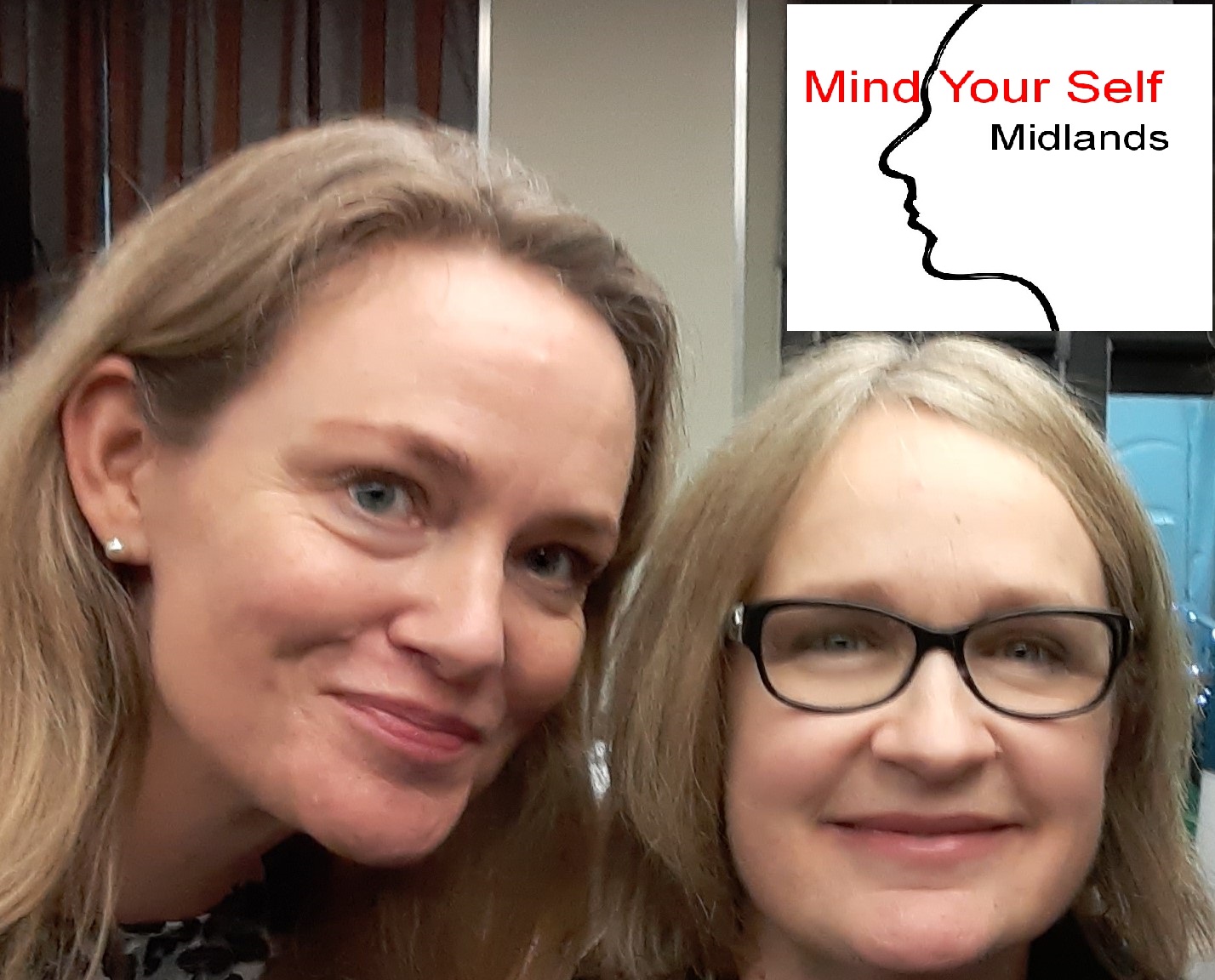
Julie O'Flaherty and Imelda Ferguson (pictured above) are chartered clinical psychologists with over 20 years of experience each. They are both currently working in private practice in Tullamore. Through Mind Your Self Midlands, they run a range of positive psychology and mindfulness courses, with the focus on practical application to everyday struggles. They can be contacted through the Psychological Society of Ireland website (www.psychologicalsociety.ie) in the Find a Psychologist section, and also on their Facebook page, Mind Your Self Midlands.

Subscribe or register today to discover more from DonegalLive.ie
Buy the e-paper of the Donegal Democrat, Donegal People's Press, Donegal Post and Inish Times here for instant access to Donegal's premier news titles.
Keep up with the latest news from Donegal with our daily newsletter featuring the most important stories of the day delivered to your inbox every evening at 5pm.

This publication supports the work of the Press Council of Ireland and Office of the Press Ombudsman, and our staff operate within the Code of Practice of the Press Council. You can obtain a copy of the Code, or contact the Council, at www.presscouncil.ie, Lo-call 1800 208 080 or email: info@presscouncil.ie.