Denis O’Donovan of Ballyryan, Donohill, Co Tipperary
Search


12 Mar 2026

Please allow ads as they help fund our trusted local news content.
Kindly add us to your ad blocker whitelist.
If you want further access to Ireland's best local journalism, consider contributing and/or subscribing to our free daily Newsletter .
Support our mission and join our community now.
To continue reading this article, you can subscribe for as little as €0.50 per week which will also give you access to all of our premium content and archived articles!
Alternatively, you can pay €0.50 per article, capped at €1 per day.
Thank you for supporting Ireland's best local journalism!

Johnny Hayes crosses the finish line in the 1908 London Marathon

The 1908 London Olympic Games Marathon was a remarkable race which also has a special connection to Nenagh and a local man will soon follow in the footsteps of a famed competitor in that historic race who had Tipperary roots.
"I was delighted to get the rare opportunity to race the original 1908 Olympics Marathon course which I will be doing in aid of the North Tipperary Hospice on March 7th," Gerard Keaty, who lives in Cloughjordan said.
Gerard is greatly inspired by the story of Johnny Hayes, the winner of the 1908 London Marathon - an event where the fifty-five runners on that day made history.
The 1908 Games organisers had the task of creating a course of loosely 26 miles starting in Windsor, passing through various towns and suburbs like Eton, Slough, Harrow, Wembley, and Wormwood Scrubs and finishing in the White City Stadium in Shepherd’s Bush.
The plan was to start at the Queen Victoria statue on the avenue leading up from the town to Windsor Castle.
READ NEXT: Roscrea Hotel plan 'was always a joke' says Tipp TD
But, after discussions with King Edward VII, the starting line was moved 700 yards further back and into the private grounds of Windsor Castle itself, where the Princess of Wales (the great-grandmother of the current King Charles) and her children could wave off the start away without members of the public.
They also moved the finish to line up with the royal box in the stadium. These changes meant that the final course distance ended up at, the by now famous but quirky, 26 miles and 385 yards (or 42.195 km).
This distance later became the codified standard and is the seemingly random distance that every marathon is run at today. Those extra 385 yards were to prove highly significant to one man in particular.
"As a runner I am nothing special. I have run one or two marathons in the past and I train with a great group of people at Birr A.C. once or twice a week to keep me in shape.
"I have been living in Cloughjordan for a few years now and so I was excited to recently discover Nenagh’s 1908 Olympic Games connection. The more I investigated the story the more fascinating it became to me," Gerard said.
Passing the courthouse in Nenagh you might well have noticed the athletic figures inside the railings; three life-size bronze statues of Olympic gold medallists, all of whom have their roots in Nenagh.
The figure on the left is Matt McGrath, arms outstretched to the sky, about to launch his winning hammer throw at the 1912 Stockholm Olympics.
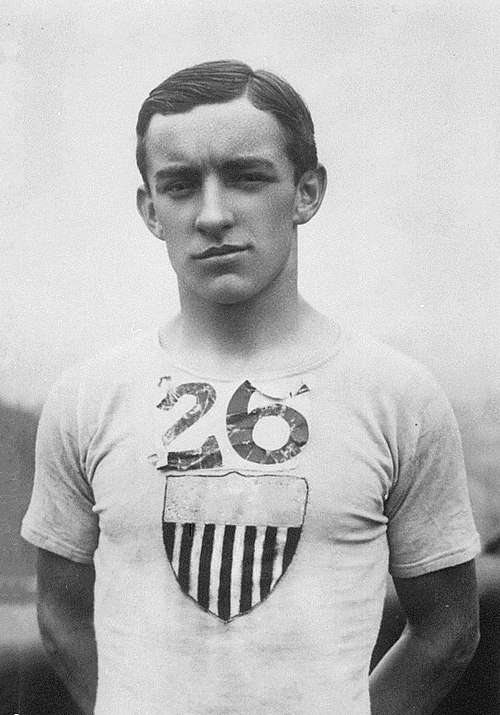
Johnny Hayes in 1908
On the right is the lean figure of Bob Tisdall, his leading leg sweeping over a waist-high hurdle.
He won gold in the 400m hurdles at the 1932 Los Angeles Olympics. And finally, the central figure of Johnny Hayes, five foot four inches tall, gazing directly ahead, in total concentration on the miles before him, and about to win the 1908 Olympic Marathon.
Johnny Hayes was representing the USA team. He was born in 1886 in New York and was the eldest of the six children of Michael and Ellen Hayes from Nenagh, and who emigrated to New York in 1880.
The Hayes family ran a bakery in Nenagh’s Silver Street and Michael found work in a bakery when he got to New York.
Johnny’s parents passed away when he was a teenager and in his late teens, we find him doing hard manual work as an underwater digger, shovelling muck underground for the construction of the New York subway.
Johnny had a talent for long-distance running however and by his early twenties he had won the 1907 Yonkers marathon and placed second in the 1908 Boston marathon. His athletics club had also, by now, found him a safer job at Bloomingdale’s department store, which allowed him to train more.
The marathon was the most anticipated event of the 1908 Olympic Games, and the route was thronged with crowds.
Looking across the starting line on the morning of July 24th, Johnny Hayes would have seen the race favourite, Tom Longboat, the sensational Canadian First Nations athlete, warming up. The British team were there with a strong contingent too and naturally the British press was predicting a home victory.
It was a very warm day for running a marathon - in the grainy photographs from the race the course looks hot and dusty.
Hayes had, by all accounts, prepared for the race by having a lunch of beef, toast, and “a sup of tea” and took no liquids except for gargling his throat with brandy during the race.
An Italian runner, Dorando Pietri, a pastry chef by trade, had a knotted a handkerchief on his head to protect him from the sun.
As the starting gun went off at 2.30 p.m., little did any of them know the drama that was about to unfold.
The British runners went off quickly and remained up front for the first half of the race. Their man Fred Lord was ahead at the half way mark (13 miles), while Hayes was back in 11th position. By the 20-mile mark, the South African Charles Hefferon had taken the lead and was being followed by Longboat.
Surprisingly however, Longboat, succumbed to the heat and not long after this point. Many other runners were dropping out by now including another of the favourites, Alexander Duncan, who had won the trial marathon earlier that year on the same course.
Pietri, the Italian, was four minutes behind Hefferon, but gradually increasing his pace. With only 2 miles to go he surged into the lead. Hefferon was by now suffering from stomach cramps which he credited to foolishly accepting a glass of champagne from a spectator on route.
With just over a mile to go, and now with a significant lead, dehydration and fatigue started to take its toll on Pietri. He entered the White City Stadium but initially went the wrong way.
He was redirected by officials before collapsing on the track. The umpires helped him up but he fell at least another three times. According to the New York Times, he was “staggering like a drunken man” in front of over 70,000 spectators and the watching Queen Alexandra, the wife of King Edward VII.
The officials, including Irish medical officer, Dr. Michael Bulger, massaged him to keep his heart beating and ran beside him each time he got to his feet. Arthur Conan-Doyle, sitting in the stand, called it a “horrible but yet fascinating” struggle.
After a huge effort Pietri crossed the line in first place.
There is an iconic photo of him at that very moment, chest touching the tape, knotted handkerchief on his head, upper body bent back, knees buckling, and race officials shepherding him across the line. It was estimated that he took 10 minutes to complete the last 350 metres.
Out on the course Hayes had overtaken Hefferon and crossed the line in second place in a time of 2:55:18. As the Italian flag was being raised for Pietri, the US team was formally appealing the result. Within a few hours, the Olympics officials had disqualified Pietri for receiving help in those last metres.
Johnny Hayes was declared the winner of the most dramatic marathon in history and Olympic gold medallist.
At 22 years of age, this son of a Tipperary man had just sealed his place in history.
He was feted in Britain and the USA and toured Ireland immediately after the Olympics and was mobbed in Dublin, Cork, and Belfast. He came to Nenagh too, to visit his relatives, and was met at the train station by huge crowds and a marching band.
When he returned to the US he quickly turned professional and subsequently had a career as a coach and later a businessman but he never ran in the Olympics again.
"He visited Nenagh once more, in the 1960s, and died in New Jersey in 1965.
"Hayes made history that day wearing the number 26 bib on his vest, and I was delighted to get the same number 26 for my own race this March. It will only be the 9th marathon ever run on the exact same route. It will be an honour to run in the footsteps of Johnny Hayes and those Olympians from 118 years ago.
"I will look out for the one surviving London 1908 Marathon sign –a blackened iron sign with the words “MARATHON ROUTE” and an arrow pointing the way near the famous school in Eton," Gerard said.
Sadly, the White City Stadium was demolished in 1884 for an office block development.
"All that remains is a plaque and an inscription on the ground where the finishing line would have been.
"Like Johnny Hayes I hope to reach that line but unlike him I hope I won’t need to gargle brandy on route.
"I will be running in the Original Marathon IX on March 7th in support of the North Tipperary Hospice," Gerard said.
All donations would be welcome and can be sent by following the Hospice fundraising link here https://platform.payzone.ie/10416/fundraising/campaign/2003
"I have chosen to support hospice services in recognition of the palliative care my own father received at the end of his life during a covid lockdown in 2020.
"My family and I are enormously grateful for the dignity that the palliative nurses and carers gave to him in his last days. I think they deserve huge recognition for what they do," Gerard said.

Subscribe or register today to discover more from DonegalLive.ie
Buy the e-paper of the Donegal Democrat, Donegal People's Press, Donegal Post and Inish Times here for instant access to Donegal's premier news titles.
Keep up with the latest news from Donegal with our daily newsletter featuring the most important stories of the day delivered to your inbox every evening at 5pm.

This publication supports the work of the Press Council of Ireland and Office of the Press Ombudsman, and our staff operate within the Code of Practice of the Press Council. You can obtain a copy of the Code, or contact the Council, at www.presscouncil.ie, Lo-call 1800 208 080 or email: info@presscouncil.ie.