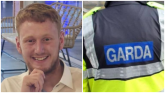
Gardai say Aodhan Ryan has been located following the urgent appeal issued on April 3
Search


05 Apr 2026

Please allow ads as they help fund our trusted local news content.
Kindly add us to your ad blocker whitelist.
If you want further access to Ireland's best local journalism, consider contributing and/or subscribing to our free daily Newsletter .
Support our mission and join our community now.
To continue reading this article, you can subscribe for as little as €0.50 per week which will also give you access to all of our premium content and archived articles!
Alternatively, you can pay €0.50 per article, capped at €1 per day.
Thank you for supporting Ireland's best local journalism!

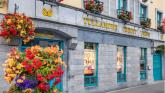
A house in Callary St which is named in honour of a former PP

REV. Hugh Behan, parish priest of Tullamore, died suddenly in May 1899, but no successor was appointed to the post until September of that year. Fr Behan is recalled today in the name of the apartment development beside the Tullamore GAA Centre at Ardan Road.
The new parish priest was Rev. Philip Callary who was well suited to the task of finishing the new Tullamore church, the foundation stone of which had been laid in June 1898. Fr Callary had helped to complete the bell tower and spire at St Mary’s Drogheda before his transfer to Trim in 1893. At Trim he took over a situation where a church had been started in 1891, but was proving difficult to complete because of lack of funds arising from the deep political divisions in the parish caused by the Parnellite split. The rift did not heal overnight but by the time Father Callary departed Trim parish in 1899 the church was well on the way to completion (Trim church was dedicated in 1902).
‘Philip the Builder’
Within a few months of his arrival in Tullamore Father Callary had reactivated the building committee and threw himself into the work of building the church, which was finally completed in 1906. It had cost about £25,000 and was the largest building project in Tullamore since the completion of the new courthouse in 1835 and its rebuilding in 1927.
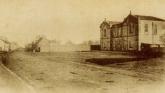
As soon as the debt was cleared he set about erecting two secondary or intermediate schools and that for girls was opened in 1911, while the boys’ school was opened in 1912. Both schools were built at Convent Road, but the girls’ school was demolished in 1960s when the new convent was built, while the boys’ schools served as De Montfort Hall from 1961 until the 1990s.
READ NEXT: Major new volume on the urban history of Tullamore to be launched
Disliked artificial flowers as ‘a pagan practice’
Callary was a founder of the Tullamore Relief Committee in 1916 and this continued its work for the winters of 1916-19. He had perceived waste as much as piety in mind when he told his congregation in Tullamore in the lead up to Christmas 1916 that the practice of placing artificial flowers on the graves in Clonminch cemetery was to be deprecated. It was a pagan practice and far better to have an offering of masses and the giving of alms.
Other church related activities included the promotion of temperance. At a great temperance parade in Dublin in July 1914 Tullamore and district is said to have had been represented by between six and seven hundred young men and women led by spiritual directors and Tullamore curates, Rev. Fathers Daly and Lynam.
Dignior in the episcopal stakes for Meath diocese
Philip Callary was born at Oldcastle, County Meath in 1849, and was ordained at Maynooth in 1873, He was secretary to the fiercely anti-Parnellite Bishop Nulty for a time and when Bishop Gaffney retired in 1906 Fr Callary was dignior or runner-up in the vote for a new bishop. The hierarchical order of names are usually listed in order of suitability as dignissimus (most worthy), dignior (more worthy), and dignus (worthy) on the list of candidates – the Terna List. While the dignior is deemed highly suitable, the Pope (or perhaps the Nuncio) often selects from the list based on Rome's own investigations, not necessarily selecting the top candidate listed. The successful candidate in Meath diocese in 1906, Dr Gaughran, appointed Fr Callary vicar general of the diocese in July of that year.
The county infirmary, Sinn Féin and Mrs Molloy
Fr Callary was popular in Tullamore and was said to have combined his interest in building projects with pastoral duties. He was the author of a pamphlet on the life of Bishop Oliver Plunkett and wrote a number of articles on medieval Trim. Fr Callary departed from involvement in the new county technical education committee in 1902 when the department refused to sanction the use of St Brigid’s National School for technical education classes on the grounds that it was unsuitable.
He was associated with a number of public bodies and was chairman of the board of governors of the King’s County Infirmary for eighteen years and up to June 1920. He was not nominated to the chairmanship of the infirmary by the new Sinn Féin dominated Offaly County Council in June 1920, despite protests from his colleague, and rector of Tullamore, Dean R.S. Craig.
Callary’s experience in Trim may have put him off any association with politics and the national movement. He strongly condemned the shooting and killing of R.I.C. man, Sergeant Henry Cronin, outside his home in Henry/O’Carroll Street, Tullamore on Halloween, 31 October 1920.
Callary had taken no interest in local politics in 1916, unlike younger men such as Fr Burbage in Geashill and Fr Magee in Tubber/Tober. The views of their bishops were mixed with Gaughran of Meath and Foley on the conservative side and Fogarty in Killaloe much more supportive of the Volunteers, if not of the Rising itself. All united during the conscription crisis but divided again for the War of Independence and most favoured the Treaty concluded in December 1921 and voted on in the Dáil in January 1922. Callary, in his role as chairman of the county infirmary proved unreceptive to the Local Government Board suggestion in 1919 (after the war) that venereal disease be catered for.
READ NEXT: The beating heart of an Offaly area celebrates its 50th anniversary
The infirmary was abolished in 1921, but a new role could have been found for Callary by the Sinn Féin council if even some sympathy existed on both sides. Callary’s dispatch by the Sinn Féin councillor and ideologue T.M. Russell may not have been with repercussions at a time when he lived at Ballyduff House, Clara Road and the lease was up for renewal.
Russell was elected to the county council in June 1920, receiving the second highest vote after Clara’s Sean Robbins. It was soon after that his landlord, Mrs Molloy, wanted her house at Ballyduff back and in September 1920 the Russell family left Tullamore saying that it was impossible to get another house. Whether it was the slighting of Fr Callary in regard to his pre-June 1920 chairmanship of the county infirmary, a rent increase, or the need to have the house for a Molloy family member we may never know. In any case Russell left town and retired from local politics only a few months into his membership of the new 1920 county council.
Mediator
When Tullamore experienced its first major strike in 1924 Callary offered his service as a mediator. He was ill for almost a year before his death, aged 76, on 9 September 1925. Fr Callary’s funeral was a striking tribute to a man who had spent 26 years of his 52 years as a priest in Tullamore. Thousands attended the funeral including upwards of 100 clergy, together with Bishop Gaughran and all business was suspended until the funeral had ended. The altar boys, the children of the school, about 200 Foresters, the urban council, all marched in the funeral procession. The local press noted that:
During the progress of the funeral to the graveside at Clonminch the doleful peals of the bells of the Church of the Assumption and St Catherine’s church were heard at intervals, thus typifying that Protestant united with Catholic in giving expression to the general grief and mourning.
When 56 new houses were built east of Davitt Street, Tullamore in the mid-1930s by Duffy Brothers for the urban council the members agreed unanimously on the names Callary Street and Callary Terrace – the latter for the houses facing the canal at Convent View. No doubt Very Revd Fr Callary would have welcomed the Eucharistic Congress Cross prominently plastered on the front wall of each house.

Subscribe or register today to discover more from DonegalLive.ie
Buy the e-paper of the Donegal Democrat, Donegal People's Press, Donegal Post and Inish Times here for instant access to Donegal's premier news titles.
Keep up with the latest news from Donegal with our daily newsletter featuring the most important stories of the day delivered to your inbox every evening at 5pm.

This publication supports the work of the Press Council of Ireland and Office of the Press Ombudsman, and our staff operate within the Code of Practice of the Press Council. You can obtain a copy of the Code, or contact the Council, at www.presscouncil.ie, Lo-call 1800 208 080 or email: info@presscouncil.ie.