Search


04 Apr 2026
Search
04 Apr 2026

Please allow ads as they help fund our trusted local news content.
Kindly add us to your ad blocker whitelist.
If you want further access to Ireland's best local journalism, consider contributing and/or subscribing to our free daily Newsletter .
Support our mission and join our community now.
To continue reading this article, you can subscribe for as little as €0.50 per week which will also give you access to all of our premium content and archived articles!
Alternatively, you can pay €0.50 per article, capped at €1 per day.
Thank you for supporting Ireland's best local journalism!

Handwriting is old hat? It shouldn't be because putting your thoughts to paper can be very therapeutic

IT is rare these days to write and receive letters.
There are so many instant ways of communicating directly with friends and family, that have succeeded traditional letter-writing. While psychologists spend a considerable amount of time engaged in 'talk therapy' with clients there are a number of techniques and tools that draw on other modalities of communication. The written word is one of these.
Psychologists and psychotherapists have used writing as a therapeutic tool in a number of ways over a number of decades. In the 1980s a social psychologist named James Pennebaker emerged as a researcher and advocate for the benefits of writing therapy.
So, how do we utilise writing in therapy? One method is simply encouraging clients to access their thoughts and feelings by putting pen to paper. This can be done through 'free' writing where the client just sits and writes about whatever is on their mind or whatever comes up for them, without any heed to grammar, spelling or structure. Mostly the writing is purely for the writer’s eyes, but clients may decide to share in therapy with their therapist. Many clients and therapists call this journalling.
Writing therapy is more structured and often directive than journalling. The therapist directs the client towards addressing certain situations/emotions that they may be struggling with.
Cognitive Behaviour therapy, CBT, is another therapeutic approach which utilises the power of the pen. The main premise underlying CBT is that thoughts impact our feelings. This in turn impacts our behaviour. We are predisposed to pay more attention to negative thoughts (that’s a throwback to our evolutionary history).
However sometimes these thoughts are neither helpful or correct. These thoughts are often automatic and can take hold very quickly. CBT trains the client to become more aware of these thoughts, to 'catch' them and to actually write them down.
When we record these thoughts , we can see them in black and white. This can help us identify if they are accurate or unreasonable, and we can train ourselves to look for alternative more helpful explanations and thoughts. This in turn can help shift a low mood. When we think about things in a more helpful and often optimistic way we are more likely to engage in activities that may help further lift a low mood.
Cognitive processing therapy is a trauma based therapy, the basic premise of which involves writing about the trauma that has been experienced by the client and reading the account repeatedly aloud in therapy sessions. The written account should describe how the trauma has impacted on their thoughts and beliefs about themselves, about others and about the world. The aim is to identify unhelpful thoughts that are keeping the client 'stuck', impacting adversely on mood and relationships.
This approach can be very helpful for clients who are stuck feeling guilt or shame in the wake of the traumatic event, as it can help the client construct more accurate, helpful and compassionate meaning about what they have been through. When we use this exercise with clients we advise them to time-limit these writing sessions and to do something different, for example, go out to the garden with a cup of coffee or go for a run afterwards, to help create a sort of emotional boundary around the exercise.
An approach that can be helpful for dealing with nightmares which are often a key symptom of trauma, is imagery rescripting. In brief, this technique is about imagining a different, most usually positive alternative to the ending of the nightmare.
If, for example, a client is still having disturbed sleep and nightmares about a car crash they were involved in, the therapist will help them to rehearse over and over an alternative ending, whereby that car journey did not end in a crash and instead the client reached their destination safe and sound (as in so many previous car journeys they had made before the accident). Writing down this new imagined scenario can help set up this new imagined scenario, which in itself needs repetition and practise.
Compassion Focussed Therapy, CFT, also recognises the importance of writing things down in order to express ourselves and process emotions. Techniques include managing difficult thoughts using thought records which direct us to look at them from a compassionate viewpoint.
Compassionate letter writing is a tool we use with clients to help them to see their struggle from a compassionate viewpoint. The compassionate letter is more than this though; it incorporates essential components of CFT such as sensitivity, sympathy and empathy with our struggle, non-judgement, kindness to self and compassionate action to alleviate suffering and make changes.
Research has found that compassionate letter writing is associated with a variety of benefits, such as better mood, less self-criticism and shame and higher levels of self-compassion.
There is a gratitude exercise too that we encourage our clients to practise. At the end of the day, or at any time of the day, write down a couple of things you enjoyed that day, were grateful for that day and were satisfied with. In our experience writing in this way forces the mind (which don’t forget has a negative default and is programmed to look for what’s wrong rather than what’s right) to reflect on optimistic, helpful thoughts.
An American study which looked at the impact of a six-week expressive writing intervention found that expressing ourselves through writing increases resilience, decreases depressive symptoms, perceived stress and rumination amongst a group of people suffering from trauma. In general, the literature suggests that writing therapy has proven effective for a range of different psychological and psychiatric conditions, from low self-esteem, grief and loss, communication and relationship problems to anxiety, depression and PTSD.
In addition, other psychological research studies suggest positive physical health benefits associated with writing therapy, for example, improved immune system functioning.
In the 21st century we can avail of any number of helpful virtual platforms and applications to record our thoughts and emotions. We can make records on our phones, on our laptops, on the go. We often suggest to clients that they “write” the old fashioned way, using pen and paper. Studies using magnetic resonance imaging have shown that low-tech writing by hand increases neural activity in particular brain areas and involves more senses and motor neurons than writing on a keyboard.
Other studies have demonstrated that writing things down by hand can aid cognitive functions such as memory and learning. We find that writing by hand forces us to slow down, to be more mindful, it cuts down on screentime, it is cost-effective and accessible. Our hand writing is of course, so personal and unique to all of us. Whatever method you choose, high or low tech, there are so many benefits to this form of expression with and without any input from a professional.
Julie O'Flaherty and Imelda Ferguson (pictured below) are chartered clinical psychologists, both based in private practice in Tullamore. Through Mind Your Self Midlands, they run courses on Positive Psychology and mindfulness throughout the year. They can be contacted through the Psychological Society of Ireland www.psychologicalsociety.ie (Find A Psychologist section) or on their Facebook page, Mind Your Self Midlands.
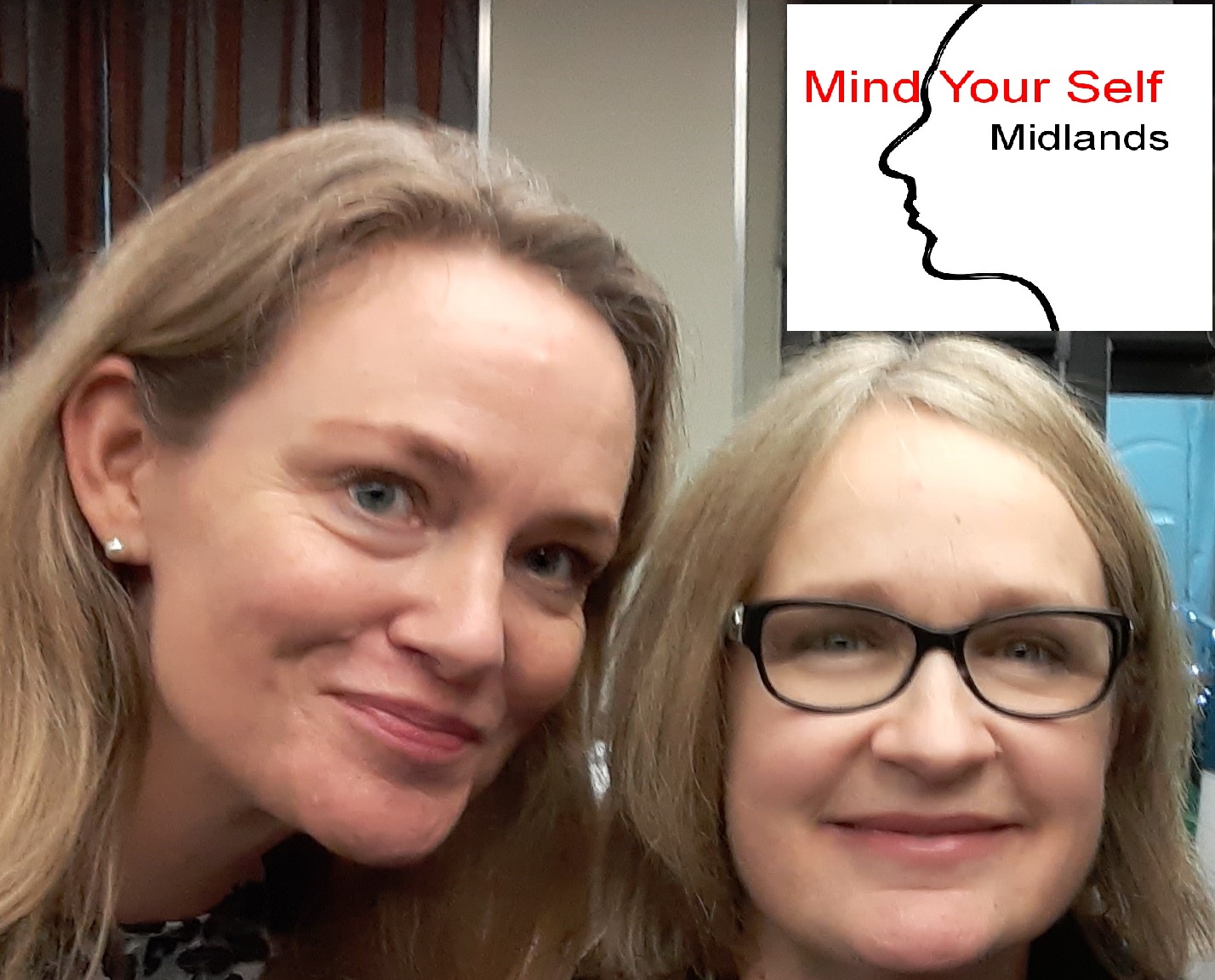
They will host a morning of mindfulness and positive psychology in Tullamore on May 23. The practical half-day course on how to manage and reduce stress, anxiety and worry using mindfulness and positive psychology.
Ms Ferguson said: “Many people are familiar with the experience of stress, anxiety and worry. At times we can feel overwhelmed and these experiences can be disruptive in our everyday lives.
“In this half-day course we will explore some of the well-researched methods from positive psychology and mindfulness which are proven to be powerful tools in tackling stress, anxiety and worry.”
Ms O'Flaherty added: “This course will be a blend of theory and practice of relaxation skills and mindful meditation. We hope it will be both a relaxing and useful experience for participants. The course is suitable for everyone and no previous experience is required.”
Topics will include: why do we experience stress, anxiety and worry? Understanding the physiology and getting basic self-care right; progressive muscular relaxation for relaxing deeply; what is mindfulness? How the principles, attitudes and practices can help reduce stress, anxiety and worry; recognising and reducing anxious thoughts and worry; experiential meditation.
The event will take place on Tuesday, May 23 next from 10am to 1pm in the Central Hotel, Main Street,Tullamore (opposite Lidl).
Participation in the course costs €100 (early bird fee of €80 when paid by May 12, the fee includes course materials, tea/coffee and hotel parking).
For further information or to book a place, contact Imelda on 087 2271630 or Julie on 087 2399328; or send a private message on the Facebook page: Mind Your Self Midlands.

Subscribe or register today to discover more from DonegalLive.ie
Buy the e-paper of the Donegal Democrat, Donegal People's Press, Donegal Post and Inish Times here for instant access to Donegal's premier news titles.
Keep up with the latest news from Donegal with our daily newsletter featuring the most important stories of the day delivered to your inbox every evening at 5pm.

This publication supports the work of the Press Council of Ireland and Office of the Press Ombudsman, and our staff operate within the Code of Practice of the Press Council. You can obtain a copy of the Code, or contact the Council, at www.presscouncil.ie, Lo-call 1800 208 080 or email: info@presscouncil.ie.