Search


02 Apr 2026
Search
02 Apr 2026

Please allow ads as they help fund our trusted local news content.
Kindly add us to your ad blocker whitelist.
If you want further access to Ireland's best local journalism, consider contributing and/or subscribing to our free daily Newsletter .
Support our mission and join our community now.
To continue reading this article, you can subscribe for as little as €0.50 per week which will also give you access to all of our premium content and archived articles!
Alternatively, you can pay €0.50 per article, capped at €1 per day.
Thank you for supporting Ireland's best local journalism!


If you aren’t screeching, ‘HOW MUCH?’ every time you pass by a petrol station at the moment, we’d be surprised. Fuel prices are skyrocketing, but so are energy bills and even mortgage rates. It can be difficult to keep on top of what’s going on and why, especially when the world feels like it’s at war and your financial health is struggling on top.
So we asked Dr. Danilo Spinola, a senior lecturer in economics at Birmingham City University, to explain what’s happening and how long we can expect it to last…
What’s triggered these price spikes – is it purely the US-Israel war on Iran?
“The problem right now comes from what we call in economics, external shocks; when something external happens that is not directly related to what’s going on in our economy. The war in Iran has created a big issue in terms of global energy choke points,” says Spinola. “Twenty per cent of global oil and fertilisers pass through the Strait of Hormuz; when it closed because of the war, there was a reduction in the supply of oil around the world.
“That increased quite substantially the price of oil. And oil is the basic energy of our economy. We use oil for basically everything, as well as fertiliser, which is another commodity that is being strongly affected by the war.
“[This situation] creates a shock that passes through the other things we produce. So the increase in oil prices ends up affecting food prices, gas prices, transportation, shipping costs [which affects] everyday goods, and creates broad inflation.”
“This inflation actually spreads out to the whole economy, and that’s when the problem with mortgages and other types of financial assets [start], because you have an increase, or expected increase, in prices,” says Spinola.
“Increasing interest rates is the weapon the central bank [the Bank of England] has to tackle inflation, because once you increase interest rates, you end up constraining credit, you constrain demand, and then you’re capable of keeping prices down.
“There is a lag between the central bank’s decisions and what is going on in daily life,” he continues. “The central bank doesn’t change its basic rate every day. It changes once a month. And during this period, the markets try to anticipate what is going to happen. And this anticipation embeds economic variables into those expectations. So the expectation, by itself, is capable of driving the interest rates, it doesn’t need to wait for the central bank to do it.”
“Mortgages are linked to those expected rates,” says Spinola. “When you see higher uncertainty, and you see higher expectation in terms of inflation, expected interest rates go up, and mortgage lenders start charging higher rates, and that’s why borrowing costs are going up.”
If the war ended, could prices fall quite quickly?
“Usually what we see is that prices don’t go down. The rate of inflation goes down, so the prices stop increasing, but that doesn’t mean they come back to how they were before,” says Spinola. “If the Iranian war stops and [President] Trump decides to not do these things anymore, and the Strait of Hormuz reopens, probably we will see interest rates going down, because expectations will be more relieved, but part of this embedded inflation, it stays.
“So we will see an improvement in the situation, but part of the damage is already done. There is nothing we can do, it has already happened.”
What can we do as individuals to weather this shock?
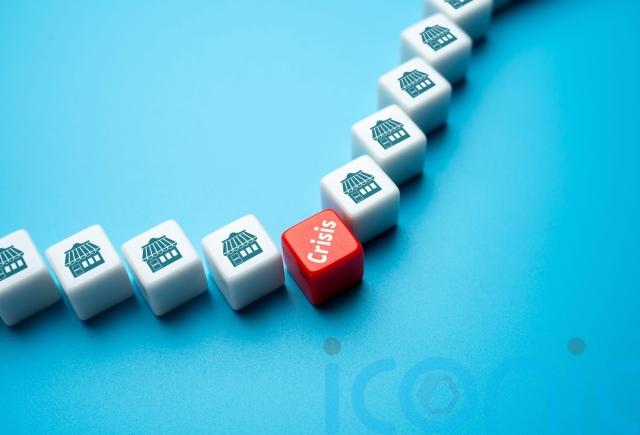
“In these situations, you need to be careful. [In times of] uncertainty, it’s better to reduce your spendings a little bit, try to find good saving alternatives so you can protect your wealth,” says Spinola. “We cannot continue a pattern of spending that puts us in debt. If you are indebted, the interest rates might, and probably will go up, so you’re going to pay more for your debt.”
He says to hold off on major purchases too: “If you’re planning to switch your car or move house, maybe postpone it for a while during this period of uncertainty.”
How worried should we be about what’s happening?
“It’s not the end of the world. We have a short memory, but if we go back 50, 60 years, there have been so many shocks that are quite similar to these ones. In the Seventies, we had terrible shocks and oil prices with the Yom Kippur War that actually were much worse than the one we are facing right now,” says Spinola. “We had shocks in the Eighties and Nineties, the dot.com bubble and the financial crisis in 2008, so there have been a number of crises, and we always recover.”
Even more recently, “we faced Covid, we faced the cost-of-living crisis and the Ukrainian war. I don’t think it’s going to be worse than that.”

Subscribe or register today to discover more from DonegalLive.ie
Buy the e-paper of the Donegal Democrat, Donegal People's Press, Donegal Post and Inish Times here for instant access to Donegal's premier news titles.
Keep up with the latest news from Donegal with our daily newsletter featuring the most important stories of the day delivered to your inbox every evening at 5pm.

This publication supports the work of the Press Council of Ireland and Office of the Press Ombudsman, and our staff operate within the Code of Practice of the Press Council. You can obtain a copy of the Code, or contact the Council, at www.presscouncil.ie, Lo-call 1800 208 080 or email: info@presscouncil.ie.