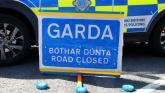
Motorists are being advised the road remains closed to facilitate a technical examination by Garda Forensic Collision Investigators
Search


02 Mar 2026

Please allow ads as they help fund our trusted local news content.
Kindly add us to your ad blocker whitelist.
If you want further access to Ireland's best local journalism, consider contributing and/or subscribing to our free daily Newsletter .
Support our mission and join our community now.
To continue reading this article, you can subscribe for as little as €0.50 per week which will also give you access to all of our premium content and archived articles!
Alternatively, you can pay €0.50 per article, capped at €1 per day.
Thank you for supporting Ireland's best local journalism!

Sean Robbins, back right, on the Offaly junior football team in 1927

‘A Revolution in Profiles’ is a free online Dictionary of Biography dealing with Offaly in the Revolutionary Decade.
The project has received assistance as of the Royal Irish Academy’s Decade of Centenaries programme.
Modelled on the Royal Irish Academy’s Dictionary of Biography, the website is divided into 100 profiles, each about 600 words long and it’s hoped to add another 30 profiles over the next year.
It features a number of Offaly people, including a long serving Offaly GAA chairman and the first man from the county to become chairman of Leinster Council, Sean Robbins – who the cup for the Offaly Senior Hurling Championship is named after.
There’s no charge. The site is completely free and can be accessed at
https://revolutioninprofilesoffaly.com/
The official launch is online on Thursday 14th December at 8 pm a: https://www.facebook.com/profile.php?id=61553625544577
Each biography aims to give the maximum amount of information in the minimum amount words, to an audience who might never heard of the person being profiled.
While focused on the Revolutionary period the website contains a certain amount of crossover into sporting life at the time. In addition to Robbins, there are profiles on James Corrigan (Clareen) and Mick Cordial (Kinnitty), members of the Offaly 1915 junior hurling team which won the county's first Leinster title; Felix Cronin who played on the Tipperary side which defeated them in the All-Ireland; Eamon Bulfin of Derrinlough, the winner of Sigerson and Fitzgibbon medals with UCD; James Moran full back on Kildare's 1919 All Ireland football victory, who was heavily involved in republican activities in Edenderry; Jack Finlay, the well-known Offaly footballer killed in a robbery as he delivered supplies during the Civil War.
There are also occasional tangents mentioning cricket, golf and horse racing.
The profile on Sean Robbins
Sean Robbins was born at Erry, Clara in 1892. After his father’s death he was raised by his mother Mary, a domestic servant. Robbins worked as a labourer in Clara’s main employer the Goodbody Jute factory. A noted athlete, he competed in 220- and 440-yard races and went on to represent Offaly at senior football.
Robbins helped organise an Irish Volunteers company at Clara in 1917. As a result, he was frequently imprisoned and lost his employment at Goodbody’s. While imprisoned in Belfast Gaol on Gaelic Sunday 1918, he was one of a combined Leinster-Connaught combination which lined out to play on the prison’s exercise yard.
Shortly after Sean Robbins release from Belfast Gaol in 1918, the delayed 1917 county football was played at Clara. At the game, Sean Robbins hosted a tricolour manufactured by his neighbour Mary Margaret Bracken, herself an employee at Goodbody’s and Cumann na mBan member. This is believed to have been the first occasion at which a tricolour was flown during an Offaly County Final.
Arrested and imprisoned in late 1919, the following March he took part in the mass escape of 20 republican prisoners from Mountjoy.
Operating on the run he was elected to County Council in 1920. During the War of Independence, he participated in raids for arms, sabotage operations. As a Battalion officer Robbins took part in a series of attacks and hold ups on trains between Clara and Ballycumber. He was a member of the party which attacked Clara RIC Barracks in June 1920.
Sean Robbins and Mary Margaret Bracken were married at Killina in September 1920. By the Truce he had been appointed Quartermaster of the IRA’s Offaly No. II Brigade.
Opposing the Treaty, Robbins was involved in a confrontation with pro -Treaty soldiers in April 1922 at Athlone, when George Adamson was killed.
He was part of the anti-Treaty forces who fought National Army troops at Ferbane early in the Civil War. Promoted to O.C of the Anti-Treaty Offaly No. II Brigade, he was captured at Borrisoleigh, in January 1923. Interned at the Curragh he participated in the camp hunger strike later that year.
Appointed a Home Assistance Officer for south Offaly, Robbins moved to Birr shortly after his release from internment.
Re-engaging with Gaelic games he captained Offaly to a Leinster Junior hurling title for the 1924 season. A noted referee he was the man in the middle for the first All-Ireland minor football final played at Birr between Clare and Longford and went on to officiate at numerous All Ireland hurling deciders including to two of the legendary Cork, Kilkenny games held in 1931.
A longstanding Chairman of Birr GAA, Robbins was one of the driving forces behind the purchase and development of St Brendan’s Park. Chairman of the Offaly County Board on several occasions, he was appointed its Life President in 1960. From 1936-38 he served as President of the Leinster Council.
Throughout his administrative career he remained a vocal supporter of the GAA’s ban on foreign games.
During ‘The Emergency’ he served as commander of the Local Defence Force in south Offaly.
On his death in 1960, he received a military funeral to Clonoughill cemetery where Tom Malone provided the oration.
When the Offaly Senior Footballers returned to the county after the appearance in the 1961 All Ireland final, they were led into Tullamore behind the flag which Robbins had unveiled at Clara in 1918. The flag remains in the care of Clara GAA club.
In 1960 Offaly County Board Chairman Fr. Vaughan obtained the Sean Robbins trophy, to be presented to the winners of the Offaly Senior Hurling Championship, while the Robbins cup has been presented to the Leinster under 21/20 hurling champions.

Subscribe or register today to discover more from DonegalLive.ie
Buy the e-paper of the Donegal Democrat, Donegal People's Press, Donegal Post and Inish Times here for instant access to Donegal's premier news titles.
Keep up with the latest news from Donegal with our daily newsletter featuring the most important stories of the day delivered to your inbox every evening at 5pm.

This publication supports the work of the Press Council of Ireland and Office of the Press Ombudsman, and our staff operate within the Code of Practice of the Press Council. You can obtain a copy of the Code, or contact the Council, at www.presscouncil.ie, Lo-call 1800 208 080 or email: info@presscouncil.ie.