
Why is there no RTE Late Late Show tonight?
Search


07 Mar 2026

Please allow ads as they help fund our trusted local news content.
Kindly add us to your ad blocker whitelist.
If you want further access to Ireland's best local journalism, consider contributing and/or subscribing to our free daily Newsletter .
Support our mission and join our community now.
To continue reading this article, you can subscribe for as little as €0.50 per week which will also give you access to all of our premium content and archived articles!
Alternatively, you can pay €0.50 per article, capped at €1 per day.
Thank you for supporting Ireland's best local journalism!


Existing levels of regulation are “hindering supply of homes” and other infrastructure delivery, the Public Expenditure Minister has said.
Speaking to reporters in Dublin, Jack Chambers said all the systems involved in housing and infrastructure delivery need to come under “scrutiny and reform”.
He said the Infrastructure Division being established in his department would “accelerate” current processes and systems.
“Some of the systems, structures and sequencing of decision making is too slow. It’s stopping housing supply and it’s harming infrastructure delivery, and that’s why the focus of this Government isn’t just additionality in the context of the National Development Plan, it’s a real focus on reform.”
He added: “Some of that will be assisted by the Planning and Development Act, which is due to be commenced, but we will need a broader suite of reforms if we’re going to accelerate the infrastructure delivery in our economy, because things are taking too long.
“It’s affecting our ability to fulfil our energy objectives in terms of energy security and also around decarbonisation of our economy, and there’s lots of practical examples which we hear from people across our economy where they see paralysis and an absence of decision making.”
Mr Chambers said it is well documented that projects in energy, water, transport and housing “continue to face endless delays”.
“Some of that sits within Government in the context of the assessment and the processes that are under our control, and other parts of this rest with an overly litigious system which we’re trying to restructure in the context of the commencement of the Planning and Development Act.
“But what we do need to do is ensure that the system is balanced in the interest of actually delivering housing and infrastructure.
“And in too many instances, we’re seeing lots of examples in Dublin and elsewhere, eminently sensible proposals – I’m not going to name specific ones – which appear to be being refused for specific aesthetic reasons, which undermines housing supply.
“And as far as I’m concerned, if we’re going to provide additionality that needs to be matched with an ability for people who are willing to invest and deliver infrastructure and housing, that they have that certainty when they try and achieve that in the context of the systems that the state has and the existing ones that are there.”
Mr Chambers said a review of the National Development Plan would not yield improved outcomes “if it isn’t matched with a laser-like focus on the systems and how they make decisions”.
“We can’t have systems in place which don’t fulfil the Government objective, which is infrastructure delivery and housing supply.”
Asked if he was signalling further deregulation relating to aesthetic considerations or other housing measures, the minister said: “I think we need balanced regulation and I think there’s legitimate criticism of the levels of regulation which is hindering supply of homes and is hindering the delivery of infrastructure and economy.
“My focus is ensuring that the outcome happens and that there’s balanced regulation around that – and I think that has to be a central reform for this Government.
“Making decisions on more regulation where it acts as a market constraint for supply isn’t fulfilling the broader social objective of more housing.
“And I think we need a broader focus on this over the coming period, so that we achieve the objective which is more homes, accelerated infrastructure delivery and energy and transport and water, which are important enablers for economic growth.”
He added: “And frankly, we’ve had excessive paralysis around decision making in some of the planning applications that are in situ where we have those who seek to object and frustrate the social and economic objective have the upside in how the systems operate, and we need to see a rebalancing of that if we’re going to fulfil that objective.”
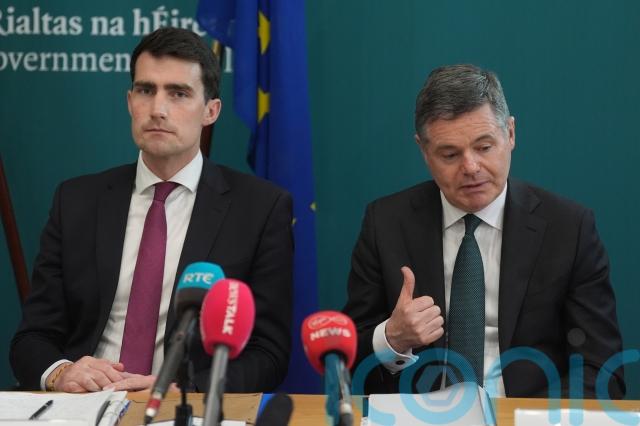
Mr Chambers was speaking at a press conference alongside Finance Minister Paschal Donohoe, who refused to be drawn on whether he expects house prices to fall amid global trade shocks.
The Department of Finance published a report outlining the impact of different tariff scenarios on economic growth and employment.
However, Mr Donohoe said his department does not model the potential impact on house prices.
Asked if he expected a moderation on house prices under future scenarios involving tariffs between the US and the EU, he said: “I can’t forecast what would be the price of homes in the future.
“What we are trying to do is make the homes more affordable though, and the way in which we could try to make more homes more affordable is to continue to support the growth of incomes within our country and to continue to put in place measures that increase the supply of homes.”
He said house prices are not part of the overall macro-economic models.
Asked if the department was unable to model the impact on house prices, he said: “It’s not included in the economic scenarios that we’ve done dealing with the trade shock. The models that we published only looked looked at employment and economic growth.
“It didn’t, at that point, look at the effect on prices and in the scenarios that we generally publish does not include the forecast on house prices.”
Pressed on whether the Department of Housing would carry out such an assessment, Mr Donohoe said: “They may well be looking at that but on the forecasts we do, it looks at the economy overall and does not get into producing forecasts of what could happen on issues apart from inflation, economic growth and jobs.”
Asked if he was concerned that economic anxiety could exacerbate the housing crisis by slowing down supply, Mr Donohoe said the most likely scenarios projected by the models suggest the economy will still experience growth, albeit at a slower rate.
“There will continue to be lots of people in work. So for all of those reasons, my expectation is that there will continue to be a very high level of demand for homes to be purchased and built in our country, and the issue that we’re most likely to still confront in the time ahead is supply.”

Subscribe or register today to discover more from DonegalLive.ie
Buy the e-paper of the Donegal Democrat, Donegal People's Press, Donegal Post and Inish Times here for instant access to Donegal's premier news titles.
Keep up with the latest news from Donegal with our daily newsletter featuring the most important stories of the day delivered to your inbox every evening at 5pm.

This publication supports the work of the Press Council of Ireland and Office of the Press Ombudsman, and our staff operate within the Code of Practice of the Press Council. You can obtain a copy of the Code, or contact the Council, at www.presscouncil.ie, Lo-call 1800 208 080 or email: info@presscouncil.ie.