Search


20 Jan 2026
Search
20 Jan 2026

Please allow ads as they help fund our trusted local news content.
Kindly add us to your ad blocker whitelist.
If you want further access to Ireland's best local journalism, consider contributing and/or subscribing to our free daily Newsletter .
Support our mission and join our community now.
To continue reading this article, you can subscribe for as little as €0.50 per week which will also give you access to all of our premium content and archived articles!
Alternatively, you can pay €0.50 per article, capped at €1 per day.
Thank you for supporting Ireland's best local journalism!


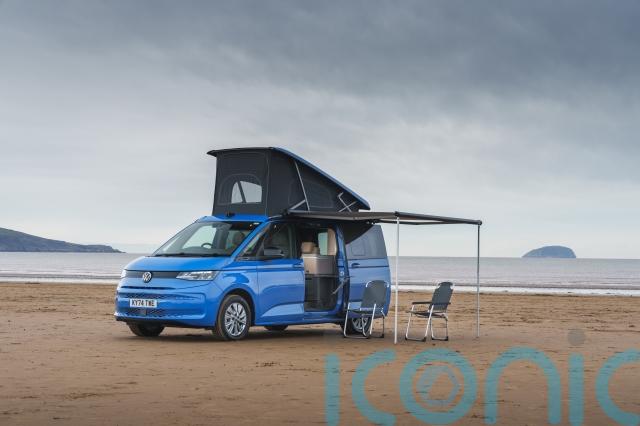
The Volkswagen California is one of the best-known names when it comes to camper vans. With a lineage that can trace back to the 1960s, the California is a modern interpretation of that go-anywhere spirit where all you need is the open road ahead and a bed in the back of the van.
But as time has moved on, so the California has become more premium and feature-packed. This latest generation comes equipped with more creature comforts than ever, but does this dilute the overall experience? We’ve tested it in the UK to find out.
There’s quite a difference with this new generation of California. For the first time, it is no longer based on a van – the previous model shared its underpinnings with those of the hardy Transporter panel van – and instead, this new California has a lot more in common with the Multivan. With its MQB platform, the Multivan is on the same platform as cars like the Golf. So, in essence, this is a van, which is based on another van, and that one is based on a car. Keeping up?
The idea is that the new California should offer a more car-like driving experience than before with improved refinement and handling. That’s the theory, anyway.
‘Our’ California comes with a rather familiar setup that is second-nature to cars within the Volkswagen Group. There’s a 2.0-litre turbocharged diesel engine linked to a seven-speed DSG automatic gearbox, sending a modest 148bhp to the front wheels. Zero to 60mph will take just over 12 seconds but, more importantly, you’ve got 360Nm of torque to help maintain that acceleration when you’re fully loaded.
Earlier in the year, Volkswagen introduced a plug-in hybrid variant of the California which offers up to 54 miles of electric-only running. That version could be great if you’re looking to do more local adventures, whereas this diesel option remains in place for drivers who need long-distance efficiency above all else. Speaking of which, Volkswagen claims that you should get up to 41.5mpg combined.
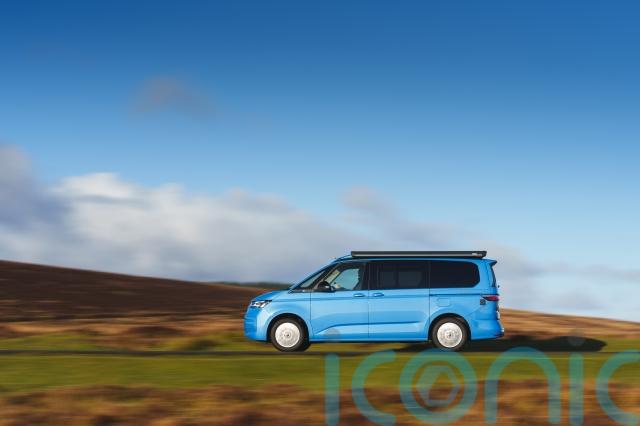
With the new platform underneath, you’d expect the California to feel more car-like than ever. In many areas, it does, with a decent level of road-holding through the bends contributing to a confidence-inspiring feeling when you’re cornering. As in other Volkswagen Group cars, this diesel engine remains quite agricultural, but it does a great job of getting the California up to speed in good time. It’s nice and quiet when you’re at motorway speeds, too.
Given the open nature of the cabin, there is quite a lot of noise to be dealt with when you’re moving quickly and it’s not all that relaxing. Plus, road imperfections do tend to upset the California’s ride somewhat. However, you need to remember that you’re carrying a full kitchen and bed suite along with you – so there are some allowances to give when considering outright refinement.
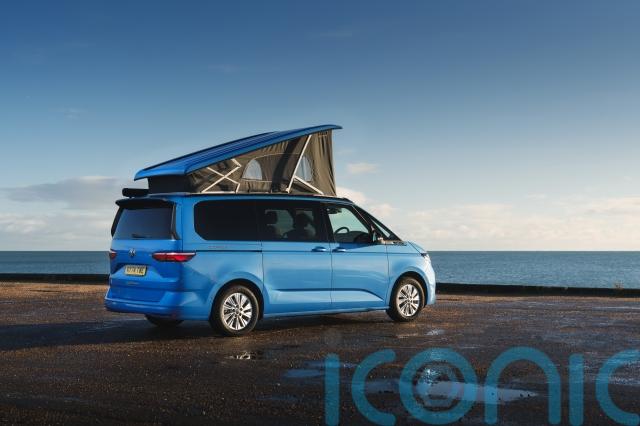
Volkswagen has done well to evolve the look of the California without changing things too much. This is, after all, a rather iconic model and completely ripping up the rule book would likely be met with some fierce opposition.
You can still get the split-colour design, should you want, though we were rather fond of our all-blue test van. There’s loads of choice when it comes to colourways, mind you, with thirteen options available if you’re looking at just the split-tone shades.
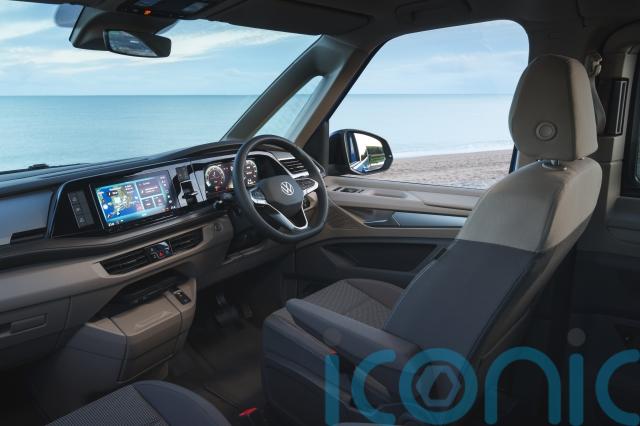
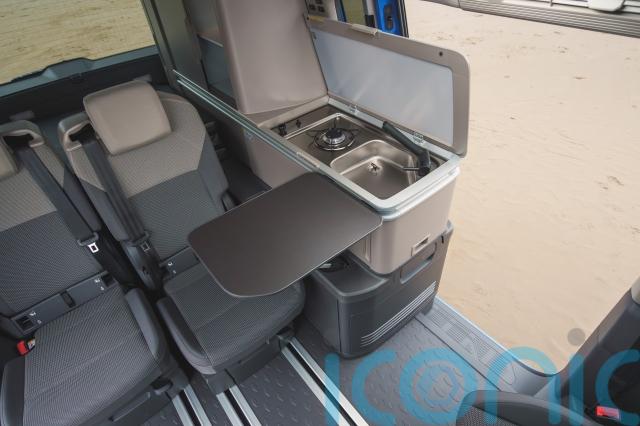
It is, of course, inside where you’ll want the most from the Volkswagen California. It’s good news, then, that it’s jam-packed with features regardless of which version you opt for. For the first time, both sides of the van come with a sliding door – it was just one before – and this makes things easier right from the start. Entry-level Beach vans get a mini-kitchen at the rear which slides out of the rear with its single-flame gas cooker, while models from Coast and above get a fully-fitted summer kitchen inside. Everything is brilliantly well planned out and you’ll find USB-C charging points nearly everywhere, so you’ll never be short of somewhere to charge.
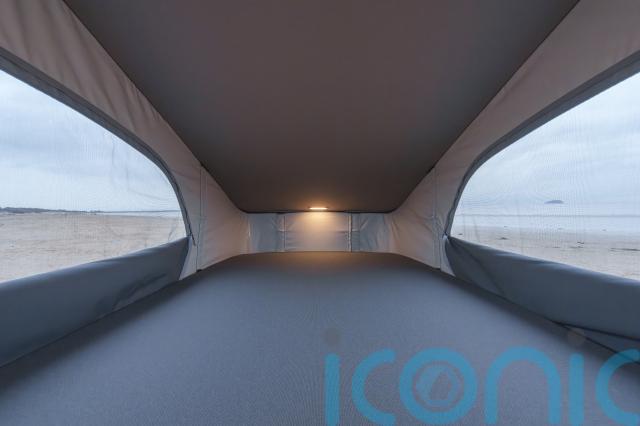
All versions get a pop-up roof, too, with those from Coast and above electrohydraulically operated. There’s an additional bed up there and it’s the easy option if you’re looking to sleep in a hurry, though the large ‘main’ bed offers more space. We’re fans of the control panel to the side of the cabin, too, which gives you quick access to key information such as water and power levels.
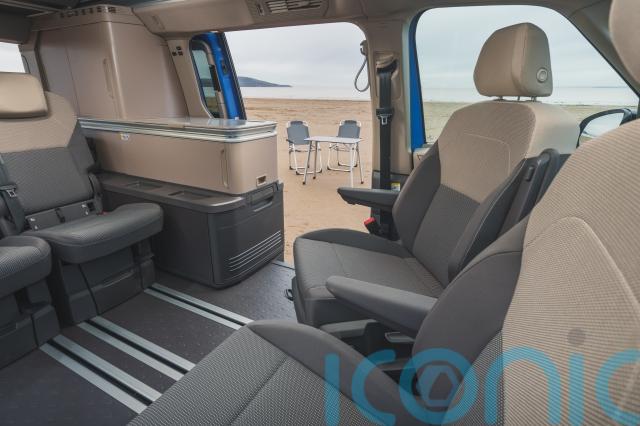
You’ll pay £68,481 for a California in Beach specification, which gets you a manually-operated pop-up roof, slide-out mini kitchen and manual air conditioning in the rear. However, we expect that most camper buyers will opt for the £70,681 Coast, which adds in an electrically assisted pop-up roof, an integrated summer kitchen with outdoor folding table and climatronic three-zone air conditioning for more comfortable adventures.
At the top sits the flagship Ocean, which, as well as styling features such as 18-inch alloy wheels and upgraded LED Matrix headlights, gets power-latching sliding doors and heated front seats. At just over £77,000, it starts to take the California’s price into a different zone, which is why we’d recommend the mid-level Coast as the best compromise.
The Volkswagen California feels just as complete as before, but adds in some welcome features. Are there noticeable boosts in refinement over the previous van-based model? Only small ones. But fortunately, the cabin has been so well thought-out that any ride inadequacies are likely to be an afterthought once you’ve stopped to set up camp.
Avoid the range-topping model if you’re looking to swerve sky-high pricing and the California should prove to be a trustworthy companion for many adventures to come.

Brendan Ward, with Christy Todd, right, pleading with supporters to leave the field after their sitdown protest at the 1998 All-Ireland SH semi-final v Clare

Tullamore Harriers ladies at the Leinster cross country

Tony McCormack TD has welcomed the increased figures on the scheme for Offaly

Subscribe or register today to discover more from DonegalLive.ie
Buy the e-paper of the Donegal Democrat, Donegal People's Press, Donegal Post and Inish Times here for instant access to Donegal's premier news titles.
Keep up with the latest news from Donegal with our daily newsletter featuring the most important stories of the day delivered to your inbox every evening at 5pm.

This publication supports the work of the Press Council of Ireland and Office of the Press Ombudsman, and our staff operate within the Code of Practice of the Press Council. You can obtain a copy of the Code, or contact the Council, at www.presscouncil.ie, Lo-call 1800 208 080 or email: info@presscouncil.ie.