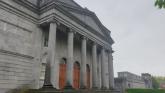
Man flooded a cell in Tullamore courthouse because voice told him walls were covered in excrement
Search


08 Mar 2026

Please allow ads as they help fund our trusted local news content.
Kindly add us to your ad blocker whitelist.
If you want further access to Ireland's best local journalism, consider contributing and/or subscribing to our free daily Newsletter .
Support our mission and join our community now.
To continue reading this article, you can subscribe for as little as €0.50 per week which will also give you access to all of our premium content and archived articles!
Alternatively, you can pay €0.50 per article, capped at €1 per day.
Thank you for supporting Ireland's best local journalism!

Kerr Brien from Pollagh, pictured in his World War One uniform.

I HAD never heard of Kerr Brien before last week when my Editor asked me to attend the official launch of a book about his life.
The book has been produced to a high standard and has been well written by the five members of Pollagh Heritage Group. It's called “The Extraordinary Life of Kerr Brien” with a subtitle of “The Great War and Back 1887 - 1959.”
The lounge area of the Pull Inn was packed with people for the launch and we were entertained by musicians performing a couple of ballads popular during the Great War and the poignant anti-war song “Green Fields of France”. When I got home I opened a bottle of wine and read the book late into the night. I found it hugely entertaining. It shone a light on a great Offaly personality who brought considerable colour into people's lives and is fondly remembered by those who knew him.
Kerr, whose original name was Kieran, was born in 1887 to Patrick Brien and Mary Reilly, the fourth in a family of eight children. The family lived in a small cottage on the Grand Canal Line beside the Pollagh Bridge.
Kerr joined the British Army at the age of 18 years and six months in December 1905. He travelled down to the Royal Artillery Military in Nenagh to join up. He became a Royal Garrison Artillery Bombardier and served with the British Army in Singapore, Malta, China and the Mediterranean.
When the Great War broke out his unit was transferred to the Western Front in France in September 1914.
During the first two weeks of the Battle of Albert, fought between the 1st and 13th of July 1916, Kerr was awarded the Military Medal for bravery when he rescued a wounded Commanding Officer while under heavy shellfire. During this battle the British Army suffered the most losses in one day in their history with 57,000 casualties on the first of July.
The Pullough man was wounded during the 3rd Battle of Ypres on the 30th of July, 1917. For ten days beforehand the British artillery relentlessly bombarded the German trenches. It's believed that Kerr was injured when the German artillery returned fire. Upon recovering from his injury he was assigned to the Labour Corps. The Labour Corps was formed from men not healthy enough to serve on the front line. It was while working in this Corps that he suffered a devastating injury when his left arm was crushed while uncoupling a train carriage. Admitted to hospital on February 1st, 1918 the doctors could not save the arm and had to amputate it above the elbow. He was discharged from the British Army on the 12th March 1918 by the Army Medical Board Depot in Le Havre, France.
On returning home he married local woman Rose Molloy on the 7th of May 1918. Rose was a daughter of Joseph Molloy from Turraun, Pollagh.
Kerr had been away with the British Army since 1905. Ireland was now a very different place and often hostile to men such as he. There were a number of very committed Republicans in the Pollagh area and it's believed that the Unit Commander ordered that he be shot. When he heard this, Kerr decided to grab the bull by the horns. He walked into the Unit Commander's house and told him to shoot him himself and not hide behind those under his charge. Kerr's spirit, his bravery, had been tested by the hell of the Western Front. The event passed off without incident. The family of Kerr's wife were also committed Republicans. His wife persuaded those of them who were IRA members to look out for her husband. It was rumoured that Kerr later joined the IRA himself.
Kerr was known for his keen intellect and his sense of humour. He was also very fit, as well as being an excellent shot with rifle and shotgun. He regularly walked for miles at a time on a day's game shooting. He ran a small shop and cycled to Tullamore twice a week to stock up, a round trip of 24 miles. He became legendary for this, because he did it even without an arm. A newspaper report in 1924 referred to him as being “a well-known and popular figure in Tullamore.”
One anecdote says he shot a duck while out hunting on a November day. The duck fell in water sixty metres away. Kerr had no dog, therefore he stripped and entered the water. A local man saw him swim back successfully, with the duck in his mouth.
Another anecdote relates that he was an early riser and he therefore demanded that the Rambling House sessions in his cottage finish relatively early. If he saw that his wish wasn't being obeyed and people weren't leaving then he would pull the bath into the centre of the room, begin filling it with water and start removing his clothes. Without fail everyone left as quickly as they could!

Subscribe or register today to discover more from DonegalLive.ie
Buy the e-paper of the Donegal Democrat, Donegal People's Press, Donegal Post and Inish Times here for instant access to Donegal's premier news titles.
Keep up with the latest news from Donegal with our daily newsletter featuring the most important stories of the day delivered to your inbox every evening at 5pm.

This publication supports the work of the Press Council of Ireland and Office of the Press Ombudsman, and our staff operate within the Code of Practice of the Press Council. You can obtain a copy of the Code, or contact the Council, at www.presscouncil.ie, Lo-call 1800 208 080 or email: info@presscouncil.ie.