
Gardaí are appealing for witnesses following a road traffic collision
Search


07 Mar 2026

Please allow ads as they help fund our trusted local news content.
Kindly add us to your ad blocker whitelist.
If you want further access to Ireland's best local journalism, consider contributing and/or subscribing to our free daily Newsletter .
Support our mission and join our community now.
To continue reading this article, you can subscribe for as little as €0.50 per week which will also give you access to all of our premium content and archived articles!
Alternatively, you can pay €0.50 per article, capped at €1 per day.
Thank you for supporting Ireland's best local journalism!


Are you ready to try an alternative to your difficult poinsettia, which so often seems to wilt when you get it through the front door? Make way for the hippeastrum, also known as amaryllis, the giant bulb which produces an array of mammoth flowers.
You can use these huge beauties to decorate your Christmas table, spark festive conversation in your living room and provide a bounty of colour – in every shade from red to pink and white – in your kitchen.
They are easier to maintain than poinsettias, says Claire Bishop, senior plant buyer for Dobbies Garden Centres.
“Poinsettias are the absolute divas of the houseplant world. It’s like Goldilocks, ‘It’s too hot, it’s too cold, I’m going to drop all the leaves, I’m not happy’.
“In the right spot, a poinsettia is fabulous but you almost know you’re just going to have it for Christmas and if you have a draughty house or are going to be moving it about, it’s not going to enjoy that at all.”
If you didn’t have time to plant the hippeastrum bulbs yourself in October or November in time for Christmas, you can buy them in a pot, ready to reach their full glory over the festive season.
And if you receive one on Christmas Day as a gift, it should be in flower in about six weeks’ time, Bishop says.
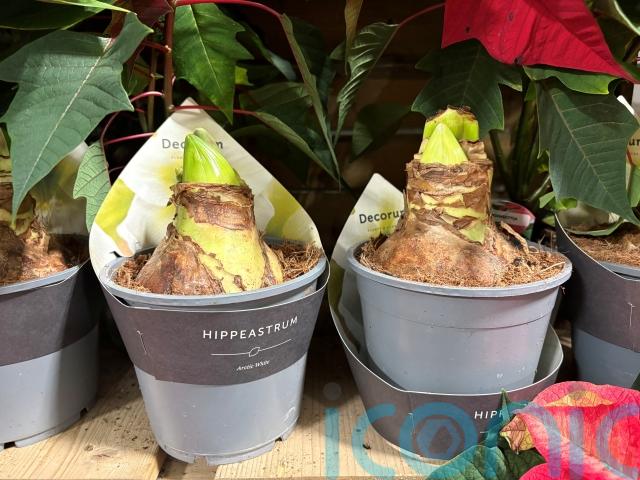
“They are a stereotypical Christmas plant, however, I think people aren’t quite sure what to do with them,” she says.
“A lot are bought in little boxes but you can almost choose when it flowers and it will flower a lot over the period, so it’s a beautiful centrepiece.”
Ways to display
If you receive a boxed hippeastrum, a coir disc or compost pellet in the pot basically makes enough compost to fill the container but you need to rehydrate it with a little warm water so it expands, she advises.
Bishop favours glass bowls for amaryllis displays. “Put the compost in the bowl and then put the amaryllis in, so it’s a bit more unusual, more of a centrepiece,” she suggests. “You could then add moss and microlights nearer to Christmas, or plant it in the pot and make a festive wreath around it.”
Red, white and peach colours are the most popular, she says. Ideally the bulb crown should be out of the soil.
When it starts flowering it can become top heavy, but could be supported with holly stems, or willow from the garden, and you can decorate it with lights for the festive season, she suggests.
Best situation
“They should be fine in a dining room, living room, near a window. They are not space-hungry because they are tall and thin, so if your space is limited you can still see across them. But you wouldn’t want to put it in a porch or vestibule. Don’t put them in direct sunlight, which will scorch them, or near a direct heat source. If you buy them late and want to bring them on quickly, they will shoot up more in a warm room, she adds.
Flower power
Bulbs often produce four dinner-plate sized flowers, Bishop explains.
“Each flower should last a couple of weeks if it’s kept cool, while other buds are emerging on the plant. Just snip off the spent flower to encourage all the energy back into the plant.”
In the right conditions, your blooms may last beyond the festive season and into January, as long as they are not near roaring fireplaces, radiators or any other source of heat, she says.
What about waxed bulbs?
These are ideal for the no-maintenance fan, as the bulbs are coated in thick wax to seal in their nutrients and moisture for a single blooming cycle, and need no soil, growing medium or water to bloom.
The roots of waxed amaryllis bulbs are removed before being dipped in wax.
They are ideal for Christmas, but will not typically regrow even if the wax is removed after flowering, whereas normal bulbs may be more long term and can re-bloom.
Growing them on
After they’ve finished flowering, hippeastrums have a dormancy period, Bishop explains.
“You can leave it dormant for around eight weeks and then go again or just dry it out and leave it in a cool, dark, dry place then go again next year.”
They don’t need much watering because the bulb shouldn’t be overwatered. Make sure the roots have enough water but don’t let the bulbs sit on a wet surface, she advises.
Time the flowering
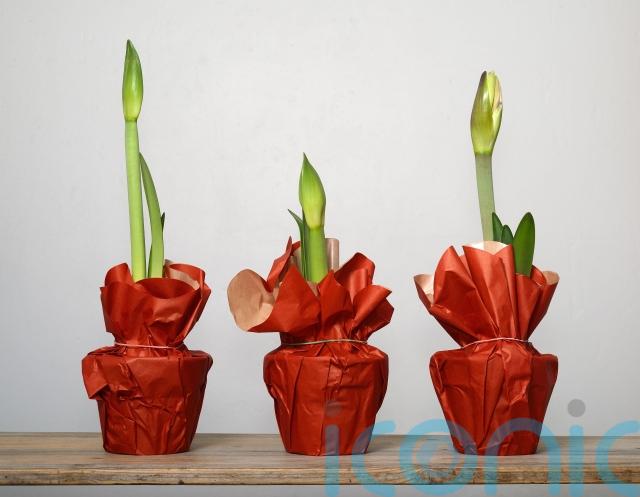
“The warmer your house, the quicker it will move on. You can almost stall it a little bit if you feel it’s starting to shoot up too quickly and move it to a cooler room.
“Amaryllis like a bit of light, as all plants do. When it starts to shoot up its flower stem, it will grow towards the light so turn it to try to keep it straight,” she advises.

Subscribe or register today to discover more from DonegalLive.ie
Buy the e-paper of the Donegal Democrat, Donegal People's Press, Donegal Post and Inish Times here for instant access to Donegal's premier news titles.
Keep up with the latest news from Donegal with our daily newsletter featuring the most important stories of the day delivered to your inbox every evening at 5pm.

This publication supports the work of the Press Council of Ireland and Office of the Press Ombudsman, and our staff operate within the Code of Practice of the Press Council. You can obtain a copy of the Code, or contact the Council, at www.presscouncil.ie, Lo-call 1800 208 080 or email: info@presscouncil.ie.