

Death of a 96 year old giant of Offaly sporting, community and missionary life

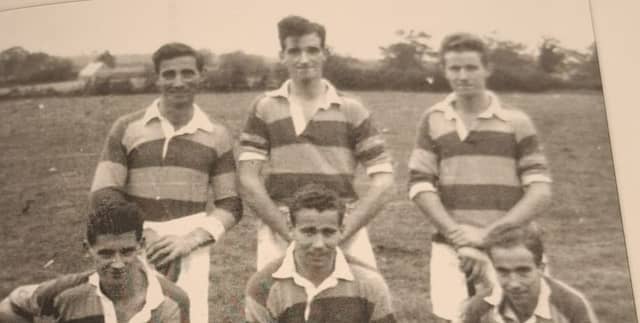

Late priest was a central figure in some iconic county and club GAA successes
THE death has taken place of one of Offaly's most revered and cherished personalties, ending an era in his beloved Ballinamere, parish of Tullamore, county of Offaly and much further away in the missionary fields of Africa in Nigeria and Cameroon, where he spent the bulk of his life.
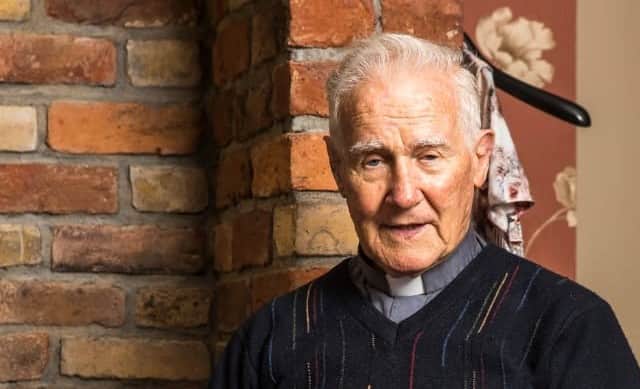
Fr Rory O'Brien
He was a passionate GAA supporter all his life and he was synonymous with some of the most iconic successes in Offaly and his parish. He was corner back on the first Offaly football team to win a Leinster championship, minor in 1947 – while Offaly had won All-Ireland junior hurling titles in the 1920s, that was the county's first championship win in A grade football or hurling. Offaly's subsequent success story can be traced to that win over Dublin and it's importance was profound.
He won a Leinster junior hurling medal in 1953, playing in the All-Ireland final where Offaly lost out to Tipperary and that team was also cherished for decades – his brothers Michael and Ted also played on that squad.
He is one of a unique group of Offaly people with Offaly Senior Football and Hurling Championship medals. The vast majority of them are from Tullamore and Fr Rory won a hurling award with them in 1959 while he was a member of the famous Durrow team that won a controversial Senior Football Championship title in 1952.
A spiritual and deeply religious man, he was ordained as a priest in 1955 with the Kiltegan based St Patrick's Missionary Society and spent sixty years on the missions in Nigeria and Cameroon. Religion devotion was a big part in his life from an early age and four of his sisters became nuns, with Sr Corona (Josephine) surviving him and Sisters Josephine (Maidie), Annmarie (Anna) and Loretto (Brigid) pre-deceasing him. He was also predeceased by his infant sister Claire, and Rose, and his brothers Donal, Michael and Ted.
He was in Nigeria during the ugly Nigeria-Biafra Civil War from 1967 to 1970 – that war broke out when Biafra declared its independence from Nigeria in 1967 and saw thousands killed in combat and millions dying in an accompanying famine.
It only ended with the final defeat of the Biafrans in early 1970 and Fr Rory published an evocative and moving book on his personal recollections of the war in Afikpo just a few years ago in 2018, having written it earlier.
He finished up in Nigeria in 1988 when locals honoured him as Chief of Effium, giving him special robes and regalia – the first white man to be given that tribal title. He went to serve in Cameroon in 1989, staying there until he retired in 2015, when he returned to live in Tullamore for a few years before seeing out his life in Kiltegan.
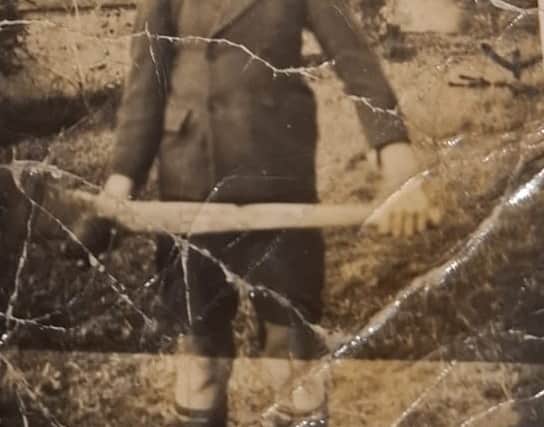
A young Fr Rory O'Brien in 1940, hurl in hand.
A large, successful farming family who have moved with the times, that tradition is being carried on by the current generations. He attended the local Ballykilmurray National School, with his siblings, finishing his primary education in Tullamore CBS before boarding in St Finian's College in Mullingar with his late brother Ted.
A religious life was probable from a young age – 11 of his school year in St Finian's studied for the priesthood and Fr Rory went into St Patrick's College in Kiltegan in September 1948. He was ordained on Easter Sunday 1955 in Kiltegan, quickly leaving for Nigeria. Before leaving for Nigeria, he officiated at his first wedding, his brother Donal to Kathleen Kelly while his first baptism was Dermot Minnock in the Island Church, Rahan parish.
Then a British colony, Nigeria was a very poor, backward country at that time, mainly undeveloped with very sparse educational opportunities. The first trip there was a long one by sea followed by another arduous one on land. He later told a story about agreeing a price with a local to drive him by lorry to his destination. When they arrived, the driver demanded more money and produced an iron bar when Fr Rory resisted but settled for the agreed amount after the new arrival quickly grabbed his hurl.
Fr Rory initially went to Ikom, introducing Christianity there, promoting education, medical care and self sufficiency. Nigeria gained its independence from Britain in 1960, as the disintegration of the British Empire in the wake of the second World War continued. Unfortunately, the Biafran War within a short few years set that part of the country back on its heels and Fr Rory found himself in the midst of this when he was transferred to Afikpo in 1967, making the very brave decision to stay and help maintain a local hospital until the war was over when he took a much needed break home.
He provides a revealing insight into the trauma the war caused and the devastation it wrought in his book. Him and colleagues had to hide in their mission when Afikpo fell to the rebels in April 1968, anointing each other with death apparently imminent. After the end of the war, he helped the area get going again in a variety of ways, especially food distribution and in projects such as teaching bread baking, sewing and giving out nets for fishing.
There was of course much more to his pastoral work than that and in his early years, he regularly had to mediate in disputes between Christians and adherents of the various tribal religions. Surrounded by dense jungle, his usual mode of transport was along the Cross River in boats known as “dugouts”. He immersed himself in various Church building projects and his role also involved paying school teachers, deducting their tax and collecting local contributions as the Nigerian Church grew.
The GAA permeated his life and he had a passionate, infectious enthusiasm and love of Ballinamere and Offaly GAA.
He was close to ordination when Offaly reached that All-Ireland junior hurling final in 1953 and at the time, clergy was discouraged, often prohibited from playing gaelic games. His brothers Ted and Michael were also on that Offaly squad and it took a visit from the then Offaly chairman Fr Edmund Vaughan and secretary Stephen Cloonan to Kiltegan a week before the final to get permission for Fr Rory to play it.
A fit, active young man, he returned home from the missions every year and played a big part in some famous Offaly championship wins. He was one of six O'Brien's that won Junior Hurling Championship medals with Ballinamere in 1959 – alongside Ted and Michael and cousins, another Rory (known as Rody), Joe and Peter, Fr Rory was centre forward and scored two crucial late goals in a great come from behind win over Kilcormac.
At the time, players could play junior with their own club and senior with another in the same parish and Fr Rory was centre forward on the Tullamore team that hammered Coolderry in a replayed senior hurling final in 1959 – Rody, Ted and Peter were also on the starting fifteen while Joe O'Brien came on as a sub.
A highly rated, very good, tough, committed hurler, he played a pivotal role as Ballinamere won the Junior and Intermediate Hurling Championship in 1950 and 1953, when he was the captain – a citation at a 1994 reunion of the Ballinamere teams of the 1950s quipped: “He is now a good priest but he was no saint on the hurling field”.
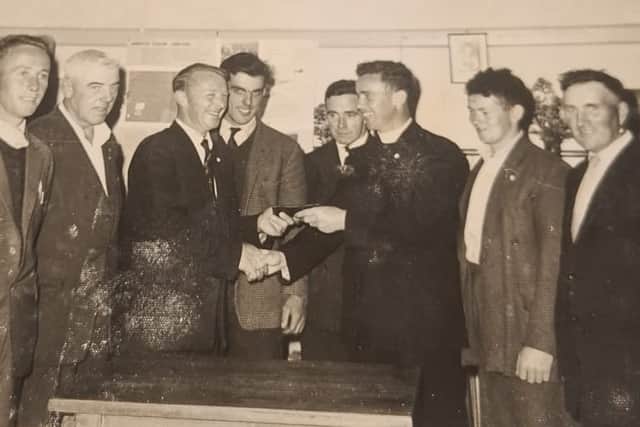
A young Fr Rory O'Brien receiving a presentation.
Hurling was a huge part of his life and the O'Brien family were entrenched in Ballinamere GAA from their formation in the early 1900s. Ballinamere is unique in that it is a hurling hotbed surrounded by general football territory and the roots of the game run deep in the area. Hurling was reputedly introduced into the area in the 1880s when a local priest became frustrated at the propensity of young people to embrace faction fighting – the Ballycowan Fair was notorious for fights of this nature as youths from adjoining communities brawled with and maimed each other,
Ballinamere was the home of hurling in Tullamore parish, even though it was Tullamore GAA Club that came to the ascendancy in the game. It could have been different. Tullamore were hammered by Coolderry in the 1904 senior hurling final with Fr Rory's father Danny (Daniel) on the team, along with other O'Brien's in Pat and Rody.
Ballinamere reached the senior hurling final themselves in 1908, losing to Drumcullen by just 2-1 to 1-2. That final was only completed in 1909 – championships regularly over ran in that era with a row over the venue for Ballinamere's semi-final win over Killoughey contributing to it. That stand off was only solved when Killoughey offered to play it on Ballinamere's “own dunghill”. That “dunghill” was on O'Brien's farm – the early GAA relied on farmers for playing fields and it was from the 1920s on that clubs began to purchase their own ground – and Ballinamere qualified for their first final.
Their team included players from Clara and Rahan and Danny O'Brien was the captain as they suffered a controversial defeat to Drumcullen. The final was played in Killoughey and there was obviously a residue of bitterness from the semi-final and row over the venue – when Ballinamere arrived in Killoughey, they found the name of a star Drumcullen player, Jack Tooher, white washed across the pitch while contested umpiring decisions lasted in Ballinamere memories for decades.
The parish rule was introduced into Offaly in 1909 and meant that players from Clara and Rahan could no longer play with Ballinamere and Tullamore won their first Senior Hurling Championship title in 1909, beating Drumcullen by a point in the final.
Ballinamere players backboned that historic win. Danny O'Brien got the all-important goal while the captain was his brother Pat, known to many as Paddy – the politics of that time are long forgotten but GAA historian John Clarke acknowledged in his 1988 history of Tullamore GAA Club that Tullamore players throwing in their lot with Ballinamere, rather than vice versa would have been the more natural path in 1909.
Whatever the rationale was, it was a decision that had big repercussions for both clubs as Tullamore went on to win several senior hurling titles while Ballinamere are still waiting for their first triumph – hurling also went into decline in Ballinamere in the 1910s and '20s and it was only in the 1930s that it revived, culminating in their first junior hurling win in 1944.
The 1959 double for Ballinamere and Tullamore is very much part of parish folklore. While the Balliunamere influence on Tullamore was obvious, it was a two way street. The Ballinamere team included one of Tullamore's most famous hurling figures, Eamon Fox, who had returned from England and joined Ballinamere GAA Club to allow him to play junior hurling with them and senior with Tullamore – with both clubs in senior in 1960 (There was no intermediate at the time), Fox quickly gave his allegiance to his home club.
Ballinamere had to wait until 1980 to win their next junior hurling title and 1959 proved to be Fr Rory's last championship medal to win in Offaly.
Durrow's Senior Football Championship win in 1952 was a big part of his life story. That win only became possible as a result of a bitter split in Tullamore GAA Club with some of their best and most prominent players transferring to Durrow – the row was over the provision of shower facilities and other issues in O'Connor Park and culminated in Durrow defeating Edenderry in the 1952 final.
Durrow had to go senior first and did so in 1950 when they won the Intermediate Football Championship title. The arrival of the Tullamore players immediately transformed them into title contenders and they lost to eventual champions Edenderry in the 1951 semi-final - Fr Rory was one of the locals on those teams, playing at corner back in the '52 final with Ted on the half back line while a fellow Ballinamere man Paddy Molloy was the captain.
While Ballinamere GAA and hurling was at his essence, he also retained a great interest in the affairs of Durrow GAA (or St Columba's when that was the name of the club) and football – he was also very proud when Ballinamere made their mark in football, winning their first Junior Football Championship title in 1983 while a talented nephew Barney played for Offaly in the 1989 All-Ireland Minor Football Championship defeat by Derry, later playing senior county after returning home from a spell in Australia.
He also played for North Offaly divisional teams that competed in hurling in the early 1950s and was on the team beaten by Drumcuillen in the 1951 senior semi-final.
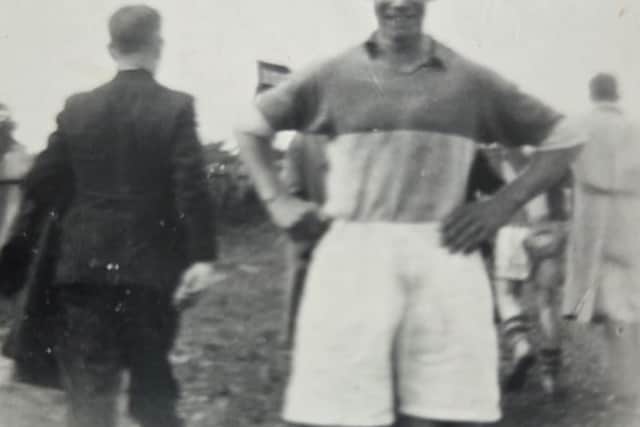
Fr Rory, with Offaly.
After going to Africa, he was able to return home for some lengthy spells, enabling him to play while he often went back to the missions with a supply of hurleys and sliotars, mainly for practice himself but also enjoying trying to teach the locals how to play. He represented Ballinamere GAA Club at county Conventions during his holidays home. The locals were very supportive of his missionary work, regularly making presentations of money and gifts to him for use in Africa.
Life president of Ballinamere GAA Club, he had a long tradition of presenting hurleys to young children in the national school and club each year on his visit home. He kept up to date with all the events of his area, GAA and otherwise, through the Tullamore Tribune, the Offaly Independent and Offaly Express, getting a copy of the Tribune sent out to him abroad and compiling a comprehensive scrap book. He had a trmenendous interest in local history, both events, groups and individuals and he cherished the cultural tradition of ceile, dance and song in Ballinamere. He enjoyed celebrating Mass in Kilbride Cemetery, a history rich landmark near the Grand Canal and Ballycowan, on visits home.
He was delighted when Ballinamere GAA Club finally got on the property ladder in the 1970s, purchasing a field from Joe Wyer in 1976, developing a pitch with GAA president Padraig McFlynn performing the official opening in August 1980 – he celebrated the silver jubilee of his ordination around the same time as the local community savoured a great double celebration.
Ballykilmurray Community Centre was built in the wake of this, adjacent to the GAA dressing rooms, becoming the hub for all local organisations – for decades, O'Brien's Loft was the local venue for GAA celebrations, dances and other events and while the Community Centre was a terrific asset to the whole area, there was a profound sense of loss for many around the end of the loft. Among the functions held in the Loft was his ordination party after his first Mass in Tullamore's Church of the Assumption in 1955.
Fr Rory was fiercely proud of all strands of his family tree and the republican tradition of his father and wider family, researching his descendants on both his paternal, the O'Brien's, and maternal, the Fox (another popular local family from Aharney), lines.
A pioneer and a real force of nature, he was engaging company, interesting, knowledgeable and hugely popular.
Thankfully, he was not one of the men who had to wait until death for people to celebrate him and pay tribute to him. He was regularly lauded for his contribution over the decades and in 1988, he was the centre piece of a surprise “This is Your Life” tribute in the Bridge House. That was a great occasion as he was joined by family members, locals, priests, including people from his missionary work, and team mates from the many teams he starred on, including the 1947 Leinster minor football champions. He was delighted to see the goalkeeper of that team present that night, a fellow man of the cloth, Fr Vincent Cowen, Clara – a brother of the late Fianna Fail TD Ber Cowen and uncles of future Taoiseach and TD, Brian and Barry Cowen, it was their first time to meet since 1947.
He spent most of his life in Africa, had a deep bond with Kiltegan and the St Patrick's Missionary Society but a big piece of his heart remained in Ballinamere and Offaly at all stages. This is reflected by the fact that he is returning home to be buried with his Funeral Mass in Tullamore on Friday at 12 noon with burial afterwards in Durrow Cemetery – his body will repose in O'Reilly's Funeral Home, Harbour Street on Thursday from 6.30pm to 8.30pm.