

'Tear down those walls' at Grand Canal Harbour in Tullamore plea
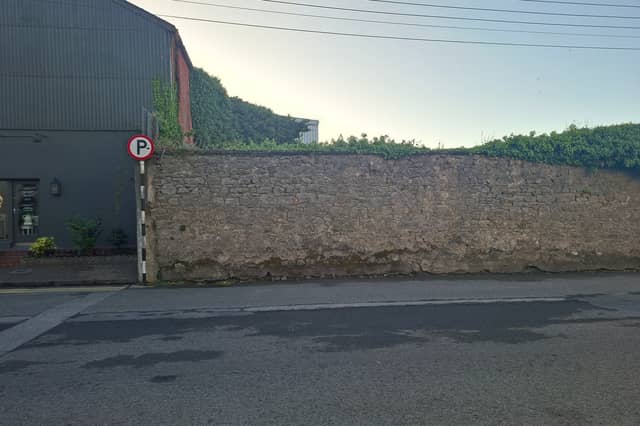

The prison-like enclosure of the Grand Canal Harbour in Tullamore highlighted
From the simple elegance of the Presbyterian Church on High Street to the soaring spire of the Church of the Assumption and from the grandeur of the Courthouse to the modest terraces of Davitt Street, I have great affection for all of the historic architecture of Tullamore.
There are however two particular structures I have detested from childhood because of their arrogance, their intrusiveness and their symbolism.
The prison-like walls of the Grand Canal Harbour really annoy me.
The Harbour
From its first day the Harbour has been physically and socially separate from the life of the town. Its military and commercial operations needed to be protected and unseen and its entrance guarded. As with a prison, high exclusionary walls reinforced its security and today. it is still a place apart.
Over the years sheds and warehouses were erected around the dock but these were simply functional structures without pretensions or architectural merit. The sole exception was the three storey warehouse of the early 1800s on the western side. This boasted an elegant thrust out central feature crowned with a pediment and a central plaque and was located so as to close the vista with the entrance on the other side of the Harbour.
It was one of the finer examples of considered civic planning in Tullamore but was demolished in 1952 and all that remains of it today is a length of uncoursed blank rubble wall staring rudely at the architecturally elegant terrace of Store Street.
The wall on the Harbour Street frontage is equally banal. Neither has any aesthetic value whatsoever. Indeed, the Government's own National Inventory of Architectural Heritage does not regard any structure at all within the Harbour to be worthy of mention.
It is debatable as to whether or not these walls have any historical value either. They could not compare with such genuinely important structures as the remnant of the wall of the 1716 Barracks at Marian Place, but maybe a professional historian would take a different view.
The Masterplan
As its commercial function waned, hopes began to rise that the Harbour and the town might at long last be united.
It began to be possible to envisage living in a flat looking down on the wonderful waterbody or sitting at a cafe watching visiting boats coming and going. You could kayak or paddle in the dock or maybe even have a swim on one of the increasingly warmer summer days.. A ‘Cooler Pool’ perhaps?
The announcement of the appointment of Grafton Architects to lead a team to provide a Masterplan for the future of the Harbour was welcomed in the light of their extraordinary international reputation.
It might have been hoped that their Masterplan would propose the removal of the walls but they felt that ’ It is important to keep these walls to retain the Harbour’s character’. Yet the essential historic character of the Harbour derives solely from its isolation from the town and surely the whole purpose of the exercise was to open it up as much as possible?
The Plan did however suggest that ‘ making specific openings to enable access would form a type of urban acupuncture - to reveal the hidden harbour and also create urban connectivity’ and proposed to make a small breach on the Store Street frontage to provide a very limited vista of the spire of the Church.
However, on foot of a recent Section 5 Reference, Offaly County Council declared that the Store Street wall is untouchable as it is within the curtilage of a Protected Structure. This decision presumably covers the Harbour Street wall also and therefore the total retention of these two structures- and possibly many others within the Harbour- may be a condition of its redevelopment.
It now appears that the outcome of the final approved Masterplan may not be to open up the Harbour at all but to copper-fasten its privacy. The potential for vibrant day and night time ground level activities along Store Street and Harbour Street may never be pursued.
While these dilemmas are being resolved by the promised Working Group, possibly Inland Waterways Ireland and Offaly County Council would straightaway create even a temporary little dockside plaza with some seating and invite the townspeople to come in to see and enjoy this extraordinary amenity on their doorstep.
And then - after two hundred and twenty seven years - lets tear down these walls!