
Met Éireann issues weather warning with two counties braced for brutal conditions
Search


20 Jan 2026

Please allow ads as they help fund our trusted local news content.
Kindly add us to your ad blocker whitelist.
If you want further access to Ireland's best local journalism, consider contributing and/or subscribing to our free daily Newsletter .
Support our mission and join our community now.
To continue reading this article, you can subscribe for as little as €0.50 per week which will also give you access to all of our premium content and archived articles!
Alternatively, you can pay €0.50 per article, capped at €1 per day.
Thank you for supporting Ireland's best local journalism!

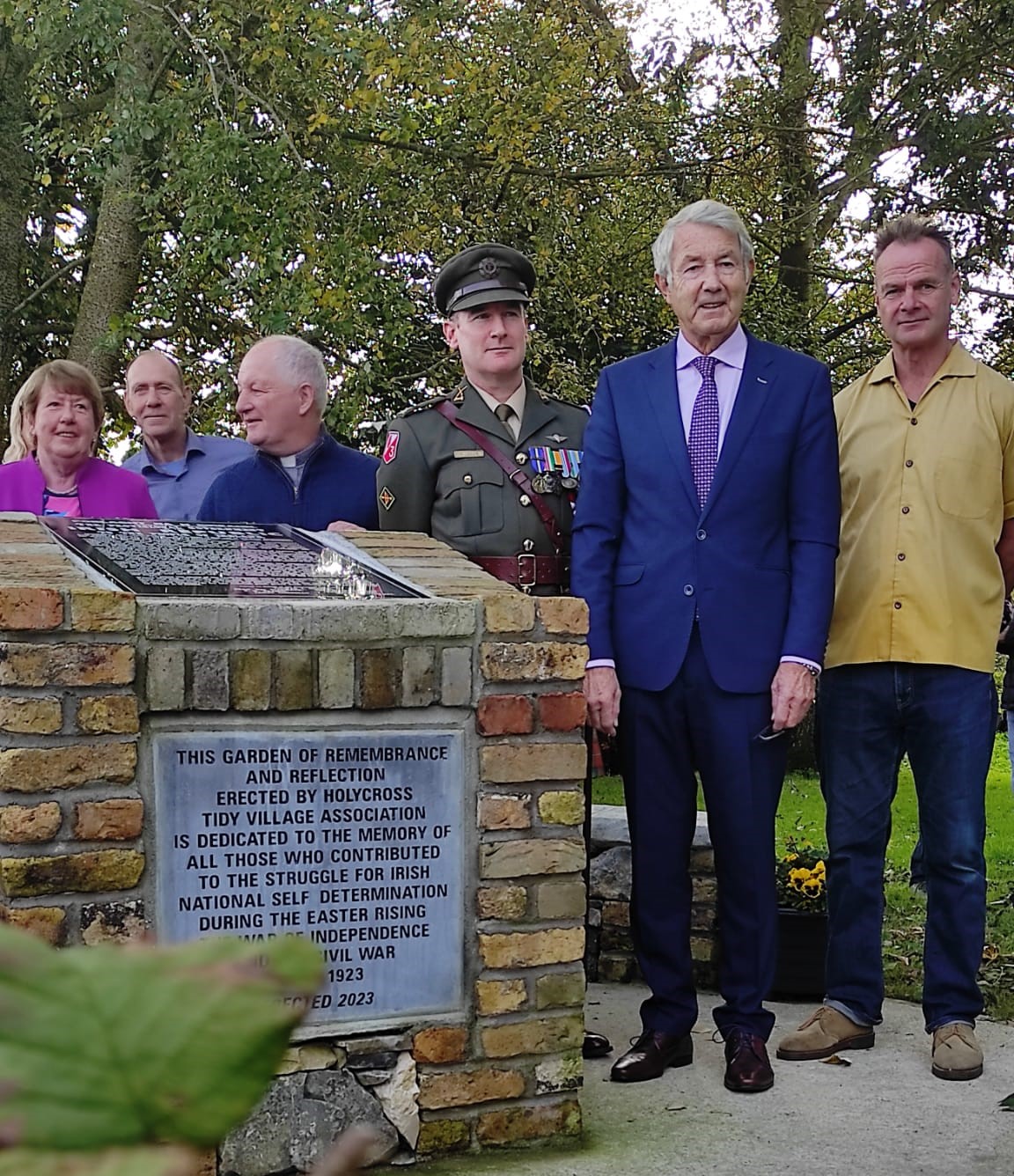
Depuity Lowry pictured at the unveiling of the memorial

Speaking at the unveiling of a Garden of Remembrance and Memorial in his home village of Holycross on Sunday, Deputy Michael Lowry said that it was an honour and a pleasure to be invited to do so in the tranquil surroundings of such a beautiful setting.
The event was organized and hosted by the Holycross Tidy Village Association, who erected the Memorial to ‘honour the memory of all those who contributed to the struggle for Irish National Self-Determination during the Easter Rising, the War of Independence and The Civil War between 1916 and 1923.
In his address to the large gathering, Deputy Lowry said ‘It is noble and appropriate to pay tribute to the men and women from this parish, from our county and from our country for their bravery and their sacrifices. In doing so we must be mindful that it came at an enormous cost to them and their loved ones. This haven of peace and tranquility allows us to remember and reflect on this.
‘As we stand here on this lovely Sunday, we do so because of them – because of their bravery and courage, and also because of their foresight. They fought for a future. They fought for hope. They fought for us.

The memorial
‘The 1916 Rising started on Easter Monday. At the time many thought it was just another attempt by the Irish to overthrow English Rule. But this time it was different. Although the aims of the Rising were not achieved, it was a catalyst for much of the turmoil within the country that would take place over the next 7 years.
‘Many believe that if it hadn’t been for the very public executions of the 1916 leaders, the subsequent outcry across the country would likely not have happened. Those executions galvanized massive resentment and an anti-British sentiment.
‘When we recall the Easter Rising it would be remiss of us not to remember the role played by women. On the day of the Rising, Cumann na mBan members arrived armed and entered GPO alongside their male counterparts. By nightfall, women insurgents were established in almost all the major rebel strongholds throughout the city.
‘The majority of these women worked as Red Cross workers or sourced rations for the men. However, many gathered intelligence through scouting expeditions or carried despatches and transferred arms from dumps across the city to insurgent strongholds.
‘At the Four Courts, the women of Cumann na mBan helped to organise the evacuation of buildings at the time of surrender and to destroy incriminating papers. It was a Cumann na mBan member that acted as a go-between when a decision was taken to surrender. Under British military supervision she brought the surrender order to the rebel units still fighting in Dublin.
‘Although the Rising was defeated, the British response led to greater popular support for Irish independence’ he said.
‘In the 1918 General Election - which was part of the UK General Election - Irish Republicans standing for election won a landslide victory in Ireland.
‘On 21 January 1919 a breakaway Government was formed and Irish Independence was declared.
‘On that day, two RIC officers were killed in the Soloheadbeg Ambush in Tipperary by IRA volunteers acting on their own initiative. This was the incident that began the Irish War of Independence.
‘This is when many of the famous Irish names feature. Strong and indefatigable men gained their names in Irish history. This was when, as our history books taught us, the IRA fought the British army and auxiliary units known as the black and Tans.
‘It was an extremely violent time in Ireland. It is said that 500 IRA were killed and 1000 British died during the period. 900 civilians also lost their lives.
‘’The War of Independence continued until July 1921, when the British were forced to negotiate a truce. This led to the Anglo-Irish Treaty on 6th December resulting in a compromise solution with the annexation of 6 northern counties.
‘There was much rancor and division in Ireland. Some saw the Treaty as a stepping stone to achieve freedom and others viewed it as selling out the original beliefs and aims of the War of Independence. On 7th January 1922 Dail Eireann voted to approve the Treaty.
‘In April 1922 a hard-line group of IRA occupied prominent buildings in Dublin. The newly formed Free State Army was ordered to attack the rebel positions.
‘This was the start of the Civil War which ran to the middle of 1923. It was a particularly brutal time in Irish history. Friendships were split apart. Many former comrades-in-arms were torn on either side of the Pro-Treaty and Anti-Treaty sides. There were incidents of brothers taking up arms against brothers. Families against families. Fathers against sons.
‘As brutal as the War of Independence had been, The Civil War was even more vicious. There are many recorded examples of cruelty and murder. This was a dark chapter in Ireland’s history.
‘There was much pain, suffering and sacrifice by families all over the country. They suffered heartbreak, sorrow and fear unlike anything we could imagine today. It left deep wounds and hurt.
'Some of the heaviest fighting during the War of Independence and the Civil War took place in Munster. Sons, fathers, brothers and uncles were killed in the fighting. Many civilians, including women, were also victims. They fought and died for their beliefs. They paid the ultimate price for all of us that came after them.
‘Today as we stand here in this peaceful Garden of Remembrance and Reflection, it is hard to comprehend the horrors that these brave and determined men and women faced. The passion that drove them to risk their lives. The fear and heartbreak their loved ones felt.
‘In future years others will stand where we stand today. They too will ponder on the history of our country. They too will have the same feelings of pride and gratitude for those that we honour today.
‘They will also be grateful for this initiative by Holycross Tidy Village Association in creating this lasting memorial to our history. A place of remembrance and reflection. A reminder of the past.
‘They will also look back and wonder what life was like for us in 2023 on the day this Memorial was unveiled. I believe that, when they do, they will see a love of place, a sense of pride and a vision that ensures that, while the past may be over, it can never be forgotten’, Deputy Lowry said.

Subscribe or register today to discover more from DonegalLive.ie
Buy the e-paper of the Donegal Democrat, Donegal People's Press, Donegal Post and Inish Times here for instant access to Donegal's premier news titles.
Keep up with the latest news from Donegal with our daily newsletter featuring the most important stories of the day delivered to your inbox every evening at 5pm.

This publication supports the work of the Press Council of Ireland and Office of the Press Ombudsman, and our staff operate within the Code of Practice of the Press Council. You can obtain a copy of the Code, or contact the Council, at www.presscouncil.ie, Lo-call 1800 208 080 or email: info@presscouncil.ie.