
IRELAND SNOW MAP - Where will it snow as Met Éireann issue new weather warnings?
Search


13 Feb 2026

Please allow ads as they help fund our trusted local news content.
Kindly add us to your ad blocker whitelist.
If you want further access to Ireland's best local journalism, consider contributing and/or subscribing to our free daily Newsletter .
Support our mission and join our community now.
To continue reading this article, you can subscribe for as little as €0.50 per week which will also give you access to all of our premium content and archived articles!
Alternatively, you can pay €0.50 per article, capped at €1 per day.
Thank you for supporting Ireland's best local journalism!


In most families, one parent – often the mum – takes on the majority of the invisible labour and mental load that comes with taking care of children.
Boring school admin, managing morning chaos, making sure the kids eat something other than sweets, knowing when they need their PE kit – it’s all a very mundane but necessary part of parenting, although not a part that usually gets recognised or rewarded. But it often seems to be the responsibility of just one parent.
That person has been dubbed the ‘default parent’ by mum-of-two Lou Beckett, wife of the comedian Rob Beckett. And she felt so weighed down and frustrated by the emotional and logistical burden of being the default parent that she’s written a book about it.
Lou, whose daughters are now aged eight and 10, explains: “A default parent is the one that’s in charge for almost everything, almost all of the time, unless they specifically devolved the task or booked in child care. It’s that permanent assumption of responsibility for everything.
“All of the invisible stuff that has to happen to keep the family functioning gets swept up in your role. So much is semi-invisible, unless you withdraw your labour completely, then slowly people will go ‘This isn’t happening, and this isn’t functioning, and we’re not getting to where we need to be at the right time.’”
Lou, 39, is a former secondary school history teacher who left teaching because of health problems, including ulcerative colitis, just before she got pregnant with her first child more than 10 years ago. She started writing the blog that was a precursor to the book to express her feelings about her default parent role after an unsuccessful teaching job interview a few years ago.
“I came out of that interview feeling like I’d lost that last anchor to myself, my pre-mum identity, and then decided to verbalise it, cathartically get it all out into a blog about that loss of identity and the new role I’d taken on almost without ever really signing up for it,” she explains.
“Obviously, I signed up to be a mum, and I really wanted to be a mum, but the job turned into something I wasn’t quite expecting. I hadn’t expected it to be so all-encompassing.
“Writing the blog was the first time it was really clear that I felt I’d completely lost the person that I was pre-baby.”
So the blog became a book, in which she says she’s “really honest” about feeling lost and unfulfilled, but she stresses: “I was very careful to make sure my children knew I still loved them by the end of it, and that Rob knew I still loved him by the end of it.”
She’s keen to point out that she hasn’t written the book as some sort of self-help guide, she just wanted to express how she felt about her parenting role in the hope that it would resonate with other default parents. But writing it has helped her learn how the default parent can deal with things better – she says: “You’ve got to communicate what you need. Otherwise things aren’t going to change.”
Because of Rob’s work, she says it’d be hard to change their existing system without getting a lot of childcare, but she explains: “I think it’s shifted now, because we have much more deliberate conversations about who’s going to do what. We check in every couple of weeks about what the next few weeks look like, who’s doing what, can you do more? How are we going to split the load so it works for both of us?”
She says they’re the sort of conversations she and Rob didn’t have in the early years of parenting, explaining: “We were just doing what needed to be done to get everyone from A to B. Rob’s always done a lot – he’s never shirked his involvement, wanting to be present and part of it. But where I’d taken over so much of a responsibility for everything, we’d got really entrenched in those systems of I just did it, unless I specifically booked him to do it, or for him to be in or booked babysitting.”
“I hope if non-defaults read it, they can empathise a bit more and maybe understand. The problem with parenting is everybody’s working the hardest they’ve ever worked, mums and dads, so it’s very hard to have any kind of conversation about needing the other parent to do a bit more without it feeling like an attack. Maybe the book can somehow help people meet in the middle.”
Rob has read the book, of course, and Lou says happily: “He’s changed in little ways. I’ve made a bit of a joke out of it, but he now does all the kids’ suncream on holiday, and it’s such a small thing, but actually, just having someone else in charge of the little things does make a massive difference.”
Towards the end of the book, Lou includes what she calls Rob’s Right of Reply (from behind enemy lines), in which he answers her questions about their parenting roles. He points out that their situation is unique because of his job, performing all over the country, and says last year, for example, he was away from home for 112 nights.
“That’s one third of a year, which puts a huge amount of pressure on you [Lou] to do everything and be the default. I couldn’t do it and keep working like I am.”
“What I’ve also learnt is just how thoroughly different Rob and I are as parents.”
She refers to Rob’s “maddeningly chipper ‘It’ll be fine, you worry too much’ attitude to organisation,” and adds: “Betwixt the two of us, we muddle through.”
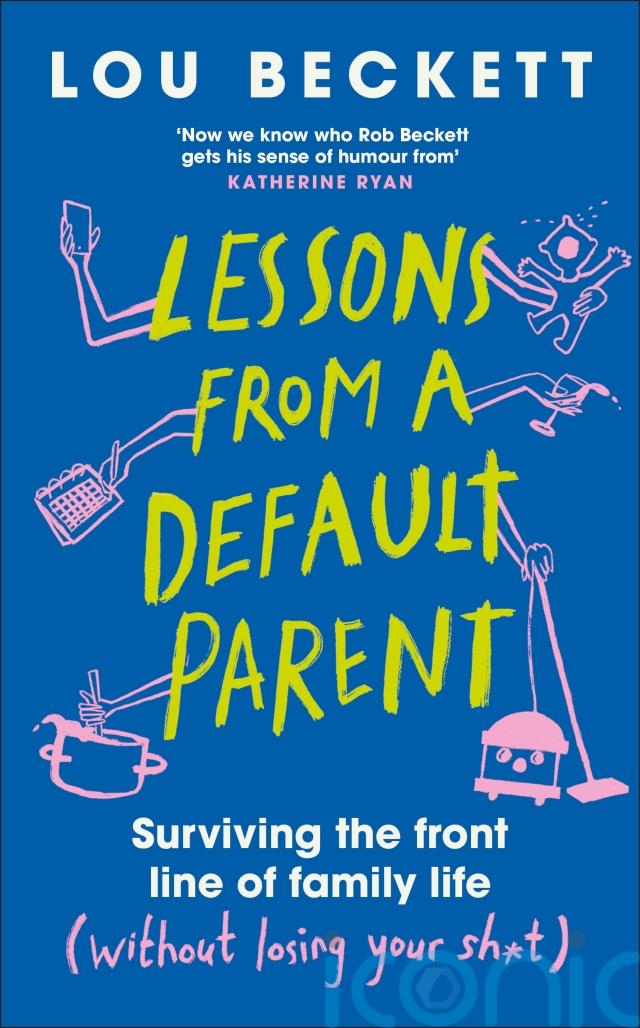
Lessons from a Default Parent: Surviving the Front Line of Family Life (Without Losing Your Sh*t) By Lou Beckett is published by DK Red, priced £18.99. Available now.

Subscribe or register today to discover more from DonegalLive.ie
Buy the e-paper of the Donegal Democrat, Donegal People's Press, Donegal Post and Inish Times here for instant access to Donegal's premier news titles.
Keep up with the latest news from Donegal with our daily newsletter featuring the most important stories of the day delivered to your inbox every evening at 5pm.

This publication supports the work of the Press Council of Ireland and Office of the Press Ombudsman, and our staff operate within the Code of Practice of the Press Council. You can obtain a copy of the Code, or contact the Council, at www.presscouncil.ie, Lo-call 1800 208 080 or email: info@presscouncil.ie.