Search


21 Jan 2026
Search
21 Jan 2026

Please allow ads as they help fund our trusted local news content.
Kindly add us to your ad blocker whitelist.
If you want further access to Ireland's best local journalism, consider contributing and/or subscribing to our free daily Newsletter .
Support our mission and join our community now.
To continue reading this article, you can subscribe for as little as €0.50 per week which will also give you access to all of our premium content and archived articles!
Alternatively, you can pay €0.50 per article, capped at €1 per day.
Thank you for supporting Ireland's best local journalism!


Sophie Richards says she felt ignored by doctors for years, despite being “bed-bound” for two weeks of every month – until she was diagnosed with endometriosis and changed her diet.
The women’s health practitioner and host of ‘The Finally Found Podcast’ says she felt like she was “screaming at doctors” that something was seriously wrong, but she was continuously told it was “just IBS or just painful periods – it’s ‘part of being a woman'”.
She’d experience “agonising pain”, brain fog, nausea, fatigue and extremely heavy, 10-day long periods, until she was diagnosed at 21.
Now 29, Richards says it wasn’t that doctors didn’t want to help, they just didn’t have answers.
Endometriosis UK estimates that 10% of women suffer from the chronic condition – where tissues similar to the uterine lining grow outside the uterus – but it takes approximately eight years on average from the first GP visit to get a diagnosis.

There is currently no cure for endometriosis, and Cardiff-based Richards was was told there was nothing more they could do to alleviate her symptoms, except a hysterectomy – “That this was my life, and I just thought, ‘there is no way I can carry on in this agonising pain’.”
She says the pain was at its worst at two points each month – “In the middle of my cycle and then just before my period, the luteal phase, were absolutely excruciating. For at least two weeks of the month I was bed-bound.”
One thing Richards had noticed, though, was that her symptoms often got worse after certain meals. “I started to do a little bit more digging and some research, and saw this link between inflammation and endometriosis,” Richards says. So she underwent a course to become a women’s health practitioner to learn more, began to eliminate inflammatory foods from her diet, and shared her progress on Instagram.
“I was really sceptical. I thought, ‘How on earth are lifestyle changes going to help when I’ve had four surgeries (including two for egg freezing) and they’re all telling me nothing’s going to work. But I just thought, you know what? What’s the harm?”
Previously, she ate what she considers a normal diet for someone of university age “with no nutritional background or information”.
She says: “I thought what was healthy was a vegetable lasagne instead of a meat lasagne – it was very processed, I was eating lots of protein bars. I grew up thinking calories were bad, so anything that had ‘low calorie’ and ‘low fat’ I thought was a green sign.
“In my mind I was eating healthy food but the reality was very, very different.”
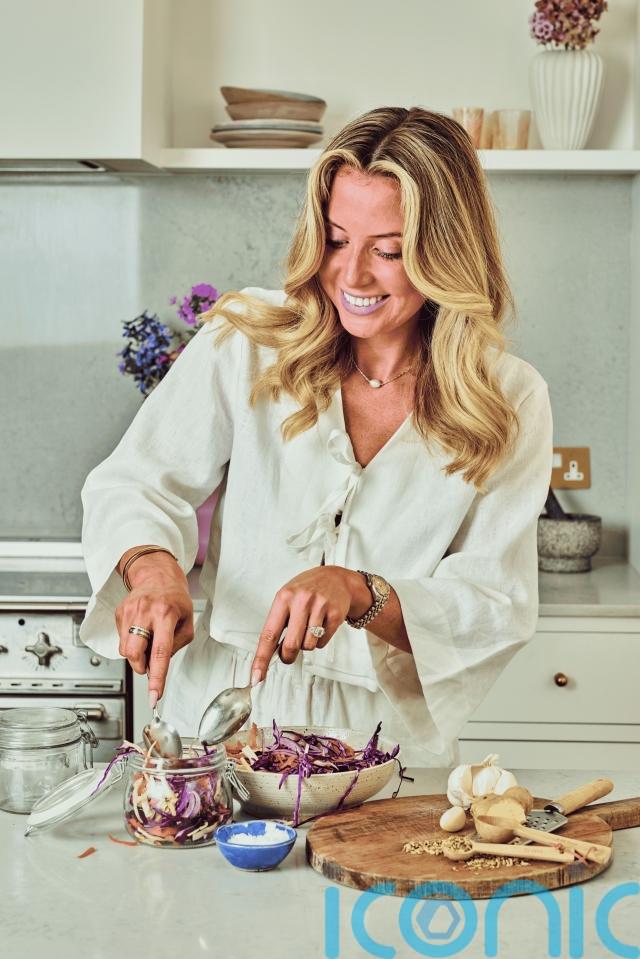
So Richards began implementing little daily habits and immediately started to feel better. “My periods are a little bit lighter, which was crazy because I used to flood through all my pads and tampons, and I wasn’t flooding anymore.”
Now she has published her debut book, The Anti-Inflammatory 30-Day Reset, an accumulation of everything she learned, as well as expert knowledge and recipes, split into six ‘pillars’ of an anti-inflammatory lifestyle: food, gut health, detoxification, sleep, stress and movement.
Food was the biggest change she made. “There were some meals that I would eat and, straight after it, I’d be doubled over [with] a big swollen belly, and just didn’t understand why.
“Looking back, it was more heavily processed foods. Basically, the more complicated the ingredients were, the more artificial the chemical sweeteners, the worse the symptoms were.
“Artificial carbohydrates were my biggest problem. Things like white pasta, very processed breads…”
She says one recipe in the book – grain-free seeded bread – is “actually the only bread I can have that doesn’t make me feel awful and it’s because it’s full of healthy, whole food ingredients rather than processed stuff.
“I used to eat gluten and it would swell me up, she adds. “I’d have this huge kind of migraine after it. So processed foods, gluten and dairy I’d say were the three key things.” so all her recipes are free from UPFs (ultra-processed food), gluten and dairy – think chicken karahi with quinoa, pistachio-crusted cod, or Spanish tortilla and romesco dip.
While changing her diet helped Richards almost immediately, she knows “We’re all unique, We’re all individuals”, not everyone with endometriosis has the same symptoms and inflammation is a complicated topic we don’t even fully understand yet.
“But, from what we do know, it’s very clear that there are different points in the cycle that are more inflammatory. And it is really clear that some foods can cause inflammation over others. The general consensus is [to] move to a whole food way of eating.
“When something doesn’t have a label, it’s a good sign. So I always think; meat, fish, fruit, veg, nuts, seeds, grains, legumes. When you move to that way of eating, you lower inflammation. Fibre is so important to the gut, it helps with hormones, and helps with inflammation.”
So what’s Richards’ advice for battling a sugar or junk food craving?
“First of all, remember it’s totally normal – these foods are built to make you feel addicted to them. Also off the back of Christmas, when you have that high blood sugar going on, you tend to crave more as well.”
But if you’re able to balance your blood sugar by eating meals high in protein, fats and ‘nature’s carbohydrates’, “and when you understand the ‘why’ behind something, you’re able to sit with the craving a little bit more.
“The more sugar you eat, typically, the more you will crave it.
“Now I don’t eat any rubbish, and I don’t crave any rubbish because I’ve been eating this way for so long.”
Living an anti-inflammatory lifestyle has helped Richards’ mood dramatically improve too. “I didn’t even realise I was struggling until I’d almost come out of the fog. I wasn’t feeling down all the time.”
Of course, the condition is still there – but it doesn’t take over her life in the same way. “I have endometriosis but because I’m not feeling the symptoms of it anymore – I can live with anything if it’s not affecting me.”

The Anti-Inflammatory 30-Day Reset by Sophie Richards is published in hardback by Michael Joseph, priced £22. Photography by Clare Winfield. Available now.

Subscribe or register today to discover more from DonegalLive.ie
Buy the e-paper of the Donegal Democrat, Donegal People's Press, Donegal Post and Inish Times here for instant access to Donegal's premier news titles.
Keep up with the latest news from Donegal with our daily newsletter featuring the most important stories of the day delivered to your inbox every evening at 5pm.

This publication supports the work of the Press Council of Ireland and Office of the Press Ombudsman, and our staff operate within the Code of Practice of the Press Council. You can obtain a copy of the Code, or contact the Council, at www.presscouncil.ie, Lo-call 1800 208 080 or email: info@presscouncil.ie.