

An Colún: A beautiful legend with possible Irish roots

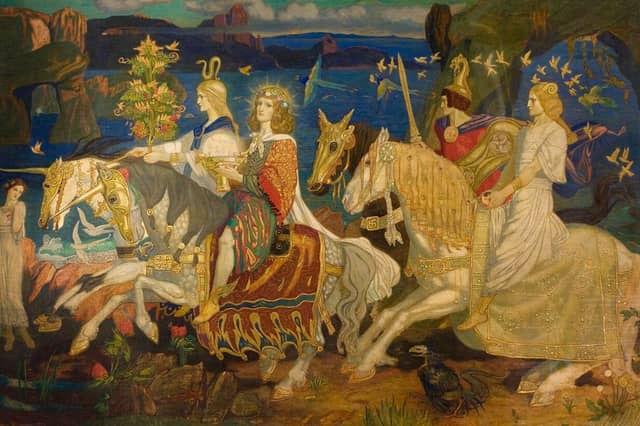

‘Our Irish ancestors possessed a deep reverence for thin places, for springs and sacred trees’
THE beautiful legend of the Holy Grail could have its origins in Irish mythology. According to some it could have been inspired by a Cauldron which belonged to the Dagda, a member of the supernatural Tuatha Dé Danann.
The Cauldron of the Dagda, was also known as Coire Anseasc (which means “the undry”) and bears similarities to the magical, life-sustaining vessel of the Grail legends. Brought to Ireland by the Tuatha Dé Danann from the mythical city of Murias (a city which was associated with the teacher Semias, who was a sage & druid), this bottomless vessel possessed distinct properties: It never ran dry, providing endless food and nourishment and no company ever went away from it unsatisfied. No matter how many people gathered to eat from it, everyone always received a full and satisfying portion, and "no company ever went from it unthankful." According to lore, it doled out food relative to a person's worth or virtue, or provided precisely what each seeker needed when a portion was drawn with a spear or fork. Beyond mere sustenance, and like other mystical vessels in Celtic lore, it symbolised life and hospitality; it symbolised the maternal, life-yielding waters of the Otherworld, providing spiritual as well as physical nourishment.
The Dagda himself was a very powerful, father-figure god of the Tuatha Dé Danann. His name means "the good god", which didn’t refer to qualities of moral perfection but rather to his being a master of all trades, magic, and cosmic order. He was the chief druid of the Tuatha. As well as the Cauldron his possessions included a life-and-death club and a magic harp. The club was a massive weapon where one end could kill with a single blow and the other could restore the dead to life. The Magic Harp was a magnificent oak harp that played by itself and could control people's emotions as well as govern the turning of the seasons.
The Dagda obviously symbolises the lifegiving forces of nature. Mysticism and the lifegiving forces of nature share a profound connection across human history, rooted in the belief that the natural world is not just a physical space, but a living, breathing manifestation of the divine. We strongly get this sense of nature being more than just a physical space in Irish mythology, in figures such as the Dagda.
In mystical traditions, nature is viewed as a sacred mirror reflecting spiritual truths, where the forces of creation, growth, and renewal are seen as direct expressions of a higher cosmic consciousness. In the various mythologies that higher cosmic consciousness can be symbolised by various characters and legends, but the fundamental belief in a divine force remains a constant. If we push beyond the various characters and the various legends then we arrive at the great insight, which many mystics share, where we perceive the Earth as being a single, living organism (the "Soul of the World") where every element is interconnected and sustained by a singular, vital life force. If we are Christian then we express our interpretation of that vital life force through the utilisation of the Christian tradition. Our pagan, Irish ancestors expressed it through their mythology. Both Christian and Pagan can be similarly attuned to Nature’s Cycle of Renewal where Nature's constant rhythm of birth, death, and rebirth is seen as being a reflection of our own mortality and standing in the universe, where the seasonal shift from autumn to winter represents our own inevitable decline and death and the shift from winter to spring serves as a powerful metaphor for the indestructibility of our beings, for our resurrection in the next life beyond.
In Celtic mysticism the veil between the physical and spiritual worlds, between our current physical manifestation and the next life beyond is perceived as being “thin” in natural spaces like groves and springs. Therefore our Irish ancestors possessed a deep reverence for "thin places", for springs and sacred trees.
Chrétien de Troyes was a 12th-century French poet and troubadour who invented the genre of Arthurian romance. Active between 1160 and 1191, he was the first person to come up with the iconic elements of the Arthurian legend, such as Lancelot, the Grail, and Camelot. Chrétien was massively influential, shaping the way knights, chivalry, and courtly love were portrayed in Europe. He was the very first writer to mention a "grail" in literature, introducing it around 1190 in his unfinished romance “Perceval”. He didn’t call it "holy" or tie it to Jesus Christ; that specific Christian identity was added later. In Perceval, the "grail" (graal) is not a chalice or cup, but a wide, glowing, jewel-encrusted serving dish or platter carried during a mysterious procession. It is a wondrous and magical object housed in the castle of the Fisher King. However, Chrétien died before he could finish the story, therefore he never got around to explaining the true nature of the grail. Literary historians point out that while Chrétien set the concept down first, in his imagery he likely drew upon older Celtic folklore and magical cauldrons. Around 1200, the French poet Robert de Boron wrote Joseph d'Arimathie, explicitly transforming the grail into the sacred chalice of the Last Supper used to catch Christ's blood.
In his early 13th-century Middle High German epic poem "Parzival”, Wolfram von Eschenbach added wonderful elements to the story, enriching it. In Eschenbach’s telling, Parzival learns humility, grace, and the error of blaming God for his suffering.