

Largest housing scheme ever undertaken in Offaly marks fifty years since opening
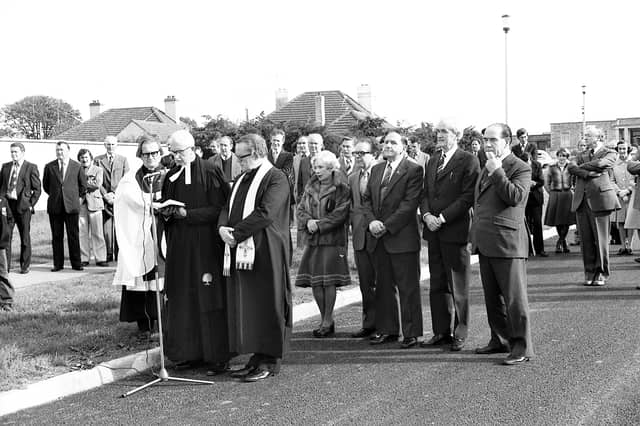

The Ardan View scheme of 282 houses was the largest ever undertaken by the Tullamore Urban District Council (1900–2014)
The Ardan View scheme of 282 houses was the largest ever undertaken by the Tullamore Urban District Council (1900–2014). The council had started building houses in 1903 because of the poor condition of the existing housing stock and the inability of tenants to pay the rents that would be needed to build good quality housing.
Many people lived in the lanes off the main streets and before 1903 there was no housing beyond the canal or the railway line save a terrace of small houses in Whitehall. By 1913–14 the town council had completed new schemes at Emmet Terrace, Davitt St., Convent View and O’Brien St. After a gap of ten years due to the war work resumed in the 1920s on Dillon Street, Kilbride Street, Parnell St. and Healty St. Building began in earnest after the new Fianna Fáil government came to power in 1932.
The new schemes of the 1930s included Callary Street, Park Avenue and the big one was the scheme of 146 houses in O’Molloy Street/Kilbride St. The early 1950s saw the completion of Clontarf Road, Pearse Park and Marian Place – another 260 or so houses. And yet the major schemes of the 1930s and 1950s did not match for size or quality what was achieved at Ardan View over the period from 1976 to 1983.
Minsters for local government had opened the O’Molloy Street scheme in 1938, Clontarf Road in 1950, Pearse Park in 1953 and Marian Place in 1955. Generally, the ministerial speeches were congratulatory of the town council and agreeable occasions helped by the luncheon in Hayes’ Hotel paid for by the respective builders. Only at the launch of Pearse Park in 1953 did the parish priest, Dr William Moran (without any script) decide to attack the boom in urban housing provided by the council and the decline of the rural population.
The Ardan View scheme of 1976 came within the eleven years of the building of Kearney Park, Connolly Park and Thornsberry Estate at which no minster attended the completion. So when James Tully (1915–92), Minister for Local Government since 1973, came to Tullamore to open the first phase of the Ardan View scheme of 76 houses in October 1976, it was the first time in 21 years for such an event. Tully was the deputy leader of the Labour Party and from his speech that day it was very clear that he was fully in charge of his brief. Indeed, the Dictionary of Irish Biography notes that ‘he was regarded as one of the most effective ministers in that coalition cabinet. At the time of his death in 1992 no other minister for local government had exceeded his house-building record of 25,000 a year for the four years of his tenure (1972–7). Moreover, the quality of local-authority housing was greatly improved during his term of office.’
The reporting of the event was I am sure by Geoff Oakley and very much his style as generous, comprehensive and independent.
The naming of the scheme
Vincent Wynter presided at the formal opening and the Labour representatives on the council were everywhere to be seen. Any why not. It was Ernie McGuire who had proposed the name of Ardan View while the council’s first woman member (1974) May Keeley wanted the estate called after ‘the man who died for Ireland to-day’ (she was referring in February 1976 to hunger-striker Frank Stagg). The Town Clerk, William Allen, had invited the council to consider Knockaunmore which, he said, was the other version of Tullamore, and would get away from the use of ‘Estate’ or ‘View’.
In his speech Minister Tully ‘commended the design of the houses in this new scheme and welcomed also the front fences. Open plan fronts looked very well on paper, he said, but children had a habit of pulling up flowers - not their own flowers but the neighbours' flowers, and that was where rows could start.’
Steady Progress
Following lunch in the Bridge House (a sign of the times as all previous had been in Hayes’ Hotel) Mr. Tully said that ‘There was a school of thought that if they could build cheap houses they could build more of them, but when he started first as Minister he opened a number of housing schemes and it became an embarrassment to him, going into houses which had been one or two months in occupation, to be expected to take a list of complaints about houses which had been badly built. For this he would blame the plan that these houses should be built at all.’
‘In completing 94 dwellings since January 1975, the Urban Council had been able to offer tenancies to many families of three persons or less. Not every town was as fortunate as Tullamore.’
The Correct One
The Minister believed the traditional house was the correct one. He supposed it was no accident that in Offaly they had largely avoided the former 'low-cost' housing which had left other areas with such unwelcome problems. The scheme he had opened that day was planned in full accord with his policy of eliminating the Local Authority housing “ghetto” syndrome which permeated the housing policies of the late sixties and early seventies.
The lay-out was almost wholly semi-detached — a form of development which at one time was considered too good for public housing. It was obviously more costly than terraced housing... but nowadays the semi-detached form of development merited serious consideration, particularly for the smaller schemes. Tenants and purchasers generally had a strong preference for the added privacy, convenience and relative openness of semi-detached development. It was hard to quantify this in money, but it was well to remember that tenant dissatisfaction costs money. The Minister pointed out, there was much to be said for a judicious architectural mix of semi-detached houses, small, well-featured terraces, and perhaps some detached single storey dwellings to give added diversity and interest.
Last a Century
The Tullamore scheme at that point in 1976 contained eight houses for elderly persons, six houses suitable for young married couples, 48 three-bedroomed houses, four four-bedroomed houses and ten houses for industrial personnel.
Stressing the importance of providing housing for old and handicapped people, the Minister supported the idea of having old people living with the rest of the community. While there were people who must go into an institution, because it was impossible to look after them at home, it was much better that old people should have a home of their own, with all modern facilities, and with young people to come in and out to them, doing messages - and learning from them.
The Minister thanked the architects for their excellent design and for the open space. He appealed to the Council to keep the open space. He would not like to see someone deciding at a later stage that there were sites being wasted there – open space was not waste.
The County Manager, Patrick Dowd, said he had had the pleasure of taking the Minister to see their 160 private site scheme (Ardan Vale) on the opposite side of the road and said he was sorry the man who had made this possible the Rt. Rev. Monsignor Clarke, was unable to be present due to illness. The Council had purchased this property from the Monsignor. [Strangely, there was very little open space in this development.]
Mr. O.J. Flanagan welcomed the Minister to the Laois-Offaly constituency and said he was very deeply honored to be working with him in the Custom House. Some of the older people there might remember the O'Molloy St. Scheme being built. This scheme of fine stone houses had been erected by a Tullamore firm of contractors, John and Peter Duffy. Other great craftsmen in building in either brick or stone were the Gallagher’s of Tullamore.
The contractors in this first stage were P. and T. Marrinan. W.A. Maguire & Partners, Architects and Messrs. J. B. Barry & Partners, Consulting Engineers.
Dick Spring TD, Leader of the Labour Party and Tánaiste, opened the final phase of Ardan View in 1983. The all in cost of the 3-bedroomed houses of the final phase was £23,100 while the four- bedroomed houses cost £28,000 each. The economic rent would be between £57 and £70 per week for the three and four-bedroomed houses but the average rent would work out at £7.70.
Thanks to Offaly History, Bury Quay for their help with this article.