

Magnificent Meelick Weir is officially opened by Minister

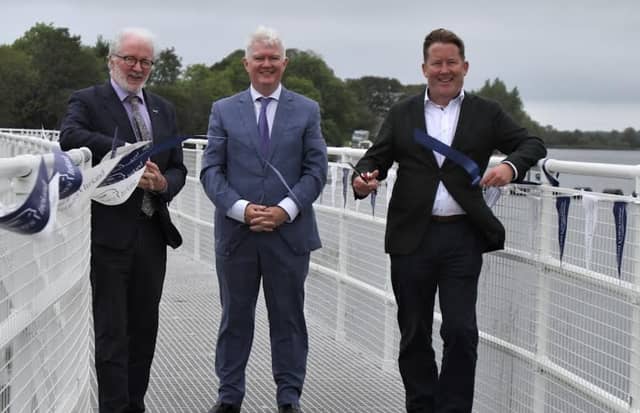

The magnificently restored Meelick Weir and walkway on the River Shannon was officially opened by Minister for Housing, Local Government and Heritage, Darragh O’Brien TD and Minister of State for Heritage and Electoral Reform, Malcolm Noonan TD on Friday morning last.
The weir was damaged in severe storms in 2009 and again in 2015/2016, when the walkway was also damaged and was subsequently closed.
Charlie Killeen, Chairman of the Meelick Lusmagh Development Committee, told The Midland Tribune that Friday's opening was the end result of many years of campaigning.
“We were often ploughing a lonely furrow trying to get support for our much-loved weir,” said Charlie, “but at long last all our campaigning and hard work has paid off and we now have this beautiful, magnificent weir, which is one of the most beautiful things along the Shannon basin. We want to warmly thank The Midland Tribune and The Connaught Tribune who often publicised our campaign. The publicity provided by these newspapers was very important.”
Meelick Weir was originally built in the 1840s as part of the Shannon Navigation. The weir is over 300 metres in length with a 12 sluice barrage. It maintains and regulates the navigation level for that section of waterway between Athlone (Lough Ree) and Meelick (Lough Derg).
The new walkway means there is now a link between the historic village of Meelick in east Galway to Lusmagh in west Offaly, and it forms part of the Hymany Way and the Beara-Breifne Way walking trails.
“The walkway was much loved and much used by locals for many years,” commented Charlie, “but it was damaged in 2015 and no one could use it after that. It's now been unofficially open for several months and we are all delighted with it. They did a fantastic job on it.” He strongly recommended that people come and have a walk across. “It's a special walk, a special experience,” he remarked.
Charlie added that there's also a plan to put a viewing platform on the martello tower in Meelick. “They have taken away the ivy from the martello tower,” he remarked. “When the viewing platform is completed there will be a fine view of the surrounding landscape and the river. They are also planning to construct a walkway from the 600 year old Meelick Church to the weir.”
Construction work on the €3.2m Waterways Ireland project began in 2019 and included the restoration of the weir, its 300m walkway and new tilting weir gates, along with other weir refurbishment. The new tilting weir system will be mechanised, meaning that staff will no longer have to manually install and remove the sluice boards in response to changing water levels.
There was a great turnout of people at Friday's official opening, and also a happy atmosphere because it had been a long time, 18 months, since anyone had attended an official opening, and it felt like another sign of life getting back to normal.
Speaking at the official opening, Minister Darragh O’Brien said: “I am delighted to be here today to officially open Meelick Weir and walkway after the completion of a hugely significant programme of work by Waterways Ireland on this state-of-the-art project. Recognising the importance of the weir and the walkway, I was pleased to support the project and to ensure funding was made available from my Department in the amount of €3.2m. It is great to see it brought to completion and ready for its official opening today.
“Meelick Weir has a dual purpose. Not only is it a critical piece of infrastructure in maintaining the navigation level between Lough Ree and Lough Derg, it also serves to unite the communities of Meelick and Lusmagh and offers a fantastic amenity in the area.
“I know this is very popular with local people and also provides a wonderful tourism opportunity for Galway, Offaly and Tipperary – the three counties that it borders. The restoration of the weir and walkway opens the potential for these historic structures to play an important role in tourism in the future.”
Minister O'Brien pointed out that the area surrounding Meelick Weir is also of huge historical significance, with Victoria Lock and its lock-keeper’s house, and Meelick Martello, located on Moran Island, all included on the Record of Protected Structures.
“Meelick Martello is a recorded monument in the care of Waterways Ireland,” he remarked. “Nearby Meelick Church, meanwhile, dates back to the 1400s.”
Minister for Heritage, Malcolm Noonan commented: “This whole area is hugely significant from a heritage perspective. This project opens the walkway and allows people travelling its route to visit Victoria Lock, which was built in the 1840s also as part of the navigation system, and the famous landmark ‘the three counties Shannon view,’ where the counties of Galway, Offaly and Tipperary meet. In terms of wildlife, it is within both the River Shannon Callows Special Area of Conservation, and the Middle Shannon Callows Special Protection Area.”
He added: “I am delighted to see the restoration of the connectivity between the communities of Lusmagh and Meelick and the re-instatement of the Hymany Way. This project will have a significant impact on the communities and the broader tourism opportunities in the area.”
Waterways Ireland chief executive, John McDonagh said: “Meelick Weir is an iconic structure and I’m delighted that this restoration project is now complete. The weir is an extremely important piece of navigation infrastructure, enabling the management of water levels on the River Shannon for navigation, and also linking the counties of Offaly and Galway, and the provinces of Leinster and Connaught via the walkway. The systems built into the weir also ensure a safer working environment for our staff.
“This is the largest project Waterways Ireland has undertaken since we restored the main line of the Royal Canal and I would like to commend my colleagues, who have worked diligently to deliver this ambitious project on budget in very challenging times.”
He pointed out that Waterways Ireland initiated design work on the project in 2012, completed the statutory environmental assessment and submitted planning for the project to Galway and Offaly county councils, which was given in 2017.
“The works involved the restoration of the weir, its walkway and the tilting weir gates along with other weir refurbishment. The new tilting weir system is a significant improvement in health and safety for employees managing water levels on site.”
To by-pass the fords and rapids at Meelick, the first attempt at improving the navigation of the area was made through the construction of Clonahenogue canal and Hamilton’s Lock c.1755 (rebuilt in 1806) but was notoriously difficult to navigate due to insufficient depth and an entrance known locally as the devil’s elbow.
In 1840-43, a second phase of navigation works was made by the Shannon Commissioners, which, under the recommendations of engineer Sir Thomas Rhodes, constructed Meelick weir and a new cut with a spacious lock named for Queen Victoria.
A stone-built cottage for the lock keeper was built on the eastern (mainland) side, while a tow path was constructed along the western bank. Victoria Lock and its lock-keeper’s house are also included on the Record of Protected Structures and are considered to be of regional importance. Located on Moran Island, the Meelick Martello forms part of a cluster of defences close to Banagher.
Both locations were historically important fording points between the east and west of the country. On this island in the river, the Martello tower was constructed to defend against a potential Napoleonic invasion. Meelick Martello is a recorded monument in the care of Waterways Ireland, as well as being included in the Offaly Record of Protected Structures.
Waterways Ireland is a cross-border body accountable to the North South Ministerial Council under the 1998 British-Irish Agreement. The organisation is headquartered in Enniskillen and has satellite offices in Dublin, Carrick-on-Shannon, and Scarriff.
Its 340 staff are deployed across the management, maintenance, development and promotion of over 1,000kms of inland navigable waterways. Waterways Ireland assets contribute approximately €560m in economic, societal and environmental value annually. The waterways estate comprises Grand Canal; Royal Canal; Barrow; Shannon, Shannon-Erne; Erne; Ulster Canal and Lower Bann navigations. In 2020, the waterways estate received 3.5 million visitors.