

Renowned Birr scientist shines fascinating light on farming in the Slieve Blooms

A GATHERING of people in Kinnitty Community Centre were treated to an excellent talk by the renowned Geologist and Botanist John Feehan recently, about the history of Farming in the Slieve Bloom Mountains.
As we drive through the Slieve Blooms we admire the beauty of the hills but we often don't think about the many people who once lived in the valleys, farming the land for centuries. John is an expert on these hills and he provided the listeners in Kinnitty with many fascinating insights.
His talk went through a number of themes, covering issues such as the farmers who lived in the mountain range prior to the advent of written history; the influences which came from Europe and from the monastic tradition; and the thousands of ringforts and their connection with farming.
His other themes included the increase of farming families in the valleys during the 18th century; and the high tide of farming in Slieve Bloom, up to the Famine; the 20th century population retreat from the Glens and the relics of that high-water mark; and Afforestation.
He told us that he started wanting to be a farmer when he was 10, “when we used to spend a few weeks during the summer holidays at my grandfather’s small farm in the heart of rural Carlow: before drifting off into other directions in my teens and twenties.”
John worked for 35 years in the School of Agriculture in UCD until his retirement, which made him very knowledgeable about the positives and negatives of farming.
Before focussing on the Slieve Blooms he spoke about the history of farming more generally, pointing out that for most of human history, people were not farmers but hunter / gatherers. Eventually a mixed farming economy, a mixture of crops and domesticated animals, was adopted. It's wrong to think of these early farmers as primitive or stupid; for example it was early farmers who built Newgrange. Long before this, the achievement of domesticating animals and selecting crop plants was an exceptional achievement.
In the earlier phases of the Ice Age the ice rode right over the top of Slieve Bloom. The significance of this story is its influence on soils.
The arrival of Christianity brought new farming techniques from Roman civilization. These techniques filtered into local farming practice.
He pointed out that Ringforts are important to preserve not because they are of interest to tourists and archaeologists, but because they are “milestones in the history that washes up on your doorstep.”
John has often talked to farmers about the Ringforts on their land “and they were always aware of the importance of these treasures. They always wanted to preserve the forts because they represented a link with farming of many centuries duration on their land.” Sadly, there have been a number of “progressive, down-to-earth” farmers who had no qualms bulldozing those that weren’t protected (and sometimes these too!)
There are only a few examples in the Slieve Blooms of the Gaelic cow economy called “Booleying”. A few booley huts can be seen high up in the glens.
A new landscape began to emerge with the collapse of the Gaelic order in the 17th century, a collapse which led to the farming system changing utterly.
“What came in was the start of what we would look back on and refer to as ‘traditional’ farming, which evolved from the 3-field system of medieval Europe; typically wheat-beans-fallow. The introduction of red clover in the 17th Century was also a major game changer. The growth of the science of Agrostology was also of importance.”
The advance into the Glens
By the time of the Great Famine, farming in Slieve Bloom had reached the maximum point of its reclamation of the mountain. The maximum point of that advance is rccorded for us in remarkable detail in the first edition map of the Ordnance Survey (1838). (And in the second edition of 1912 we can trace its subsequent evolution until the Great Decline of the 20th century.)
The many farm families living in the valleys lived frugal but essentially self-sufficient lives. There are very few farms nowadays in the Slieve Blooms.
The Famine hits Baunreagh
There is one outstanding episode in the story of the Famine that shines a light on Slieve Bloom, and that is the story of Baunreagh, the widest glen in the mountains; the name referring to the level plain at the bottom: bán réigh, level plain.
William Steuart Trench was a leading land agent who lived in Cardtown House. In the early 1840s he acquired a lease on 180 acres of deep peat in Baunreagh. He employed 200 men for the manual labour, assisted by a great 18’ x 3’ water wheel. It was the most successful example of the reclamation of waste land of its day, and attracted enormous interest and won all sorts of prizes. Lime was spread at the rate of 1 barrel per statute acre. Lazy beds were prepared (5’ wide) and potatoes planted. Imported guano was scattered on top at the rate of 6 cwt/acre (cwt means “hundredweight” which equals a hundred pounds). The beds were topped with clay from the furrows, then levelled. Because of this work the land value increased from 1 shilling /acre to £1 / acre. His farm in 1843 produced: 515 tons of potatoes; 240 barrels of oats and 90 tons of hay.
However on August the 5th, 1846 the blight hit the farm and his enterprise was ruined.
The arrival of Sitka Spruce
Before the Irish Free State was established in 1922, the Department of Agriculture and Technical Instruction (DATI) was responsible for forestry in Ireland. In 1911 DATI acquired 2000 acres in the Slieve Bloom mountains and planted most of it with Sitka spruce, beginning a trend which was continued by the Irish Free State and up to the present day. As a result vast tracts of the Slieve Blooms are covered by Sitka Spruce, often tightly planted and devoid of natural life.
John told the meeting that in spite of this focus on a monocrop the Slieve Blooms possess a considerable amount of inherent fertility and farming potential. for example in the 1810 Lewis' “Topographical Dictionary of Ireland” Lewis pointed out that the soil is “capable of great improvement by the application of lime, which is much used, as is also a compost of clay, bog mould, and the refuse of the farmyard.” Lewis also pointed out that, “Another peculiarity of these mountains is the fertility of their northern side, which is interspersed with neat farmhouses and cultivated enclosures to its summits, while its southern side is mostly a heathy waste.” J. Baldwin, in his “Statistical Survey of Rosenallis” (1819), said that the part of the hills which lie near Rosenallis, “presents to the view, almost to the very summit, hamlets and gardens in a high state of cultivation; it produces good crops of potatoes and oats; and some of the glens also between the ridges, are very productive of grain and potatoes.”
In O’Hanlon and O’Leary's “History of the Queen’s County” (perhaps published in 1907) the authors said, “Towards the centre of these mountains, the land is very fertile in pasture, and it is grazed the whole year throughout with numerous flocks of sheep and young cattle. The soil is often of limestone quality, and large rocks of that mineral are thickly interspersed: neither is the bottom range boggy, but it produces a stiff clay, from which abundant crops of corn can be procured.”
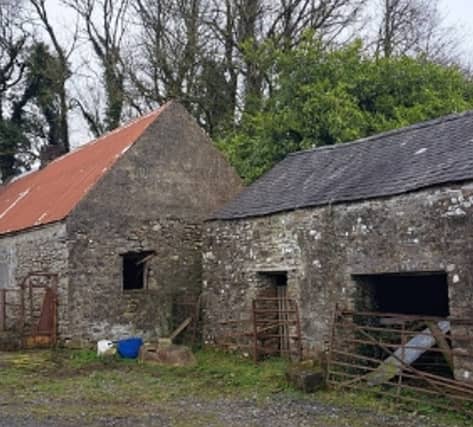
Nowadays, as you walk through the Slieve Blooms, you will often come across the remains of small houses. These dwellings, now in ruin, were typically part of a farmstead. They represent the sad retreat of farming and people from the hills. Today there are very few farms in the hills.
John pointed out as well that the decision to adopt and promote petroleum-based agriculture “without taking full account of the price in terms of environmental degradation” was a wrong step. He said the British and Irish governments should instead have followed through “on the kind of sustainable farming being perfected in Europe in the later 19th and early 20th centuries.” This is a subject which John discusses in Chapter 19 in his “History of Irish Farming”.
He talked as well about the older ordnance survey maps, which are of particular interest because they show us “Slieve Bloom more or less as it was as the tide of farming began its retreat. The scale is small, but big enough to see all the main features at the same time. All the remaining houses are marked, and the remaining tracks. The most noticeable difference compared to our ordnance survey maps today is there are no forests. Short rotation coniferous forest means the end of farming in practical terms, unless we redefine what we mean by farming. There are alternatives, but they weren’t considered at the time. We might, for example, have looked at options for agroforestry and a more imaginative and enlightened form of agritourism.” Agroforestry is the interaction of agriculture and trees. “Where we have sitka spruce today, we could, with appropriate supports, have restored the Scots pine of 5,000 years ago.”
John concluded his talk by remarking that in spite of the mistakes of the past, great possibilities are still open to Ireland and precious landscapes such as the Slieve Blooms, if we employ a mixture of imagination and energy.