

OPINION (AN COLÚN): Warriors and grave robbers in our local hills


LAST weekend I enjoyed a fabulous walk near Cadamstown. This is the Giant's Grave Megalithic Loop and it's a walk I'd recommend to anyone of moderate fitness, even neophytes in the world of hillwalking, because its gradient is gentle and the route is well signposted throughout, with red signs. In other words it's navigationally easy.
The route is 14 kilometres and it starts in Cadamstown. The walk follows the arrows uphill along an old coach road, passing by Paul's Lane (which is a shorter, very decent ramble). You continue straight on until you come to a sign pointing right for “Giant's Grave”. Here I met a farmer who was having difficulty herding a stubborn heifer into his yard. The heifer seemed determined to go any which way but that desired by its owner. At one stage it dodged the farmer's stick and headed off up the tarmacadamed road in the Giant's Grave direction. The farmer, having asked me to stand by the yard gate, jumped in his car and drove off in pursuit. After several minutes he managed to get the animal to start descending towards me at a trot. I held my two walking sticks aloft and tried to make myself look as large as possible. This worked and the heifer trotted briskly into the yard. My farming duties completed, I could return to shank's mare.
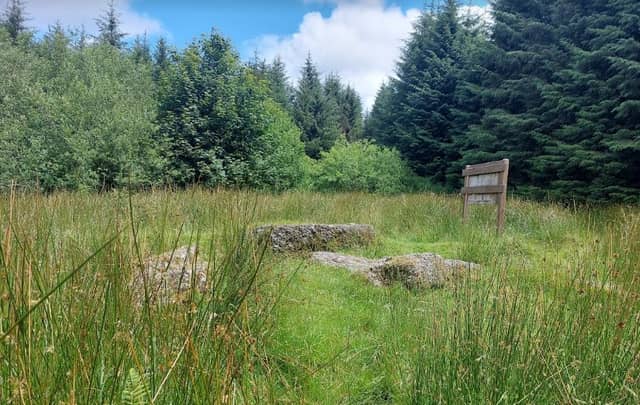
A few more kilometres brought me to the Giant's Grave. I have no doubt that this megalithic site must have greatly disappointed countless visitors over the years. A lot of people say you should visit, and the name also conjures up a grandiose vision in your mind's eye. What a disappointment then when you arrive and there's only a few unprepossessing boulders lying on their sides. However, when you start reading about the site it all becomes considerably more interesting. The main thing about this tomb is that it is, according to legend, the resting place of the warrior Bladhma, after whom the Slieve Bloom range gets its beautiful name. The myth tells us that Bladhma was from west of the Shannon, where he killed an important chieftain, following which he fled to the Slieve Blooms. John Feehan tells us that there's a warrior called Blod mac Con in the Book of Leinster who killed someone important, fled from Áth Cliath in Galway to Áth Cliath in Wicklow and ended up in the Slieve Blooms. In another 12th century text a similar story is told: “Bladma or Blod, son of Cú, son of Cass Clothmin, killed the cowherd of Bregmael...”
Whoever was buried in the burial cist in Giant's Grave was probably a person of note, perhaps a local strongman / warrior. The tomb is Neolithic, about 4000 to 2500 BC, and the interred during this period were buried in the foetal position.
What was life like for Neolithic people such as Bladhma and his Slieve Bloom contemporaries? One study I recently read had a bleak assessment: “Compiling data from various sources,” it says, “it becomes apparent that violence was endemic in Neolithic Europe, sometimes reaching levels of intergroup hostilities that ended in the utter destruction of entire communities...patterns emerge that see conflict likely fostered by increasing competition between settled and growing communities, over such matters as access to arable land for food production...”
The Giant's Grave stands beside the County River, on the Laois / Offaly border, in the townland of Killinaparson. It was first described in the 19th Century when it was recorded as “a burial tomb consisting of seven or eight boulders of local conglomerate which are of no great size.” The notice board at the site tells us that the tomb was “disturbed by treasure hunters in the eighteenth century leaving it in the ruined condition in which one finds it today.” It's said that a man with the surname of Purcell found a golden spur here.
The problem of illegal treasure hunters causing significant damage to our beloved Neolithic monuments is a problem which has not gone away. There have been a number of incidents of vandalism and theft over the last few years. Some visitors steal stones from the tombs that contain quartz. There is some evidence that this quartz is being sold online. The taking of stones, no matter their size, from a protected monument is an offence in Ireland.
Last year it was reported that Carrowkeel Megalithic Cemetery in County Sligo had been vandalised by graffiti and the dislodging of stones.
Some misguided and ignorant people also believe that valuable gold or bronze objects are hidden inside ancient monuments. They are obviously not aware that stone age sites predate the use of metals in Ireland. These ignorant treasure hunters are not only wasting their time but also damaging Ireland’s heritage.