'Such sad news' - Search for missing woman stood down as body is discovered in river
Search


21 Feb 2026

Please allow ads as they help fund our trusted local news content.
Kindly add us to your ad blocker whitelist.
If you want further access to Ireland's best local journalism, consider contributing and/or subscribing to our free daily Newsletter .
Support our mission and join our community now.
To continue reading this article, you can subscribe for as little as €0.50 per week which will also give you access to all of our premium content and archived articles!
Alternatively, you can pay €0.50 per article, capped at €1 per day.
Thank you for supporting Ireland's best local journalism!


During fashion month, collections are typically experienced through observing runways – the sweep of a silhouette, the glint of embellishment under lights, the choreography of models moving in sync with a soundtrack. But at Chet Lo’s latest show, the experience began long before the first look stepped onto the runway – and it began with touch.
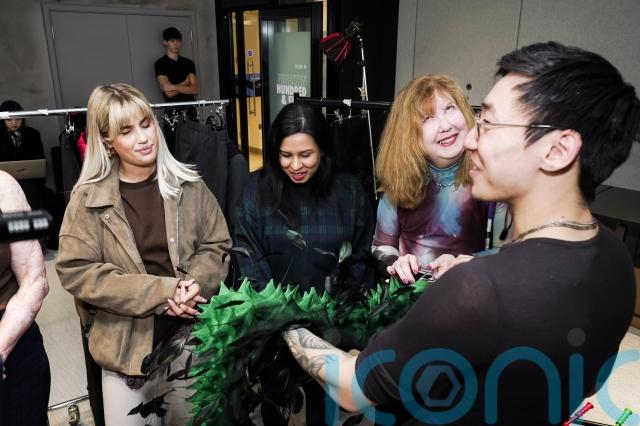
Before the runway show, blind and low-vision guests were invited to take part in a “touch tour”, part of the Hair & Care programme founded in 2019 by hairstylist Anna Cofone.
Each guest was able to feel a piece from the collection and talked through it by Lo himself. The fabrics ranged from black and emerald green spiked knits to ostentatious, feather-fluted materials.
For Cofone, who has worked with artists including Dua Lipa and Lana Del Rey and grew up with a blind father, expanding into fashion accessibility felt inevitable.
“We’ve been seeing first-hand the impact that self care, hair, and accessible hair and beauty has on blind people’s confidence, on their sense of empowerment, identity,” she says, “and so it just felt like an organic step to then also bring help to bringing fashion to the forefront, making it accessible for blind and low-vision people.”
The initiative first partnered with Lo in 2024 and is now three seasons into its collaboration. This time, it was supported by global brands including Philips Sound for the blind attendees’ headphones and haircare brand Authentic Beauty Concept. For Cofone, this is evidence that the industry is slowly shifting.
“Companies are realising that they need to be inclusive and they need to be accessible for blind and low-vision people,” she says.
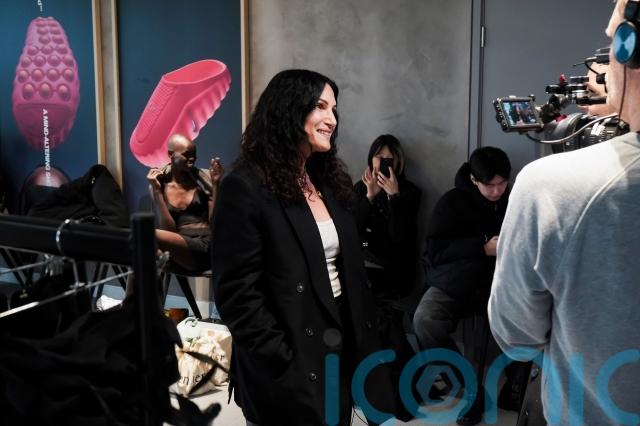
The concept behind the touch tour is simple: allow guests to experience garments through texture and storytelling before they are presented visually on the runway.
“So the idea of the touch tour is to give guests an opportunity to meet the designer in person, but most importantly, feel the key pieces in the collection up close,” Cofone explains. “It helps to paint a much stronger visual interpretation for them as they’re listening to the audio descriptions whilst the models are on the catwalk.”
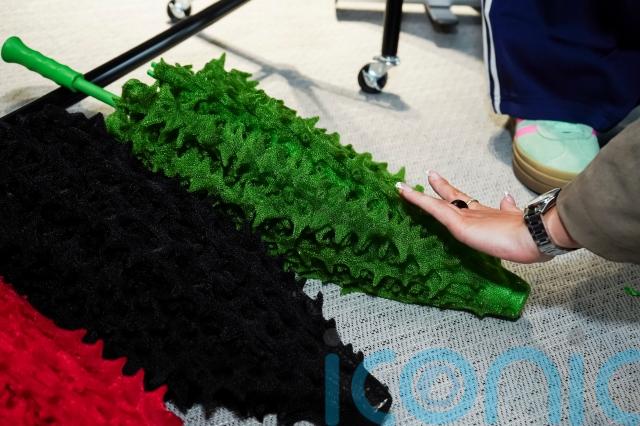
Lo’s work – known for its sculptural silhouettes and three-dimensional spiked knits – lends itself naturally to tactile exploration. Audio descriptions were prepared more than a week in advance, with the running order confirmed the night before the show to ensure seamless alignment.
For visually impaired attendee and activist Catrin Pugh, the impact is profound.
“Fashion for me has always been something that’s felt a bit out of reach,” she says. “As a visually impaired person, I have no central vision. I can’t see detail. So actually, fashion is really hard to be engaged in, because the detail is everything in fashion.”
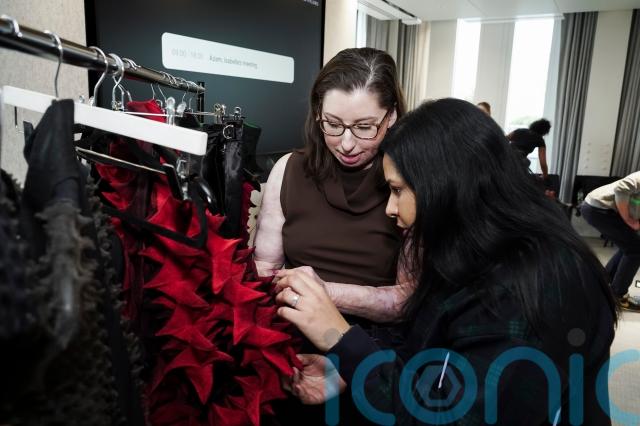
The touch tour changed that. “Coming to the touch tour meant I had an opportunity to see all these tiny elements that these designers spend hours, weeks, days, months, years, deciding on to become their own personal brand.
“I got an opportunity to see it, to feel it, and it just made such a difference that when I then saw those looks coming down a runway, I felt I still got to be part of it. And that’s not something I’ve ever felt before in fashion.”
Texture, she says, is central to Lo’s appeal. “So much of his brand and who he is is all about textures. It’s about creating shapes, about creating these unusual silhouettes and using shapes coming off the garments to actually express that,” she says.
“Chet’s work is so tactile, so for a visually impaired person, it’s like the perfect collaboration.”
One piece that stood out in particular was a pair of trousers. “[It] sounds super simple, but when he went into the delicacies and the intricacies of it, they are silk trousers with a felt embed at the top.
“That juxtaposition between the more coarse felt and the silk when it’s a tactile thing, is so important, because it does tell a story in one piece of clothing,” she explains.
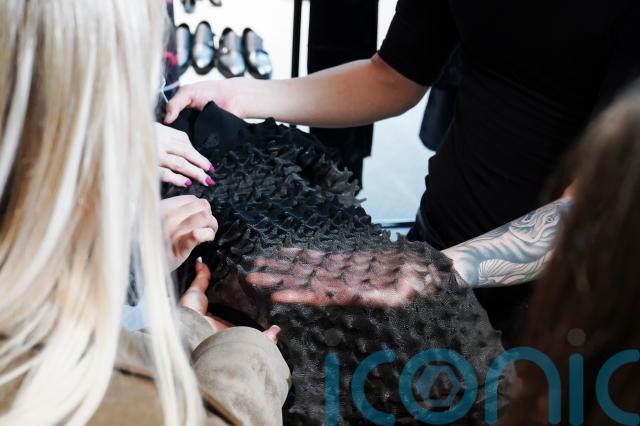
While conversations around inclusive casting have gained momentum in recent years, accessibility for audiences has often lagged behind. Initiatives like Hair & Care suggest that meaningful inclusion goes beyond who is seen on the runway.
“Anyone that has a disability, I think always feels excluded from all areas of life, but fashion in particular can be so difficult to feel included in when you are visually impaired, because it’s so much about how it looks – that is what fashion is,” Pugh says.
For Cofone, the argument is not only social but commercial for brands.
“We’re seeing the impact that it’s having on people, but also on designers,” she says.
“The purple pound is so strong and so there, as well as making people feel included and having accessible websites, accessible runway shows, packaging, it’s also helping to build stronger revenue streams.”
With around 25% of the UK population reported having a disability in 2023/24, accessibility is increasingly difficult for brands to ignore.
As the lights dimmed and the first look stepped onto the runway, guests who had already felt the fabrics and heard the story behind the collection experienced the show differently – not as observers on the margins, but as participants.
For some, that shift is everything.
“The touch tour means that I do get excited about it,” Pugh says, “I get to feel like I’m part of it.”

Subscribe or register today to discover more from DonegalLive.ie
Buy the e-paper of the Donegal Democrat, Donegal People's Press, Donegal Post and Inish Times here for instant access to Donegal's premier news titles.
Keep up with the latest news from Donegal with our daily newsletter featuring the most important stories of the day delivered to your inbox every evening at 5pm.

This publication supports the work of the Press Council of Ireland and Office of the Press Ombudsman, and our staff operate within the Code of Practice of the Press Council. You can obtain a copy of the Code, or contact the Council, at www.presscouncil.ie, Lo-call 1800 208 080 or email: info@presscouncil.ie.