Search


03 Apr 2026
Search
03 Apr 2026

Please allow ads as they help fund our trusted local news content.
Kindly add us to your ad blocker whitelist.
If you want further access to Ireland's best local journalism, consider contributing and/or subscribing to our free daily Newsletter .
Support our mission and join our community now.
To continue reading this article, you can subscribe for as little as €0.50 per week which will also give you access to all of our premium content and archived articles!
Alternatively, you can pay €0.50 per article, capped at €1 per day.
Thank you for supporting Ireland's best local journalism!


New research indicates that a drug commonly prescribed for gout may also lower the risk of heart attack and stroke when taken at an appropriate dose.
Researchers from the UK, Sweden and Italy analysed data from the Clinical Practice Research Datalink Aurum, linked with hospital admissions and mortality records, covering the period from January 2007 to March 2021.
The study included 109,504 adults aged 18 and over who had been diagnosed with gout and had uric acid levels above recommended targets before starting treatment. Participants were divided into two groups, with one group receiving uric acid-lowering medication – primarily allopurinol. Researchers then tracked the incidence of heart attacks, strokes and cardiovascular-related deaths within five years of the first prescription.
The findings showed that patients taking uric acid-lowering medication had a reduced risk of cardiovascular events over the five-year period, as well as fewer gout flare-ups, compared with those who did not receive treatment.
The greatest reduction in risk was seen among patients who achieved uric acid levels below 300 micromol/L.
In light of this research, we spoke with Abhishek Abhishek, professor of rheumatology at the University of Nottingham, who explained what exactly gout is and highlighted some early warning signs to look out for.
What is gout?

“Gout is a form of arthritis in which patients have high levels of a chemical called uric acid in the bloodstream,” explains Abhishek. “Over time, the uric acid deposits inside joints form very small crystals and when these crystals are released, it causes arthritis, which is characterised by severe pain and joint swelling.
“The arthritis usually lasts for a week to about 10 days, and people get recurrent flare-ups, because once the crystals of uric acid form inside joints, they stay inside the joints and keep on causing these flare-ups periodically.
What causes gout and what increases your risk of it developing?
“In the olden days, gout was believed to be caused exclusively by poor lifestyle factors, such as eating a lot of red meat, having a rich diet and drinking a lot of alcohol,” says Abhishek. “However, now we realise that these factors only contribute towards a patient getting gout, and that the main problem is that some people’s kidneys and gut are not efficient at clearing excess uric acid out of the body.
“So, we now realise that gout is mainly a genetic disorder in which lots of changes in genes result in people accumulating uric acid in their body.”
What can trigger a gout attack?
“There are several triggers of gout attacks, such as dehydration, a joint injury, illness, starting diuretic medication and drinking a lot of alcohol over a short period of time,” says Abhishek. “These are the reasons why some people can get recurrent gout flare-ups.”
Is gout more common in older people?

“Gout is generally present in people who are at least 40 years in age and it is very rare to get gout below this age group,” notes Abhishek. “It tends to become more common with increasing age. If you look at people who are over 70 or over 80 years in age, gout is quite common.”
What are some early signs to look out for?
“High uric acid levels do not cause any symptoms [alone], so the first symptom that most people usually experience is an acute arthritis episode, which typically affects the big toe,” says Abhishek. “During this, there’s a fairly acute or abrupt onset of joint pain, swelling and redness on the big toe.”
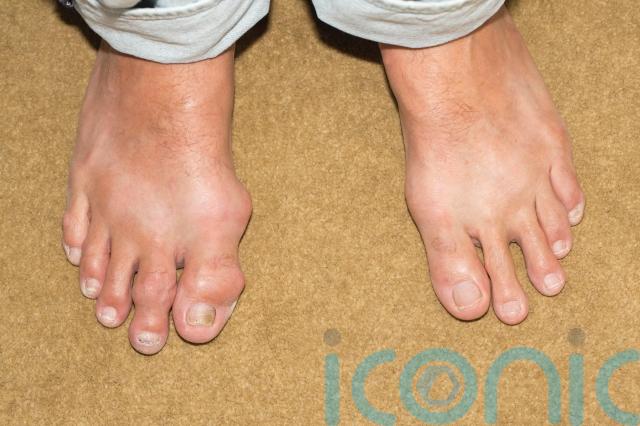
People might also experience this on their mid foot, ankle, knee or the wrist, he adds.
“In some people, the crystals can form below the skin, and they can be visible as small lumps of whitish chalk-like tissues,” says Abhishek. “This typically happens at the elbow or the fingertips.”
These small, firm lumps are called tophi, and the Arthritis UK website states that although tophi aren’t usually painful, they can get in the way of normal daily activities. They can sometimes become inflamed, break down and leak fluid with gritty white material – the urate crystals.
What complications can occur if you don’t seek treatment for gout?
“If you don’t seek treatment, you can get attacks that affect multiple joints,” highlights Abhishek. “It can affect your big toe, ankle, foot and knee at the same time, or several joints in the hands and feet together at the same time.
“Untreated gout can also last longer and lead to more severe and persistent pain and swelling. Over many years, these attacks can become more frequent, and it can then lead to permanent joint damage. The joint damage can affect small joints, such as the big toe or joints in the hands, but it can also affect larger joints, such as the knee or the elbow.”
How is gout diagnosed?
If someone thinks they have got gout, they should consult their GP, advises Abhishek.
“The doctor can do a blood test to check uric acid levels, and if the uric acid level is high in somebody who has typical symptoms of of big toe arthritis, that is usually sufficient to diagnose gout,” says Abhishek.
“In addition, if somebody has got white tissue deposits below their skin or on the fingertips or on the elbow, or sometimes on the knee, that’s sufficient to diagnose gout as well, if they have high blood uric acid levels.”
In some cases, fluid is drained from the joint.
“A doctor can stick a needle inside the joint to drain a bit of joint fluid and then look at it, or ask the labs to look for any crystals under a microscope,” says Abhishek. “If it is difficult to get fluid out, in these situations you can have an ultrasound to look for crystal deposits in the joints.”
How is gout treated and managed?
“If a patient is experiencing a gout flare-up, the treatment is generally painkillers to control the pain, which could be paracetamol,” says Abhishek. “It’s also important to rest the area and to apply some ice bags.”
There are several options to control the inflammation in the joint.
“Somebody can either be prescribed naproxen, which is an anti-inflammatory drug, for a few days or a tablet called colchicine, or a tablet called prednisolone, depending on the patient’s preference and their other illnesses,” says Abhishek.
In some rare cases, you can also have a joint injection.
“A doctor can inject the joint with some steroids to settle the inflammation,” says Abhishek. “This is to control the acute arthritis flare-up but does not control the underlying problem of high blood uric acid level or crystal deposition.”
Patients can also be given long-term medicines to lower their uric acid levels.
“There are two medicines in the UK, one of them is called allopurinol, and the second one is called febuxostat,” says Abhishek. “Both of them lower uric acid levels by reducing the amount made in the liver. If these initial treatments don’t work, then we sometimes go on and prescribe medicines called benzbromarone or probenecid that can also be effective.”
To find out more, visit arthritis-uk.org or call Arthritis UK’s free helpline on 0800 5200 520

Subscribe or register today to discover more from DonegalLive.ie
Buy the e-paper of the Donegal Democrat, Donegal People's Press, Donegal Post and Inish Times here for instant access to Donegal's premier news titles.
Keep up with the latest news from Donegal with our daily newsletter featuring the most important stories of the day delivered to your inbox every evening at 5pm.

This publication supports the work of the Press Council of Ireland and Office of the Press Ombudsman, and our staff operate within the Code of Practice of the Press Council. You can obtain a copy of the Code, or contact the Council, at www.presscouncil.ie, Lo-call 1800 208 080 or email: info@presscouncil.ie.