

An Colún: The genius with a strong Borrisokane link


There’s a poignant sense of loss about those shops and pubs which are no longer with us
A music video called “My Hometown Borrisokane” was released in the autumn of 2024. With its mixture of a pleasant tune, nostalgia and poignancy, it has received many plaudits from locals. It’s a song based on a poem written a few years ago by local man Brendan Carroll. When he wrote the poem Brendan was thinking about how much Borrisokane has changed over the years compared to when he was growing up in the 1950s and 1960s. In the song he reminisces about the shops in the town and the many people who ran them, from the 1950s onwards. There’s a sense of deep affection for all those shopkeepers and a feeling of pride about one’s hometown. He also reminisces about the pubs and those who ran them. There’s a poignant sense of loss about those shops and pubs which are no longer with us, but it’s also good to note that some of them are still operational.
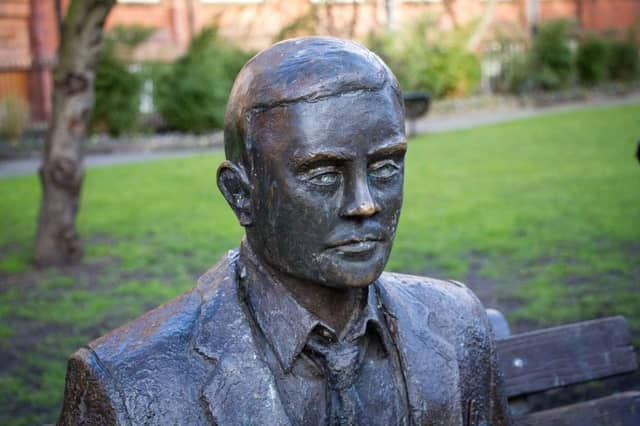
“My Hometown Borrisokane” also mentions some of the prominent buildings in the town and some of the notable features. One of the features is a stone bench in the Town Park which honours the local link with World War Two codebreaker Alan Turing.
Turing is one of the famous people associated with the town. Others include the actor Martin Sheen, and silent filmmaker Rex Ingram (who spent a number of formative years in the town while his father was Rector there).
Turing is the pioneering computer scientist who cracked the German ‘Enigma’ code during the Second World War. Breaking the Enigma code was extremely important because it allowed the Allies to intercept and decipher secret German military communications. This intelligence gave the Allies a number of crucial, tactical advantages, including during the Battle of the Atlantic. It’s said that breaking the Enigma Code shortened the war by two to four years, saving millions of lives. Turing is often referred to as being the father of theoretical computer science and artificial intelligence. A film about his life, ‘The Imitation Game’, was released in 2014.
Turing's mother was Ethel Sara Stoney (1881-1976) of the once prominent Stoney family who lived just outside Borrisokane at Tombrickane, Kyle Park. The Stoneys were for centuries the biggest landlords, not just in Borrisokane but in all of North Tipperary, where they arrived in the late 1600s. They had land in the parishes of Borrisokane, Lorrha, Terryglass, and Nenagh in the Lower Ormond barony.
The family left North Tipperary in the first half of the 20th century. Their ancestral seat, Portland Park House near Lorrha, was burned down by an armed group on May 10, 1938. Part of their legacy remains in the old Kyle Park Agricultural School near Borrisokane. Built in 1843 by Thomas George Stoney, it was one of the first agricultural schools of its kind in Britain and Ireland. Accommodating around 80 boys and 50 girls, it featured attached farmlands where senior boys were taught practical agriculture alongside standard literary and religious instruction. One of Thomas George Stoney’s eight children was Edward Waller Stoney, who went on to become a brilliant rail engineer in India and a Companion of the British Empire. Ethel Sara was one of the four children of Edward Waller and his wife Sarah Crawford. Ethel Sara was born in Madras, India, but spent her childhood in the Borrisokane area, as well as in Clare. She married Julius Turing on October 1, 1907, at St Bartholomew's Church on Clyde Road in Ballsbridge, Dublin; before moving to London, where Alan was born.
Alan Turing (1912-1954) achieved a phenomenal amount of scientific breakthroughs in his relatively short life and he is acknowledged for laying the groundwork for much of modern computer science.
The stone bench in Borrisokane Town Park was originally the top step to the entranceway of the now demolished Arran Hill House, once residence of the Stoney family. It was brought from there to the park in 2020 in a project led by Borrisokane man Seán Egan, who wanted to honour the local connection with Turing. Under Seán’s direction a plaque was also erected beside the bench, explaining its provenance.
According to local historian Eamon Slevin it was on this stone that the local rebels during the 1798 Rebellion laid their weapons after a call to disarm by the Stoney magistrate. A large cache of pikes, firearms and other weapons were left overnight on the steps outside the magistrate's house and were, perhaps, subsequently buried in a field.
The bench is now often sat on by locals during a walk in the park, and as they rest and enjoy nature’s beauty they perhaps also think about Borrisokane’s connection with this very famous and important scientist.
Alan Turing never actually visited Ireland during his lifetime, but in spite of his British upbringing he maintained a connection to his mother's roots through a fondness for the Irish ballad "Molly Malone," which was known to be his favourite song.
Turing’s end came tragically on June 7, 1954, when he died of cyanide poisoning in his home in Wilmslow, Cheshire, at age 41. His cleaner found him dead in his bed, with a partially eaten apple resting on his nightstand. After a 1952 conviction for "gross indecency" due to his homosexuality, he was forced to choose between prison and chemical castration. He chose the latter. The coroner ruled his death as suicide by cyanide, though the apple itself was never officially tested. His mother Ethel Sara strongly disagreed, arguing that his death was the result of the accidental ingestion of cyanide fumes from one of his amateur home experiments.