

An Colún: Why the traditional graveyard is preferable

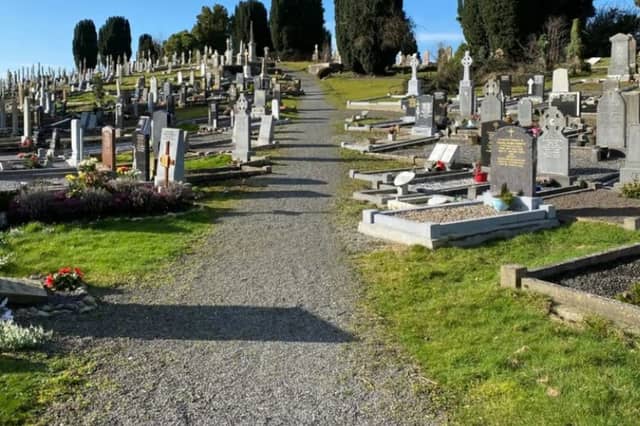

We shouldn’t ignore the centuries of tradition that have gone before
Graveyards are beautiful places to visit, places of thinking about life and the afterlife, providing a peaceful environment and a welcome opportunity to zone out from the worldly concerns and hurrying nature of our society. People who visit them can feel philosophical, mystical and briefly set loose from the fashions and obsessions, the rules and conventions of our world.
In the 17th Century cutlery was sometimes designed with a skull and the words “Memento Mori”, which means “remember that you must die”, a sort of “Carpe Diem” (“seize the day”) that encouraged the owners to reflect upon making their lives more decent and more Christian and to reflect upon the fact that worldly wealth and worldly power fade away as well. “Memento mori” wasn’t a morbid thing. Instead, it was a positive thing, calling upon us to rise above trivial, stupid or immoral concerns, and instead live with the intent to express our souls, and enjoy the beauty and love all around us.
I was in a very old graveyard recently where a slightly raised section had the feeling of a tumulus. Scattered about on this “tumulus” were the leaning headstones of several 18th Century graves. The grass was uncut in this section, the unkempt nature of which added to the aesthetic charm of the place. The graveyard was divided into two distinct halves. In one half were the old grave stones and in the other were the contemporary black marble headstones. From an aesthetic point of view I preferred the older stones, with their weatherworn and characterful appearance, and didn't like the black marble, which was too cleancut and shiny for my tastes. I often prefer the aesthetic tastes and choices of previous generations when compared to our own. I certainly prefer older cemeteries when compared to our contemporary, Americanised lawn cemeteries. County Councils across Ireland are now rolling out lawn cemeteries and have turned their back on the traditional graveyard. These lawn cemeteries are directly inspired by the United States. It always strikes me as a strange contradiction in Ireland that we frequently criticise the politics of the US but we happily embrace some of their less desirable fashion choices. The lawn cemetery concept was pioneered by Adolph Strauch, a German landscape architect who emigrated to the US. In 1859 Strauch redesigned Spring Grove Cemetery in Cincinnati, Ohio, transforming the traditional, cluttered, and walled-in Victorian graveyards into open, sprawling parklands.
Clonoghill cemetery in Birr is a good example of these contrasting approaches. Several of my relations are buried in the old cemetery in Clonoghill, a place that I enjoy visiting, because it is atmospheric and tastefully designed. There are also a lot of old-style headstones in Clonoghill and thankfully not too much black marble. It is surrounded by a stone wall, which looks well. A considerable part of the cemetery is on a slope and there are very fine views of the surrounding pasture land and woodland, beyond to the long, purple line of the Slieve Bloom Mountains. There are many yew trees in the cemetery, which is an ideal tree for graveyards. Yews and cedars are sometimes planted in cemeteries because of the symbolic meaning. They symbolize eternal life. Pines also signify immortality while willows serve as a perpetual mourner. Yews are famous for being long-living. There is a yew in North Wales which is about 4,000 to 5,000 years old. The atmosphere which yews emanate is mysterious. They remind one of entities that are majestic and wise. A poet said of the tree that it has a “form and aspect” which is “too magnificent to be destroyed.” The Celts believed that yew trees had magical powers; therefore, the trees were sacred to them. Druids used yew trees in the making of important ritual objects. The Celts crafted bows, spears, dagger handles from yew in the hope that they would inspire strength and courage in those who carried them. They associated yews with immortality, rebirth, transformation, protection against evil, connecting to one's ancestors, tenacity, etc. Yew trees were sometimes placed on the north side of church cemeteries because it was believed that was where the devil's door was situated and they would protect the dead from the devil and his demons.
The contemporary lawn cemetery in Clonoghill lies across the road, opposite to the traditional cemetery. At the entranceway is a Council sign stating a number of rules, creating a rather unfortunate, cold and proscriptive impression. The lawn cemetery is very large and highly manicured. There are no stone divides between the graves, which creates an unwelcome sense of homogeneity, and the bare concrete wall encompassing the space is a terrible choice. Thankfully a number of yew trees have been planted which makes the cemetery less stark than it used to be. In fact, because some “softening” work has gone on I am more positive about the cemetery than I used to be, but I still prefer the traditional graveyard across the road. I think it is very important that when we construct new places we should, as often as possible, not turn our backs on the centuries of heritage that have come before, we should not turn our backs on our ancestral memory and wisdom. Compared to the contemporary restrictions, it is the variety of styles in older graveyards that lend them their charm. The craft of the stonemason is evident in the Celtic crosses, in finely sculptured altar tombs and in table top slabs richly carved with spirals and Celtic motifs. Sadly, Council bye laws now stymie creative expression of this nature.