

INTERVIEW: Offaly based sculptor seeks the beauty hidden in wood

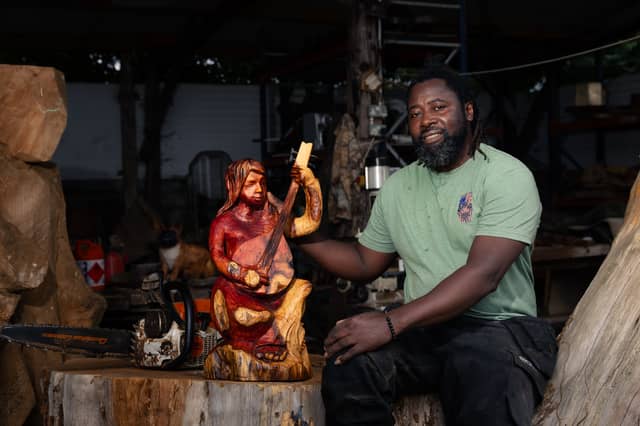

Acclaimed sculptor Paradzai Havatitye lives in a rural area between Birr and Roscrea. He's spent most of his life living in the countryside and says the beauty and peace of the Irish landscape fuels his creative drive.
Acclaimed sculptor Paradzai Havatitye lives in a rural area between Birr and Roscrea. He's spent most of his life living in the countryside and says the beauty and peace of the Irish landscape fuels his creative drive.
He grew up on a farm near the town of Mvuma in central Zimbabwe. “I was reared by a loving mother and father in the rural village of Chirumunzi. My dad was called Lazarus and my Mum Feliztus. Dad had a demanding, high-powered job in Mvuma but he burned out from it and left it, returning to Chirumunzi to work on our farm where I worked with him from a young age.”
It was a big family. Paradzai (who's known to many as Para) was the second last of eight siblings. They spoke Shona, the most common language in Zimbabwe. He said “Paradzai” is Shona for “destroy”, and “Havatitye” is Shona for “they are not afraid of us”.
He loved growing up in the village. “We fished, we worked on the farm. We used to walk or run to school every morning (and back in the evening), a distance of 12 kilometres one way. When I got home in the afternoon I would often look after the animals on the farm. It was very healthy for your body and good for your mind because you were out in nature a lot. ”
There are many wood carvers in Zimbabwe but stone carving is an even stronger tradition in the country. “One of my uncles was a stone carver,” said Para, “and I started stone carving at home with him before I tried my hand at wood. I learned a lot from my uncle.”
In his late teenage years Para felt he had a calling to be a priest. With that in mind he moved to a Mission in Mvuma. The Mission was called Driefontein. Para was very happy there but after a few months he experienced a change of heart. “There were workshops there and it was a creative place. Influenced by this I decided I would be a wood carver. I also discovered that I really loved drawing. I asked one of the priests if I could change from training to be a priest to wood carving. He was very supportive and said of course I could.
“I spent three very happy years in Driefontein and finished in 1996. My wood carving teacher was a remarkable man called Cornelius Manguma who was very encouraging and very knowledgeable. One of the things which made a big impact on my artistic training was when Cornelius got us to lie down in the grass with our drawing boards and pencils and asked us to look at the clouds. He said, Draw three things in the clouds that you can see before they change. This was a powerful exercise. He was teaching us how to use our imagination.”
Para came to Ireland in 1997 because of Fergus Costello, the acclaimed woodcarver from Cloughjordan. Fergus invited the young Mission student to work with him. Para's been in Ireland ever since.
Para says he's “married to a lovely Irish lass”, Noreen, and is “a proud father of three boys,” the eldest of whom, Simba, also has an interest in woodcarving.
As one of the guides for his work this famous quote by Michelangelo resonates with Para: “The angel is already in the stone. It is the job of the artist to remove just enough of the material to release her.” He says it's “a great quote and when I visited Rome some years ago it was wonderful seeing all those fantastic sculptures by many great artists, including Michelangelo. I bear Michelangelo's advice in mind when I am looking at a rough piece of bog yew, bog oak, beech or whatever. I forget that it is a rough piece of timber. I pick up the piece of timber, carefully examine it from all sides and visualise something that is not yet visible to the naked eye.”
Para carves with hammer and chisel and with chainsaws. The chainsaws allow him to tackle very large sculptures, often considerably taller than himself. There are many public examples of his work throughout Ireland.
He's been teaching for 24 years. “I'm employed as a teacher in LOETB in Portlaoise and in Tipperary ETB, which means I work three days a week in Portlaoise and two days a week in Roscrea. Teaching has taught me a lot about Irish culture because I have taught all sorts of people including members of the ICA and Men's Sheds and travellers. I've also taught many refugees.”
Para has always loved living in Ireland and continues to do so. “There's a lot of talk about rising racism and discrimination. I have never experienced anything like that from the Irish people and I am not experiencing it at the moment. I've always found people here very friendly and decent.”