

Offaly GAA in mourning at death of hurling immortal

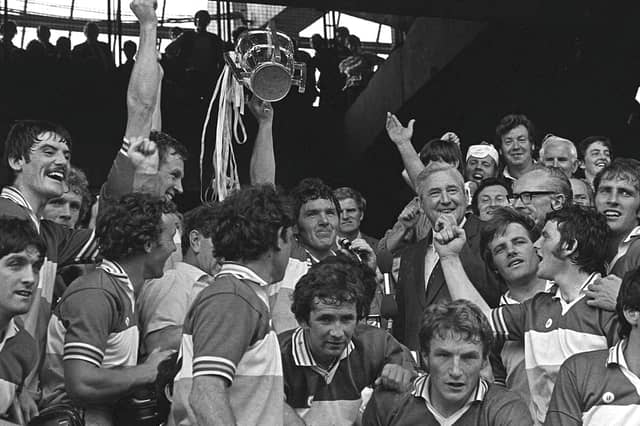

Horan was Offaly’s captain and spiritual leader in 1980s breakthrough years
THE death has taken place of one of the great, immortal figures of Offaly hurling. Captain of the Offaly team that won their first Leinster and All-Ireland Senior Hurling Championship title in 1980 and 1981, those distinctions alone would have assured Padraig Horan of a lasting place in Offaly GAA folklore but his contribution went infinitely deeper than that, possessed many more strands.
A fiercely proud St Rynagh’s man, Horan was a true giant and he was absolutely instrumental to Offaly’s hurling breakthrough in the 1980s. He was the full forward and captain and he was a true leader in every sense of the word. His passion and drive was inspirational but more importantly, he delivered with a series of ultra committed, excellent displays on the big day.
He was the free taker and his capacity to deliver on the biggest occasions when the pressure was at its most severe earned him national fame. In 1980 and 1981, he was one of the team’s elder statesmen and a great example to an outstanding generation who had begun to emerge from the mid 1970s.
Horan, his fellow St Rynagh’s stalwart Damien Martin and the gifted late Kinnitty stylist, Johnny Flaherty were older than outstanding performers such as Eugene Coughlan, Ger Coughlan, Pat Delaney, Joachim Kelly, Pat Carroll, Mark Corrigan etc. They were all All-Stars but it is fair to say that Offaly would not have won those crucial first titles without the input of the three men who had been around from the tail-end of the 1960s.
An outstanding prospect from a young age, Horan played minor hurling for Offaly in 1966, 1967 and 1968, U21 in 1968, 1969, 1970 and 1971. It is a sign of the times that all of his U21 campaigns were one game ones with Offaly’s challenge ended in the first round. There was a bright beacon of hope towards the end of the 1960s.
Offaly had a famous first National Hurling League win over Tipperary in 1966 and many felt this was a turning point for the game, including an impressionable young Horan, who later said: “I think 1966 was the start of the rise of Offaly hurling. We felt after that we could compete with anyone in Birr and we always got good results against any team coming to Birr. When I came on the scene afterwards, we always targeted teams that we would bring to Birr and we always beat them in Birr. That gave us the confidence to go on and become the team we did.”
Offaly lost to Dublin by a point in the 1967 Leinster U21 hurling final and they ran Kilkenny close in the 1969 Leinster senior hurling final. Damien Martin and Johnny Flaherty were on that team while Horan also emerged onto the senior team that year. He made his league debut in a league loss to Kilkenny in ’69 and played three league games that year but didn’t feature in a championship campaign that saw them eliminate All-Ireland champions Wexford before just coming up short against Kilkenny. Unfortunately, several of that team were in the veteran stages of their career at that stage and Offaly were not able to immediately build on it.
Instead, they had to wait just over another decade plus for the first Leinster title and the county endured some dark, horrible days and defeats in the 1970s but 1969 showed that they could compete with the best and it gave the young players a straw to grasp on. The nadir in the 1970s was reached when Offaly beat Wicklow by 0-3 to 0-1 in a notorious National Hurling League win over Wicklow in Aughrim – Horan was the centre half back that day and the team included Damien Martin, Joachim Kelly, Pat Delaney and Pat Carroll, who were to be household names within a few years.
Eugene Coughlan and Pat Delaney made up two thirds of the half forward line along with Joachim Kelly and a rearranged team was pivotal to the successes from 1980 onwards. Coughlan and Delaney were magnificent at full and centre half back in the 1980s wins and Horan had rejuvenated himself as the leader of the attack at full forward. He had played wing back for Offaly from 1972, he went to centre half back in 1972 and remained there until 1977, apart from a couple of games at midfield He played his first game at full forward in a 1977 league loss to Clare and this remained his position until the end of his county career.
While he will be remembered in Offaly for his exploits at full forward, many feel that centre half back was his best position. He was a teak tough hurler, as hard as nails, didn’t suffer fools gladly and didn’t take any prisoners as winning the ball and moving it on was paramount. He had taken some long range frees from defence but became the side’s main free taker when moved forward and he was deadly accurate. He also got several important scores from play - he got six points, five from frees, in the 1980 Leinster final win over Kilkenny, he got two points from frees in the 1981 All-Ireland final come from behind win against Galway but his contribution was immense. He rallied the forces as Offaly hunted down a 0-13 to 1-4 half time deficit and won the late free that he pointed to put Offaly three ahead late on as Galway wondered what had hit them.
He scored 2-2 from play in an extraordinary 3-20 to 6-10 win over Laois in the 1981 Leinster semi-final on a day when Offaly’s dreams very nearly came apart. Laois were very close to Offaly in that era but their neighbours had that little bit extra and were able to edge their big games. However, they sailed very close to the wind in that 1981 semi-final, conceding six goals and crawling over the line. Paddy Kirwan got the winning point from a huge free and one of Horan’s goals is entrenched in county folklore as it clearly went wide but entered the net through the side. Johnny Flaherty immediately started celebrating, Horan also shouted at the umpires to award it and in the mayhem, the umpire raised the green flag.
Horan never made any attempt to deny that Offaly had pulled a stroke that day, admitting years later: “The game was very tight and I remember cutting inside and having a bullet of a shot that went just the wrong side of the post. I remember being absolutely disgusted with myself and then I heard Johnny Flaherty shouting and looking to claim a goal. The umpire had ducked and the shot went through the side netting so when he looked up it was in the back of the net so he gave the goal. Anyone who has asked me about it since I have told them the true story."
A year earlier, Offaly’s Leinster final win over Kilkenny proved to be an occasion of great sadness for Horan. A few minutes after becoming the first Offaly man to receive the Bob O’Keeffe Cup, he got the devastating news that his father Thomas had died suddenly while listening to the late stages of the game on radio. He was only in his late 60s and Padraig Horan revealed: “He was listening to it on the radio in the kitchen but when the excitement got too much, he went out to listen to it on the car radio. Then my two sisters' children, Laura and Greg went out to the car. They came back in to tell my mother that my father appeared to be asleep in the car but my mother knew what had happened. We're all very shocked but the fact is he probably died a happy man. He died just as the final whistle was going. He knew we had won.”
As he motored through his 30s towards the 40 mark, Horan continued to put his shoulder to the Offaly hurling wheel, collecting a second All-Ireland Senior Hurling Championship medal in 1985 – by this time Pat Fluery was the captain. He got three points in the 1985 All-Ireland final win over Galway and that was a hugely important one for Offaly. That team needed a second one to truly prove their greatness while they had been badly hurt when they were mauled by Cork in the 1984 All-Ireland senior hurling final. Played in Thurles because it was centenary year, Offaly were favourites but the whole occasion got to them and a Seanie O’Leary inspired Cork beat them by 3-16 to 1-12.
While Cork were hidden away preparing in a local Convent, Offaly players were mingling with thirsty supporters in Hayes Hotel and Horan admitted that Offaly got it wrong that day, saying: “We let ourselves be made favourites and that was suicidal. Cork picked their team to hurl us. It was a day I would loved to have been at centre back. I was worried from the moment we left in the bus from the hotel. It was like a carnival atmosphere and some were too confident. I knew we were in trouble. We didn’t get the breaks. It was a game we might have won but then if we did we mightn’t have won in ’85 – these things tend to balance out.”
They certainly provided the right answers in 1985 and Horan drew the curtain down on his long career in 1986, bowing out after the Leinster final loss to Kilkenny. He ended a sensational county career with 151 competitive league and championship appearances, two All-Ireland senior hurling medals, four Leinster senior hurling ones, 1980, ’81, ’84 and ’85 and a richly deserved All-Star when the end line was in touching distance in 1985.
He epitomised all that was good about Offaly hurling, providing the perfect mix of skill and toughness and will be remembered for his hurling exploits but he was also an excellent footballer in his youth. He played U21 football for Offaly in 1970 and 1971 and played one National Football League in 1971, coming on as a sub in a draw with Kildare – meaning that he makes a considerable but very distinguished group of players to play senior hurling and football for Offaly. The Offaly senior football management was interested in having him on board in 1972 when they won their second All-Ireland senior football title but hurling was his true calling and he was always going to concentrate on that.
He did enjoy playing football. He captained the Cloghan based St Rynagh's Football Club to a Minor Football Championship title in 1968 and won an intermediate football medal with them in 1986. He took a genuine interest in the well-being of football in the parish and was a selector when St Rynagh’s won the Intermediate Football Championship in 2010.
He was a huge performer for St Rynagh’s during a golden era as they dominated Offaly hurling in the 1960s and 1970s. An amalgamation of the clubs in Banagher parish in the early 1960s, St Rynagh’s won their first senior hurling title in 1965 and their emergence was one of the things that really transformed Offaly hurling. One of the clubs in existence around the time of St Rynagh’s Hurling and Football Clubs being formed was Ballivor and Horan came from this area, as did another great Offaly hurler in the 1960s Barney Moylan. Moylan hurled with them and a young Horan pucked balls out to them at training but St Rynagh’s formation changed a lot more than their own parish – with St Rynagh’s football based in Cloghan and hurling in Banagher. Had Ballivor and other clubs stayed in existence, it would have been harder for Horan to emerge and the Offaly club scene would certainly have been much different.
They won further titles in 1966, 1968, ’69, ’70, 1972, ’73, ’74, ’75, ’76, 1981, 1982 and 1987, along with more in the 1990s 2010s and their last in 2021. Horan won the first of the first of his 11 senior hurling medals in 1968 with the last in 1987. He won Leinster club senior hurling medals with them in 1970, 1972 and 1983. They lost to Roscrea in the first All-Ireland club final in 1971 and one of the big regrets of his career was when Lougheil of Antrim beat them in a replayed final in 1983.
He was involved in a stand-off over the 1978 county final fixture between St Rynagh’s and Kinnitty. Kinnitty initially refused to play as a player was getting married around that time and they had a couple of injuries. St Rynagh’s initially insisted on the final going ahead as fixed – when County Board chairman Fr Sean Heaney asked them if they wanted the cup to be left down to them on a Monday night, goalkeeping hero Damien Martin replied: “I suggest you offer it to us and then see whether we take it or not.”
They eventually agreed to it being refixed but Horan was sent off playing for Offaly against Wexford in Gorey before it was played – he was a tough hurler who played close to the edge, not shy about pulling hard on the ball and it did mean that he got sent off on rare occasions in his career. Suspensions applied for both county and club games then and on that occasion, both Kinnitty and the Fixtures Committee agreed to St Rynagh’s request for a postponement. When it was eventually played, Kinnitty had a 1-8 to 0-6 win, ending their losing streak after being beaten in the 1976 and ’77 finals and kick-starting their most successful era ever as they broke St Rynagh’s dominance and won other titles in 1979 and three in a row from 1983 to 1985: Some of the tussles between St Rynagh’s and Kinnitty were not for the faint hearted, with players regularly sent off and occasionally a few in the one game. A young 1990s hero, Billy Dooley saw some of them, describing them years later as “slaughter battles”, and it was certainly a memorable era in the Offaly club scene.
As you would expect, the end of his playing career was not the end of his hurling life and he quickly became a very successful manager. As the great team of the 1980s went into decline and an outstanding generation from the All-Ireland minor hurling champions of 1986, ’87 and ’89 emerged onto the scene, Offaly went through managers with indecent haste. Kilkenny man, Georgie Leahy, Pat Joe Whelahan and Paudge Mulhare all had very short terms while Horan got two years in 1991 and 1992, leading Offaly to their only National Hurling League success in 1991.
He managed Birr for a spell in the 1990s as they emerged from a long famine, guiding them to Offaly, Leinster and All-Ireland club titles in 1995 - they embarked on a remarkable era of club dominance after that.
Horan played a major role in the development of Offaly’s second great hurling team in the 1990s. A woodwork teacher in Birr Community School, several of the stars of the 1990s went there and Horan had a big influence on their emergence. Birr CS won the All-Ireland colleges senior hurling title in 1986 and Horan helped coach many of these players with Cork import Br Denis Minehane having a major role, along with others.
He also managed St Rynagh’s for a couple of different spells in the 2000s but they couldn’t break Birr’s stranglehold. He was the Laois hurling manager for a period in the 1990s but resigned in 2000 after some players refused to play. He managed Offaly U21 hurlers in 2007 and 2008 as they lost Leinster finals to Dublin and Kilkenny.
He ran for the Dail under the Fine Gael ticket in the 1984 by-election following the death of Fianna Fail’s Ber Cowen. He got over 18,000 votes but discovered there was no such thing as a GAA vote as Cowen’s son Brian won a comprehensive victory, securing over 26,000 first preferences. He also ran for Offaly County Council as an independent in 1999 in the Ferbane electoral area but wasn’t elected.
He has received an abundance of accolades throughout his life. He is in the Offaly GAA hall of fame and was inducted into the national GAA hall of fame in 2007. He served his club well in a variety of capacities and was often an outspoken delegate at County Board meetings. As Offaly hurling declined after the 2000 All-Ireland hurling final defeat by Kilkenny, he occasionally spoke passionately about shortcomings in the coaching structures and support for schools. He was a terrific ambassador for Offaly hurling and just this year, he featured in a captivating TG4 Laochra Gael programme.
A real giant of a man, he was tough, straightforward and called a spade a spade. He was a very impressive man and lived life well.
Struggling with Parkinson’s Disease in recent year, Horan and wife Carmel spoke with great humility about the impact this had on their lives. In his 70s, he is known throughout the country for his hurling excellence but there is of course another private side to the man, known only to his wife, children and close friends. There is Padraig Horan, the father and husband, brother and son, the man with the gentle wit and endearing humanity.
He leaves a treasure chest of great hurling memories, a vast legacy to his native county and parish and there is one certainty: Padraig Horan’s name will remain a familiar one for a few generations to come.