

Kinnitty GAA Club make profound tribute to iconic Offaly hurling figure


Famous club has made fantastic contribution to Offaly hurling story
KINNITTY GAA Club have made a profound and moving tribute to a man whose name lies below the radar but who deserve to be up in lights along with the more modern figures who became household names in the 1980s and '90s.
His name may also be an unfamiliar one on his home soil where men such Pat Delaney, Ger Coughlan, Johnny Flaherty and Mark Corrigan, along with Paddy Corrigan, occupy a place high up on the pantheon of Offaly hurling greats.
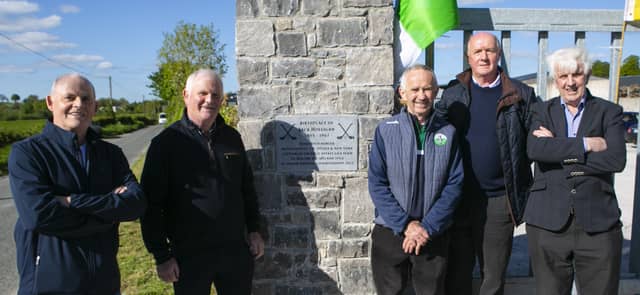
However, Jack Holligan's part in the remarkable Offaly hurling story was a brief but pivotal one and it was only fitting that his home club recognised this in a recent ceremony that was tinged with meaning and symbolism – a commemorative plaque was unveiled by the club at his birth place outside Kinnitty village.
Delaney, Coughlan, Flaherty and Mark Corrigan were star players on the Offaly side that won their first Leinster and All-Ireland senior hurling titles in 1980 and 1981. One of Offaly's great clubs, the name of Kinnitty stirs up glorious memories of fantastic hurlers, who possessed the right mix of beautiful skill and innate toughness.
Their contribution to the great team of the 1980s was massive. With four on the starting line-up in 1981, they had the highest representation of any club and their influence was shown in all its glory in the decisive late goal in the All-Ireland final win over Galway. Centre back Pat Delaney made a storming run up the field before passing to Lusmagh's Brendan Bermingham. Bermingham set up Johnny Flaherty and the goal from the late Kinnitty maestro put Offaly ahead, with time ticking away as they left a shocked Galway reeling.
Delaney, Coughlan and Corrigan were joined by Mark's brother, Paddy Corrigan for the repeat win over Galway in the 1985 All-Ireland final win and Kinnitty hurling was at its strongest from the late 1960s through to the end of the 1980s, before they entered a decline that has not been arrested – affected by population issues, they have done terrifically well to stay in senior hurling and have often threatened to take big scalps.
Pat Delaney was the national hurler of the year in 1981 and won an All-Star in 1985 while Ger Coughlan won All-Stars in 1981 and 1985 and Johnny Flaherty and Mark Corrigan both picked up awards in 1981.
Before the exploits of Flaherty, Corrigan, et-al, the road had been paved by a great generation of old hurler – and their exploits deserved to be mentioned in the same breath as the 1980s' heroes. They didn't win the same honours or fame as the heroes from the 1980s but in a way, they contributed to all of this. The excellence of former hurlers ensured that Kinnitty was staunch hurling territory and the 1980s stars grew up feasting on their legend, inspired by their stories.
Jack Holligan was captain of the Offaly team that won their first All-Ireland hurling title, junior in 1923. The final win over Cork was played in 1924 and came during a very turbulent period in Irish history as independence of sorts had just been won from the English and the following Civil War over the treaty created divisions in Irish society that have only just begun to heal fully and disappear from the political landscape – notwithstanding the continued dominance of the Civil War parties, Fianna Fail and Fine Gael.
The Civil War was the reason that final was played in 1924 – Cork personnel, including their County Board chairman, were in jail at the time, interred as they were on the anti-treaty side, and Cork refused to play the final in 1923 as a result. Offaly's initial acceptance of a walkover created ructions in the county and a furious row at a County Board meeting as chairman Lar Molloy (Drumcullen) hit out at the people who had accepted the game.
Offaly changed their stance, stating that they would play the final whenever Cork were in a position to play and they duly beat them, 3-4 to 3-2 on October 12 1924.
History was to repeat itself just under 60 years later and Kinnitty backboned that excellent side. Holligan was the captain while three members of Offaly's first great hurling family, Andy, Bill and Mick Cordial were also key players. The goalkeeper was Ned Hayes while Dick Conway was a sub and midfielder Mick Carroll finished up his career with Kinnitty, winning a Senior Hurling Championship medal with them in 1930 – he initially played with the long extinct Knockhill club, in Kilcormac-Killoughey parish, and threw in his lot with Kinnitty after they went out of existence.
It was 1980 before Offaly won their first Leinster senior hurling title but the breakthrough very nearly happened in the 1920s. Offaly won a second All-Ireland junior hurling title in 1929 while they went close in the Leinster Senior Hurling Championship, losing finals in 1924, 1926 and 1928. Some of the 1923 side played in some of those finals and after 1928, it was 1969 before Offaly returned to a provincial decider, suffering an agonising defeat at the hands of Kilkenny.
Emigration was a major factor in Offaly's brief run at glory ending by the advent of the 1930s. Several outstanding hurlers emigrated, mainly to the USA and Jack Holligan was among them.
Full back in the 1923 success, he went to New York in 1925 where he was a key member of an all conquering Offaly side, winning eleven New York senior hurling medals. He was captain of many of them and those teams included a number of players who would have been county stalwarts had they stayed at home.
Holligan had won senior hurling medals with Kinnitty in 1920 and 1923, when he was the captain - that decade was their first golden era and they also won in 1930. One of his greatest honours was being captain of the USA team that came to Ireland to play in the famous Tailteann Cup in 1928 and 1932 – that USA team was effectively a New York one and their games against an Ireland team initially captured the imagination, attracting huge crowds.
He also played for New York teams against visiting All-Ireland champions, Tipperary and Cork in the late 1920s, early 1930s and he remained active in the Offaly club in New York for years after his retirement. He died in 1967 and was buried in the Bronx – the tricolour was draped on his coffin in recognition of his role in the War of Independence. His cousin PJ Grimes is also buried along side him: a great example of the American dream being fulfilled, Grimes was a phenomenally successful business man in New York and he hurled with Kinnitty before emigrating – Grimes was from Knockbarron, a townland at the epi-centre of occasional disputes between Kinnitty and Drumcullen GAA Club. He was a powerful GAA activist in New York and immersed himself in a variety of emigrant organisations, including the Ancient Order of Hibernian.
Jack Holligan's younger brother Jim was on the 1929 All-Ireland junior winning squad and they were reared at “The Walk”, Kinnitty. Jack was born on August 12 1895, the second eldest of four children born to farming parents, James and Kate.
The commemorative plaque was unveiled at this ancestral home and its location stirred emotions for other reasons – it is now the site of Flaherty Timber, a business developed by the late Eamon Flaherty, a member of a great Kinnitty hurling family who passed away in 2019 – he was a brother of the famous Johnny.
Another touching link with the past was provided by Hubie Bannon, who was involved in the erection of the plaque, is a nephew of Bill and Pat Fox (Drumcullen), who lined out alongside Jack Holligan in the 1923 All-Ireland Junior Hurling Championship Final
Members of the Flaherty family were joined by Kinnitty GAA officials and some of their star players from the 1980s at the unveiling ceremony. Kinnitty's role in the Offaly GAA story is a powerful one. One of the oldest clubs in Offaly, they were formed in 1887 and them and Cadamstown were very important in those difficult early years – a number of clubs came and went in the parish over the decades before Kinnitty was left as the only one standing.
The emergence of St Rynagh's in the 1960s has been widely recognised as a major factor in Offaly making the hurling breakthrough but the late Johnny Flaherty used to hop when this was suggested to him, agreeing but immediately adding the caveat: “What about Kinnitty, we brought the skill to the table”!
He certainly had a valid point about Kinnitty's influence. St Rynagh's won their first Senior Hurling Championship in 1965, embarking on a run of great dominance but Kinnitty won a long cherished one in 1967 and were at their best when Offaly came good. The winners of nine senior hurling titles, their most successful era was in the 1970s and '80s – they were back to back winners in 1978 and 1979 and won a great three in a row from 1983 to 1985. Their last title was in '85 and they were agonisingly close to winning Leinster honours in those years.
Club chairman Willie Boland described it as a “very special occasion” and saying that they are very “privileged” to have figures such as Jack Holligan in their story. He also paid tribute to the Mark Flaherty and the Flaherty family for having the initiative to instigate this commemoration. “It is great to have this to mark the test of time,” he remarked.
Mr Boland revealed that the initiative for this came at a special talk given by former County Board secretary, Brendan Minnock on the centenary of the 1923 success in Birr, and later in Kinnitty.
He spoke about Kinnitty's three golden eras in the 1920s, '60s and 1970s/'80s, stating that it was important that they recognised the '60s and the '80s. “It is no co-incidence that when Kinnitty was at the top of their game, Offaly was at the top of their game,” he insisted. Noting that they won county finals in 1920 and 1923, he pointed out that there was no championships in 1921 and '22 because of the Civil War.
Mr Boland reckoned that only for emigration and that, Kinnitty would have won a lot more in the 1920s.
He saluted Kinnitty's seven All-Ireland medal winners and talked about the importance of rural clubs providing county stars. He urged people to stay at home and return, saying they should strive to emulate their achievements.
He spoke with pride about their seven representatives on the 1923 squad, including Mick Carroll – nothing that his great grandsons, Fiacra and Oisin Carroll are now hurling with Offaly and Kilcormac-Killoughey underage squads. “Jack Holligan was probably the most famous of that seven. He became a huge GAA person in New York,” he said, noting that that Ned Hayes grew up across the road from the Holligan's.
Mr Boland concluded by talking about the powerful run Kinnitty GAA Club and all clubs play in their local communities.
Brendan Minnock then gave a talk on Jack Holligan and his role in the 1923 success.