

THE BIG READ: Durrow Monastic Site and High Cross and the need to ‘box clever’

Should a Mrs Stopford Green be in charge of the OPW asks local historian
Today, the state and all its organs officially embrace the Gaelic revival much heralded from the 1890s to the founding of the Free State and the 1937 constitution. We spend millions on encouraging our language skills.
We promote street names in Tullamore including St Columba’s Place, Norbury Woods, and lately Darach Mór. We halted plans for a hotel in Durrow and ‘luxury houses’ in 2000 and the state bought the site for €3.2 million and 70 acres in 2003. We spent another €3 million (perhaps more) restoring the church and moving the High Cross inside the restored building. Ciaran Mullooly was there in 2003 to report on the purchase for RTE and it was all ‘onwards and upwards’. Except that it wasn’t. Plans for a visitor centre in Durrow were on the drawing board. Minister Parlon was gone from the OPW and the Dáil in 2007 and in 2012 Minister Hayes was there to reopen the conserved church. He was late for the unveiling as someone sent him to Durrow in County Laois. On the day he struck an optimistic note but he knew there were challenges such as access to the Abbey and road alignment in the area. “We will continue to seek funding to drive this process forward,” he said. Showing further signs of his commitment to the project were conveyed also, when at the opening he said he will “look forward to the continuation of conservation works and the expansion of facilities here at Durrow Abbey Estate”.
But that was fourteen years ago.
The house and parklands as an asset to the midlands
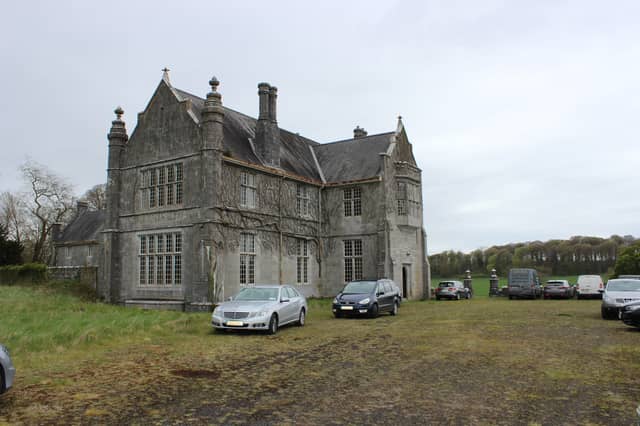
The house the state did not want and leased it (not ‘agreed to lease’ as is more usual pending completion of works or objectives) for a long term and all for what. People have still no access to Durrow and its lands. The High Cross that was accessible for 1200 years has not been available since 2020 and will not be seen this year. Should we move it to Dublin and ask a Bishop Jones (as with the Book of Durrow in the seventeenth century) to take care of it in the National Museum and perhaps erect a few windmills on the hills of Durrow in lieu?
People will say ‘No, of course not’. But for 35 years now, despite many promises very little has been achieved. The house, Durrow Abbey and the parklands, could be a great asset to the midlands and a place to be proud of. Instead, today I read on social media of ‘celebrating Marconi in Westmeath with ‘A Climate house’ and the ‘culture of the peatlands’ and all the right buttons to sustain a flow of capital, if not running costs. Perhaps Westmeath with the help of the parliamentarians in government, will ensure all this comes to pass. In the meantime, Durrow continues literally to rot. The state has paid for the house twice so far – in 1925 following its burning in the civil war (and prompt rebuilding) and again in 2003. The house has greatly deteriorated since it was bought by the state in 2003. The private owners from Norbury to Slazenger, Williams and O’Brien all kept the house and demesne in order. When next naming streets in Tullamore should we not add to Columcille and Norbury, the names of those other patrons who maintained Durrow from their private resources.
Mrs Stopford Green saw the solution for the Durrow monastic site when she visited in 1912, and others like it, as being ‘state ownership in trust for the people of Ireland’. However, it was almost a century before that happened in the case of Durrow, and then it was only under pressure due to the proposal to build a large hotel and extensive housing near the monastic site. After years of obfuscation the OPW acquired the monastic site, the abbey house and 70 acres of land in 2003 for €3.2 million. The minister at the time in charge of the OPW was Laois Offaly TD Tom Parlon and his wishes, with the support of Brian Cowen, ensured the purchase. Minister Parlon lost office in 2007 and his Dáil seat while Taoiseach Brian Cowen retired from politics in 2011.
Plans for the site wilted in the post 2008 period and the files in OPW just grew bigger and after the ‘reopening’ in 2012 things wilted, not helped by dry rot in the church and issues over the lease to a charitable foundation. In 2021 Barry Barry Cowen T.D. announced resolution of a perceived legal blockage:
"I have been in direct contact with OPW officials and have been reassured that the property will now be secured and assessed.
"I have also engaged with the High Cross Committee and will continue to liaise with the OPW to ensure the long-held ambition of the Committee, local community and Offaly County Council can finally be realised in providing the public with access to what has the potential to be a world class facility,'' he concluded.
550 A.D 1185, 2003 and 2012 and all that
Work actually began on the monastic site in late 2004 and it took eight years to restore the church including the moving of the high cross inside the building and restoration of some of the pews. The work on the church was completed in 2012 and the high cross was again viewable by the public. The window of opportunity was short and the ‘curse of Durrow’, manifest since 1186 when Hugh de Lacy lost his head, again reasserted itself with the outbreak of dry rot emerging from the base of some of the pews by about 2015. Since 2020 the church has been closed and remains closed even on ‘Pattern Day’, the feast of Columcille on 9 June. The care of national monuments and the access for the people that was so close to Stopford Green’s heart has not yet been achieved so far as Durrow is concerned. The cross is a national monument and people have a right to see it and to expect that it be housed in safe and accessible conditions.
‘The curse of Durrow’
In truth it would seem that the OPW may never have wanted Durrow monastic site in the first place. The Abbey house was burned by the Republican IRA in late April 1923 in the last such burning in Offaly in the course of a wasteful civil war. The state paid full compensation to the Toler family and the house was rebuilt. It was a house in good order that the state purchased in 2003 and leased to a Peace Foundation in 2005. Suffice to say that unhappy differences arose and the public have not been advised as to the state of things. In the meantime the delay has meant that the house is empty now for 23 years and the cost of restoration will be enormous, and much greater than if a resolution of the difficulty had been prioritised.
Sometimes the churchyard can be visited but there is no advertised access and without access to the interior of the church to see the high cross it can lead only to annoyance and frustration. The state will ultimately pay for the house three times – in 1925 (after the civil war); in 2003 by way of purchase; and again when restoration works are completed. The response in the Dáil to a question put by Carol Nolan, T.D. on Durrow in December 2024 was one of indifference.
Proposals that would draw on new funding, such as that set aside for the so called ‘Just Transition’ after the closure of the bogs, have not been put forward. It is interesting to see the same European Fund being drawn on by the State for renovations (after 35 years) at Clonmacnoise. If only a Stopford Green would take charge of OPW she might invite some of the commissioners of public works and ministers to her famed drawing room chats at 90 St Stephen’s Green and get things sorted. In the meantime we have to ‘Box Clever’ nearer home to finally lay the ‘curse of Durrow’ to rest.