

An Colún: Rising up, praising the days, during Autumn


As we are all expressions of God is it any wonder then that we should wish to imitate our parent and be creative, expressive?
WHEN we feel an impulse to be creative, when we are grabbed by a compulsion to express ourselves in some art form or other we are in a way mimicking the desire which God had to express Himself before the creation of Time and Space.
Prior to the Singularity and the explosion of the Singularity there was nothing but God; but God desired to give expression to Himself and so the universe came into being. He was the first artist.
As we are all expressions of God is it any wonder then that we should wish to imitate our parent and be creative, expressive? Our artistic efforts might be mocked and dismissed by others but there is something of the divine about them.
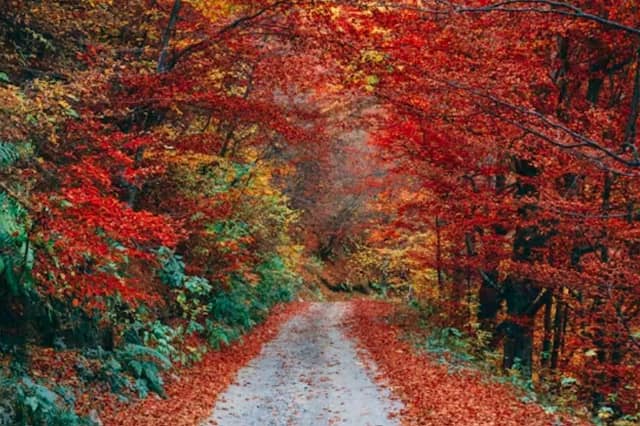
As we walk through our beautiful countryside during the Autumnal months the gorgeous colours of the trees display to us the magnificence of God's artistry.
There are several walks I love doing in the locality during this time of the year. One of them starts near Kinnitty Castle. It takes you past two 19th Century bridges (restored a couple of years ago) spanning the River Camcor, including a very fine and unusual, white suspension bridge, whose entrances are encircled by a porcupine-like design. When they emerge in their full Autuman pomp the deciduous trees lining the path are resplendent in their orange, yellow and ruddy leaves. The path soon after starts winding up and down beside the watercourse of the River Camcor. This is a popular route and you can see why.
Other walks in the locality which are recommended for an Autumnal stroll are Knockbarron woodland near Kinnitty and Orange Hill near Coolderry. It is pleasant to walk in these deciduous woodlands through the tumbling leaves of Autumn, feet rustling through the mounting leaves, the trees an intense display of reds, yellows and browns.
As I walk along I like to recite poems of the season to myself such as Yeat’s famous poem, the first lines of which are:
"The trees are in their autumn beauty,
The woodland paths are dry,
Under the October twilight the water
Mirrors a still sky;
Upon the brimming water among the stones
Are nine-and-fifty swans."
Autumn reminds us of our own decline and death. For those of us who believe that there is something beyond the material reality, we are sustained by our belief as we walk through the autumnal decline. It’s the same belief which shines triumphantly through Bach’s beautiful and uplifting Christmas Oratorio with the lines: “Shout for joy, exult, rise up, praise the days”, where the chorus is accompanied by booming timpani and festive trumpets. I recently came across a very nice, short prayer in Irish which nicely encapsulates the positive spirit, the sustaining belief, which has the aura of a heaven-sent inspiration: “A Chríost, bí mar fomhar dúinn agus bailigh sinn atá scaipthe; neartaigh dóchas i d'earrach ionainn.” In English this is: “Christ, be our harvest and gather us who are scattered; strengthen hope in your spring.”
In a poem called “Autumn” Patrick Kavanagh talks about making “a pillow of leaves - / Leaves yellow and red / Fallen from trees that are dreams / Imprisoned.” We are not sure who the pillow is for; probably for the poet, but perhaps for a lover. The image of the autumnal leaves reminding the poet of imprisoned dreams is a very fine one. The warm glow of the season, the gentleness of resting our heads in a gathering of leaves, stand in stark contrast to life's frequently prosaic and cold manner. Kavanagh continues, in the third stanza, “Mystical Autumn - fulfilment - / Mother of Bread / Young laughter that carries old age / Vanquished.”
On my most recent woodland walk I was reflecting on an interesting chapter I had just read in an excellent book about the history of the forests of Britain and Ireland. On September the 1st 1919, the Forestry Commission was established in the UK. Its task was to supply timber and provide jobs for demobilised servicemen. Unfortunately, the Commission wasn't guided by an enlightened forestry policy. Instead it was driven by commerce and it pursued a policy of afforestation. Its tree planting programme was dominated by non-native conifers, which dramatically transformed the landscape for the worse in many areas. Where previously the landscape had been covered for millennia by beautiful broadleaf trees, now they were populated with faster-growing conifers. Voices of opposition rose up against the transformation, but they went unheeded. In Wales, critics pointed out that forests were no longer “natural” but were “industrial”. One poet wrote that the conifers' “arrogant roots” were “sucking dry the old soil”. These “arrogant” plantations were dominated by Sitka spruce. Ireland followed a similar pattern, where the new coniferous forests overwhelmed many places. The Slieve Felim Mountains, the Slieve Blooms, etc, etc, were planted with vast swathes of sitka spruce, effectively bringing an industrial mindset to very scenic upland areas. Wherever these Sitka spruce forests were planted they were tightly packed, impossible to walk through and lifeless on the forest floor. The trees were also planted too close to watercourses, which meant many of them fell into the streams. Throughout the 20th Century this remained the dominant planting policy in both the UK and Ireland. Voices of objection were often raised but were ignored.