

Tullamore author launches book of short stories to wide acclaim

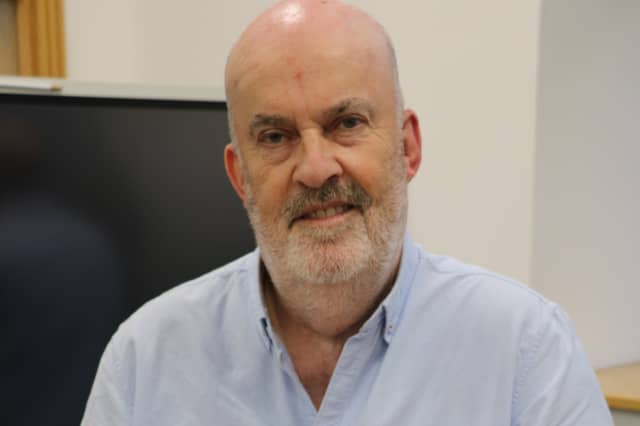

John Saunders. John Saunders is no stranger to literary pursuits. He is a founding member of the Hibernian Writers’ Group and has published two collections of poetry
HOW do ordinary people respond when life asks the impossible of them?
A mother forced to make an unimaginable decision. A refugee searching for dignity. A teenager fighting to be herself. A lonely soul longing to be seen.
In his striking debut collection, John Saunders explores the moments when ordinary lives collide with extraordinary circumstances. His characters face impossible choices, wrestle with grief and guilt, confront prejudice and loss, and discover unexpected moments of hope.
By turns unsettling, moving and darkly funny, these stories reveal the complexities of human nature with insight, compassion and quiet wit. Over My Dead Body and Other Stories is a powerful collection about the choices we make, the lives we lead, and what remains when everything else is stripped away.
Speaking at the launch in the central library in Tullamore last week, local historian Michael Byrne said: “Over my Dead Body is the first book of short stories by John Saunders. John Saunders is no stranger to literary pursuits. He is a founding member of the Hibernian Writers’ Group. He has published two collections of poetry – After the Accident (Lapwing Press, 2010) and Chance (New Binary Press, 2013) – and is one of three featured poets in Measuring, Dedalus New Writers (2012). His poetry has appeared in journals and anthologies in Ireland, the UK and the USA. His short stories have also been published in Ireland and the UK. Over My Dead Body and Other Stories is his debut collection of short stories.
The short story is an increasingly attractive format made famous by Ireland’s Frank O’Connor, Mary Lavin, William Trevor and, of course, James Joyce in his Dubliners. More recently some of the top fiction writers such as Alan Bennett, have turned to the format of the long short story – am attractive option from the readership and sales perspective in an image-driven busy world.
This Saunders book of short stories he explains as exploring the moment when ordinary lives collide with extraordinary circumstances. His characters face impossible choices, wrestle with grief and guilt, confront prejudice and loss, and discover unexpected moments of hope. That is certainly true of the first story in this collection, ‘A matter of life and death’ where Emily has to choose between saving her friends from certain death and the death of her new baby. The scenario John paints in this dystopian landscape is not so far removed from our thoughts these days with wars and the rumours of war always present.
The we have to confront prejudice and wrestle with significant choices in ‘A question of identity’. John has the support of his friend Sandra and two of his male friends in his transgender explorations which are not at all acceptable at school. Again, complex, but less of an issue in more tolerant places, but brutally dealt with in others.
‘Cocktail’ and ‘Dirty’ provide plenty of black humour while keeping us in touch with contemporary entertainment in bars and hotels. Here, two young women assert themselves and overcome trying circumstances in what become funny stories where good wins out. Per contra in the last story in this volume Lily and Skip have found love in a very ordinary unchallenging way while Skip’s parents accept their humdrum, boring lives with equanimity.
“Is there the Joycean paralysis in some of these stories. As someone who confines himself to the dusty shelves of history I marvel at John’s knowledge of society today whether it be upmarket bars and restaurants, hotels or hair salons.
‘Brodsky’ even in its title has an East European feel about it while challenging our attitude to migrants from war torn countries. ‘Guilt’, set in Budapest in part has the serious subject of consent in relationships.
Uncle Jack has me thinking of Gibbon’s Decline and Fall and how upset he would be to hear his six volumes would be used as an allurement in sexual abuse.
There are many aspects of contemporary (since the 1960s) society portrayed in these stories. Some are bleak and others have that Waughesque humour that makes a bad situation tolerable. Such is ‘We laugh at Death’ and ‘Over my dead body’. Who has not been stuck in the mud for what seemed like eternity.
This is a gripping collection of short stories from a writer who is in tune with life as it is lived especially by vulnerable people. It touches the contemporary malaise, in ways all too evident in shocking episodes at Edenderry and Waterford.
We have never had it so good and yet there is an alarming degree of discontent. John Saunders captures the prevailing mood. Some overcome the challenges and others do not. Tolstoy’s stories were said to enable us to understand and appreciate ‘the good man’. Here it is the sad person and how they meet the terrible situations that life can throw up. Sometimes it is about choice but often it is the cards we are dealt. There is loss and gain here and I strongly recommend you to savour these stories and have pleasure in launching the first volume of creative and thoughtful writing.”