

THE LONG READ: Remembering life in an Offaly town when cows were milked in the town centre
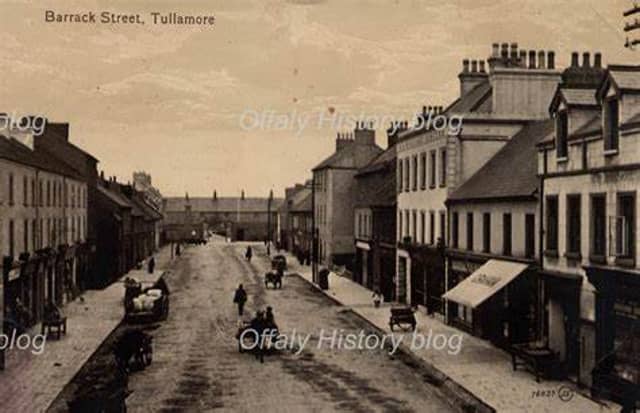

Then and now in Tullamore and the important role of family farms in our future
Back in the 1940’s dairy farmers were called on to reduce their dairy herd numbers to make more land available for tillage crops. The ‘compulsory tillage scheme’ during the Second World War proved a deeply unpopular policy with Irish farmers. Today, dairy farmers are under pressure to reduce herd numbers as a means of protecting biological diversity, water quality soil integrity and reducing carbon emissions.
The following extract from a newspaper article in regional newspapers (possibly the Midland Tribune and/or the Offaly Independent) – 10 June 1944, ‘Till or Go to Jail’, tells us that dairy farmers of that time, just like dairy farmers of today, had enormous challenges to deal with. The article stated:
‘A serious situation is threatened in Tullamore in respect of a vital article of diet. Mr John Lloyd, Cormac Street, it is understood, contemplates reducing his magnificent dairy herd to about 10 cows. As is generally well known, Mr Lloyd has one of the finest dairy herds in the country. The daily output of new milk from his dairy is around 120 gals. He supplies a big percentage of the population of the town all the year round. Mr Lloyd’s herd consists of about 40 splendid shorthorn cows and the problem of properly feeding them with properly balanced rations has become an acute one. This is easily understood when the prevailing conditions are considered. In accordance with the compulsory tillage regulations, he states that he has had to till and crop most of the pasture where these cows are ordinarily maintained, and that he finds that he cannot do both and must therefore decide between keeping the law and keeping the cows.’ (Special thanks to Nancy Harrison (nee Lloyd), for this newspaper clipping and permission to re-print it in this article).
It’s not all that long ago, as a young boy growing up in Chapel Street and Clontarf Road in Tullamore, that I witnessed the importance of small family-run animal holdings as a means of supplementing family incomes. During the late 1950’s and early 1960’s, I can remember that somewhere in the region of 200 cows or so were milked daily within the Tullamore Urban District Council Area bringing much needed supplementary economic support to families. In recent years I have watched with great interest the often-heated political debates regarding Ireland’s national herd and nature related matters.
My first encounter with dairying was not more that 30 metres from my birthplace at No 2 Chapel Street. Mrs Heavey managed and milked 25 cows daily at her yard in Chapel Lane – occupied today by Chapel Court apartments. The cows were herded every day, by her right-hand man, Eddie Costello, between Chapel Lane and Heavey’s field on the Daingean Road. Not far from Heavey’s, on the corner of Thomas Street and Store Street, Ignatius Keegan kept four cows. Further up along Store Street on the corner of Convent Road, Sarah Keegan milked about 15/20 cows.
Then just around the corner in St Bridget’s Place, the Parochial House kept somewhere in the region of 12/15 cows – managed by John Black of Emmett Terrace. Mr Black drove the priests’ cows daily to and from the ‘priests’ field’ on Arden Road – today known as Arden Vale housing estate. In Harbour Street, Mrs Murphy kept 2 or 3 cows. And across the road, Paddy Doherty the Offaly Co Council ‘tar lorry’ driver kept about 4 cows. I was particularly familiar with Mrs Murphy’s cows. At that time, I was serving an apprenticeship with Barney O’Connor in the Market Square and Barney used to share me with Mrs Murphy when she needed some chores done. I used to drive her cows to and from Harbour Street to Mrs Murphy’s field down Riverside View – the site of Coughlan Engineering Ltd today. Mrs Murphy would give me sixpence each Saturday and the loan of her bike as part of the deal.
As a mother of four young children, Mrs Murphy was a very enterprising woman and rented out rooms to several professional people, including Nurse Corr – better known as the ‘Jubilee’ nurse who could be seen every day in full nursing regalia of two-tone blue uniform, complete with navy cape and white headdress, on her ‘high-nellie’ bicycle, with wicker basket and carrier, cycling to and from the ‘Dispensary’ in the Old County Home (opposite Davitt Street) on Arden Road. Others who rented rooms from Mrs Murphy included the tailor John Barrett and recently deceased Pattie O’Grady (nee Berry from Killeigh), the dressmaker. As someone who had no particular interest in sport, I was totally absorbed and excited learning a trade and doing chores for Mrs Murphy.
Next, we head around to Patrick Street where popular publican, undertaker and dairy farmer Jimmy Walsh kept 20/25 cows at the back of his premises – occupied today by Sirocco Restaurant. Well-known local man Dinny Dwane was Jimmy Walshe’s right-hand man and could be seen every day driving the cows to and from Walshe’s field at the end of Clontarf Road – the current site of Arden View housing estate.
Just up from Walshe’s field entrance we had John Kearney on the Clara Road. John Kearney kept about 30 cows (and lots of pigs) and will be remembered by many of your readers as he delivered milk door-to-door, seven days a week, from the back of his distinguished pony and cart. I spent many days doing chores for John Kearney and included delivering milk as he went on his rounds along Clontarf Road, into Emmett Terrace and Davit Street on to Callary Street and along Convent View, finishing up at Jack Digans’ pub on the Kilbeggan Bridge for refreshments before returning home to Clara Road where the pony was decoupled from the cart and fed.
On Srah Road, Keegan’s had a very popular dairy – milking somewhere in the region of 30 cows every day. Next we travel up to Cormac Street where Paddy Lloyd (son of John Lloyd in the newspaper clip above) kept 20 cows and a grocery shop in the premises occupied today by ‘Ready 2 Run’ Sports.
Further up Cormac Street, the then ‘Station Master’, Mr Ted O’Brien kept 2 or 3 cows. One of the better-known family-run dairy farms within the Tullamore Urban Boundary area was Deegan’s dairy farm at Clonminch Bridge where P.J. Deegan kept in the region of 30 cows. Deegan’s milk was delivered daily door-to-door from the back of a van by himself and his children before they went to school each morning and after school each evening in all weathers.
Three years ago, I joined a political party for the first time in my life. On Sunday 7th July I voted for Minister Pippa Hackett as leader of the Green Party. Why did I go down that route? Unlike mainstream political party policies that benefit vested interests only, I believe that Green Party policies to date have rewarded everyone in Ireland, regardless of their political affiliation. I strongly feel that Minister Pippa Hackett embodies the quality of leadership rural Ireland needs at this moment in time. She understands women’s issues, children’s issues, rural and urban transportation issues and farmer’s issues.
As a small family-run organic farmer, Pippa Hackett, alongside her husband Mark and their four children, is ideally placed to deliver on the challenges Ireland’s family-run farms face to achieve economic viability while cherishing the restoration of Ireland’s biological diversity – a biodiversity that is crucial to our economic, social, cultural, spiritual and environmental survival going forward. Today I am reminded that her farming background is a modern-day incarnation of the numerous Tullamore families that were houses, clothed, fed and schooled on the back of small family-run farms.
“No matter where we live, we all want the same things. A decent standard of living, a sense of community and security, clean air, clean water – these things are equally important whether we are living in an urban or rural area, on or off a farm.” Minister Pippa Hackett
Today a simple audit will reveal that society is taking more from the natural world than nature is capable of replenishing on an annual basis. This is a sure recipe for bankruptcy of the natural world. This is not preaching this is a scientific fact. According to an article by Barry Murphy in the Irish Farmers Journal – 15 February 2023:
“Unfortunately, and against all current research advice, upwards of 3,000km of hedgerows are still being removed annually by a small number of landowners who are facilitated under the current Department of Agriculture regulations to destroy up to half a kilometre of hedgerow without any assessment or permission.”
This represents a linear area longer than the second longest river in Europe - the River Danube .
As a society we have an obligation to future generations to hand over an intact natural environment that will meet all their needs – this should include wilderness areas. This can be best achieved by ensuring a strong voice on their behalf. With a general election on the horizon in early 2025, and in order to avoid a return to the conflict of the 1940’s when leading ministers were unsympathetic, to small farmers cause, with the then Fianna Fail Minister for Supplies, Sean Lemass, urging ‘3the elimination of incompetent or lazy farmers’, it is essential that Minister Pippa Hackett as well as other Green Party delegates are at the next Government table.
About Tom Roche
Tom Roche – a native of Tullamore, now living in Rhode, is a craftsman, educator and human/environmental rights activist. He founded Just Forests in 1989 as a means of creating awareness of Ireland’s role in the international timber trade and its links to illegal logging, human rights and forest destruction. His latest campaign entitled: SpoArts WASH – Exposing Ireland’s Fossil Fuel Sponsorship Culture, in association with New York-based human rights Attorney Steven Donziger, is gaining international support. You can learn more about SpoArts WASH by visiting this website: https://spoarts.ie
Tom is also an active (non-academic) member of two teacher training networks – the UBUNTU Network based at the University of Limerick and RCE Dublin – the Regional Centre of Excellence in Education for Sustainable Development based in Dublin City University (DCU).
N.B. The writer takes full responsibility for any errors in dates, numbers and locations in this article.