

'I strongly believe that we need to meet each other' says Offaly Presbyterian minister
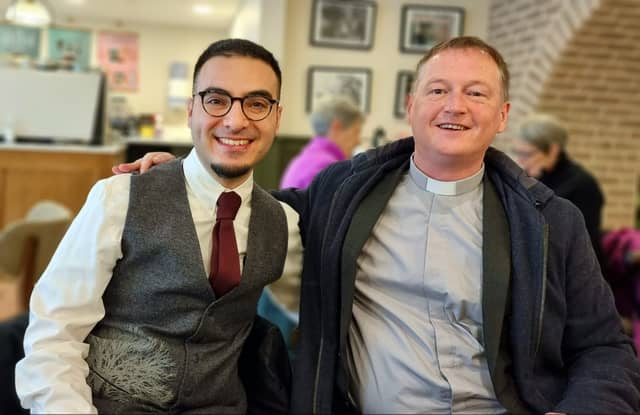

Our friendship with William Hayes, the Minister of the Presbyterian church in Tullamore, began the day we moved to town. We have never felt like strangers since the day we met him. There has never been a hierarchy between us, and I have not hesitated to ask him the most difficult questions that have crossed my mind. In this interview, readers will be able to read about the friendship of a writer and journalist in exile with a priest.
Readers will be able to read about racism, the history and philosophy of Christianity, the earthquake disaster that took place in Turkey and Syria, and much more in this interview.
Cagdas Gokbel: Before I come to the region we live in, I want to talk a little about world politics and philosophy with you. The possibility of a global war seems to have reintroduced racism into European politics. How do you interpret the emergence of racism?
William Hayes: Racism is a problem that lies under the surface of most countries. People have a tendency to trust people who look and sound like them and distrust people who look and sound different.
Racism is always wrong, and it is always a sin against our common humanity made in the image of God. But at various times in history, it has been used by governments or political parties to drive votes or keep the core of a community together against the “others.”
Because of imperialism, Europe has had an element of racism at its core since at least the 1500s. The latest form of racism in Europe is driven primarily by fear. The recession of 2007 and the austerity policies of increasingly right-wing governments created artificial scarcity, especially in services previously provided by governments such as education, healthcare and social housing.
This artificial scarcity has been manipulated by right-wing media to foster a fear of “others.” If we are busy being scared of asylum seekers coming to “steal our jobs” or “steal our houses” then we will forget to look at who the real predators are in this situation, which are the governments (that have abdicated their responsibility to look after the weak in society) and the corporations and billionaires who are growing rich on the government’s austerity policies.
Cagdas: This racism we are talking about has various shades all over the world. It has ties to fundamentalist tendencies in the East. How do you think humanity can deal with this problem?
William: I strongly believe that we need to meet each other. It’s easy to hate Muslims if you have never met a Muslim. It’s easy to hate Socialists if you have never met a Socialist. It’s much more difficult to hate people when you have eaten with them or shared a community with them.
This is one of the big dangers in the Direct Provision system in Ireland. When refugees are zoned off from the general population then it is easier to portray them in a negative light. When they live next door to you then they are no longer “The Immigrants” but they are now Sarah and Mohammed or Irina and Bogdan. It’s much harder to hate the person in front of you than to hate a general category of people.
Cagdas: I have tried to study Christianity from an intellectual point of view in many respects. There are many different interpretations within religions, and it is usual for this to happen. For example, the interpretations that the great writer Tolstoy brought to Christianity are quite remarkable. He displays a strong opposition to the tax system and compulsory military service, referring to the universal brotherhood. How do you think a warlike and expansionist ideology or interpretation emerged from a belief that outweighs the peaceful sides?
William: I’m glad you brought up Tolstoy. In his Confessions, he reminds us that the best way to start with Christianity is not with the structures (which he rejected) or the doctrines (some of which he was sceptical about) but with the person of Jesus. The historical Jesus that we meet in the early Christian writings is such a powerful figure of love and humble service that he undermines the fight for power that we see in many forms of “Christianity.”
You ask how a warlike ideology developed in Christianity and this is an important question because it reminds us that although Christians believe that Jesus is perfect we also believe that everyone else is broken and fallible. The church has a lot to repent of in its history and there is much that we have done throughout history that is wrong.Looking back to the person of Jesus, he is and was so popular because of his great love for people, especially the poor and the marginalised. This was and is one of the most powerful factors in drawing people to Christianity. Jesus calls people to follow him whoever they are and wherever they come from and Jesus changed lives.
From the moment that Christianity as a movement became popular from the 2nd Century onwards the Roman Empire took two approaches to it. The earliest approach was to try to supress Christianity. The message of Jesus that we should love not only our neighbours but also our enemies was anathema to a society based on violence like that of the Roman Empire. Systematic attempts were made roughly two or three times a century to eradicate the faith.
Once Christianity became too large to suppress the next attempt at subversion came from ambitious leaders using the language and respectability of Christianity to further their own ambitions. This was the approach taken from the early 4th Century. From the descendants of the Emperor Constantine (founder of Constantinople) onwards, the church and imperial power became interwoven and this led to the disaster of imperial power being used to “promote” Christianity.
The people in power then used Christianity as a mask to continue on doing the things that they had always done which was to misuse the work of the power and steal from people around them and call it war. The excuses for war changed from the acquisition of territory and goods as it would have been in pagan Rome to the spreading of the faith among people who had different gods. It “just so happened” that the old acquisition of territories and goods happened to also come along with these wars, the same as they did before the advent of Christianity.
The miracle is that at the level of the ordinary people the true message of love, charity, hope and trust in Jesus that is at the heart of true Christianity continued. Church history is a constant tug of war between those who would seek power for its own sake and those who would challenge them in the words of Jesus to “take up your cross and follow me” or who said, “what does it profit someone if they gained the whole world but lose their soul.”
Cagdas: You really do exemplary work at Tullamore. People of different nationalities meet in the church. What are your plans to do better today and in the future?
William: What we could do better would be to involve more ordinary Irish people in the work of welcoming and befriending immigrants into our community. The work is so rewarding and, in many ways, enjoyable. So many people in our community would benefit from the real joy of meeting people from entirely different cultures, hearing their stories and helping them to settle into our community.
Cagdas: You have shown an important solidarity regarding the big earthquake in Turkey and Syria. I thank you for your efforts in this direction. What would you like to say about the people who are experiencing this disaster and your solidarity efforts of this kind?
William: We in Ireland, in the current era, have been blessed with so much in terms of wealth, safety and security and it is only right that we should share some of these blessings with others. We are thankful that, especially in Syria, we had workers on the ground in Aleppo and other areas of northern Syria already involved in humanitarian aid, helping internal refugees and those affected by the war. This meant that they were able to respond quickly with shelters, food and medical supplies for those made homeless by the earthquake.
Cagdas: I think people's social relationships are very weakened. It seems that the social system has enslaved us all to the workplace. It's almost like there's no place where money does not apply. It is a great privilege to chat or have tea somewhere without paying money. In the Presbyterian church, people drink tea, coffee and can have a chat. I find it important that the church is not just a place of worship. We need places where we can build more humanitarian relationships where money does not apply. What would you like to say about this topic?
William: I think for us as Christians who seek to follow the ways of Jesus and not simply carry out “religious duties,” our definition of worship is wide enough that it includes such ordinary activities as drinking tea together with others and making a much-needed communal space in the community where the rules of money and the market do not apply. It was in those ordinary Palestinian spaces, such as by a well or in a fishing boat that Jesus met his disciples and formed relationships with them and so it is in these ordinary Irish encounters of having tea, biscuits (and if we are lucky a scone or cake!) and chat that we should do the same.
Cagdas Gokbel is a Turkish journalist and writer who lives in Tullamore with his wife Emine, a translator.