

Rural Ireland is slowly dying following 'years of poor government'


GAA Congress voted to change rules to make it easier for struggling clubs
Rural Ireland is slowly dying because of a movement from the countryside to larger urban areas and cities, Offaly County Council was told during its monthly meeting by two GAA officials.
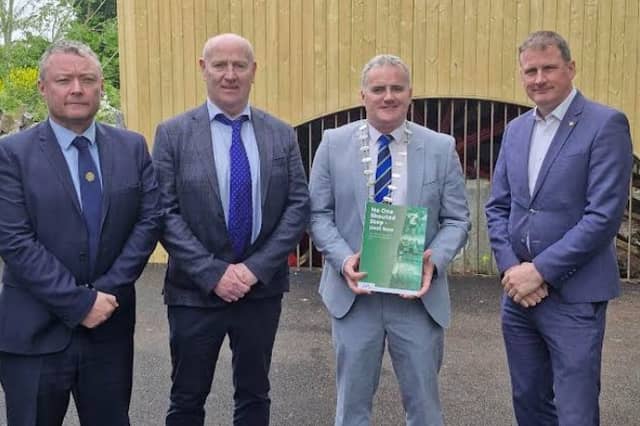
The bleak vision was laid out in an excellent glossy document produced by the GAA which shows a gradual diminishment in population numbers in rural areas, the result being that more and more clubs will either die or be significantly reduced.
The presentation was given by Dr Peter Horgan, the Strategy, Innovation and Insights Manager in the GAA, and Mr Benny Hurl, Chair of the national GAA demographics committee. Mr Hurl told the Councillors that in 2025 the GAA decided to shout “Stop!” to the decline in country areas. “We have a huge imbalance right across the country. It’s not just in Offaly,” he remarked. “Rural is being decimated. Many small communities such as the villages of Offaly are losing out.” He believed the cause is a misguided government policy which is “driving people into the larger towns and cities. 60 years ago two out of three of Ireland’s citizens were living in rural Ireland. Now it is only 30%. We believe the solutions are there to turn this around. We have to find ways to get over this.”
Dr Peter Horgan pointed out that one in three people in Ireland live in the Dublin Commuter Belt. 40% of the population lives in the Eastern Seaboard region. 62% of the population live either along the Eastern Seaboard or in a big town with a population greater than 10,000 people.
He said the reality of these demographics is stark for GAA clubs. For example, just 50 clubs in Ireland have 25% of 0 – 5 year olds in their catchments, which means that for many clubs there will be a lack of members in the future, putting pressure on them to downsize or close.
The meeting was told that 29% of males under the age of 35 are a member of a GAA club in Offaly. 42% of 6 to 11 year old boys are a member of a GAA club in Offaly. “These numbers are higher than the national average,” said Dr Horgan, “however the numbers in Offaly are decreasing. In the last number of years we have seen a huge population shift eastwards in Ireland, and in every county a shift from the rural to the urban.”
He said a meeting of GAA Congress approved (98.5% of the Congress members were in approval), a new ruling which will make it easier for clubs to maintain their club status, a ruling which recognises the reality of the current shifting demographics. "Rule 3.1 of the Official Guide 2025 defines a club as a Unit eligible to participate in a Senior, Intermediate or Junior Championship Competition. However, many rural clubs are under pressure due to declining populations resulting in their being unable to field at adult level. In this scenario, in order to remain as a club, a derogation from rule may be requested from the Ard Comhairle. In many instances, clubs are actively involved in promoting Gaelic games, through participation at underage level, female codes, or as part of group teams yet cannot field independently at adult level – resulting in a breach of rule.” The Congress agreed to overturn this ruling thus making it possible for clubs under pressure to retain their designation as a club.
The Congress also agreed, by 97% that the GAA’s competition structures must evolve. “Standard 15-a-side formats,” remarked Dr Horgan, “are increasingly unsustainable for clubs with limited numbers. Alternative models, including 11- or 9-a-side competitions, blitz style tournaments, and modified rules, should be permitted, with county championships formally recognising reduced formates. In addition, regional and cluster-based competitions would allow small clubs to pool resources and guarantee regular fixtures.”
Dr Horgan also said that the GAA strongly believes that the provision of sporting facilities should accompany increasing population growth areas in urban areas. “This would included establishing guideluines for the provision of open, green spaces per 1,000 residents in urban areas, emulating international best practice such as the UK’s 6 acres standard.”
Cllr Peter Ormond welcomed the GAA report and said it was a step in the right direction. He said numbers are dwindling in many Offaly clubs. “In the past we used to have quite a few large families in the county, quite a few families with a large number of kids, who provided many members of our clubs. Now that is no longer the case. There is also the issue that there’s been a huge growth of interest in minority sports such as Rugby or Basketball. I work in Portlaoise and a lot of the chat on a Monday morning is about what happened in the basketball rather than what happened in the GAA.”