

Offaly columnist remembers St. Mother Teresa of Calcutta
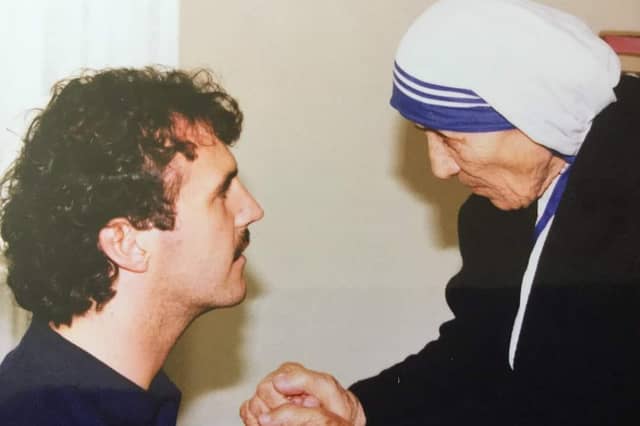

For millions around the world, she remains an icon of compassion, a woman who spent her life bringing love and dignity to people whom society had forgotten
On September 5, 2026, we mark the 29th anniversary of the death of St. Mother Teresa of Calcutta. For millions around the world, she remains an icon of compassion, a woman who spent her life bringing love and dignity to people whom society had forgotten. For me, however, remembering Mother Teresa is deeply personal. I was blessed to know her for fifteen years. I walked beside her in Romania, prayed with her in Ireland and shared quiet moments with her in the Missionaries of Charity convent in Calcutta.
Some of my most treasured memories are of kneeling beside her in the chapel during Mass, sharing her prayer book and missal and listening to her speak and sing. She was not a distant saint frozen in a photograph. She was a woman who carried the world's suffering in her heart and the hope of Christ in her hands. And perhaps her greatest message to us is remarkably simple, 'Love'. But not simply when love is easy. Love until it costs.
Seeing Christ in the forgotten
Mother Teresa had an extraordinary ability to see beyond the circumstances of a person's life and recognise their dignity. Where others saw a homeless person, she saw Christ Where others saw a dying person, she saw Christ. Where others saw somebody who was unwanted, difficult or forgotten, she saw Christ.
She spoke of encountering Jesus in the “distressing disguise” of the poor, recognising that every human being carries the image and dignity of God. Jesus gives us the same challenge in Matthew's Gospel: “I was hungry and you gave me food, I was thirsty and you gave me drink, I was a stranger and you welcomed me.” And then, “As often as you did it to the least of these brothers and sisters of mine, you did it to me.” Imagine if we really believed those words. Imagine if the next person we met who was lonely, struggling, homeless, addicted, grieving or simply difficult to love was not an inconvenience, but someone in whom Christ was waiting to be recognised. Would we speak differently? Would we listen longer? Would we judge less?Would we love more?
'I never judge anyone'
I once asked Mother Teresa how she could receive so many people without judging or criticising them. Her answer has stayed with me, “I never judge anyone, because it doesn't allow me the time to love them.” What a challenge that is in a world where judging others has almost become a pastime. How much time do we spend criticising, complaining, dismissing, cancelling or condemning people? And how much of that time could instead be spent loving? Perhaps this week we could ask ourselves, Who am I judging that God is asking me to love? Who needs forgiveness? Who needs a phone call? Who needs somebody simply to sit beside them and listen? Mother Teresa reminds us that holiness can begin with something as ordinary as refusing to walk past somebody who is hurting.
The “I thirst"
One of my most precious memories of Mother Teresa happened after an exhausting day working with the sick and dying in Kalighat. Late that evening, she walked with me into the chapel. She paused before the crucifix where the words “I Thirst” were written beside Jesus. She looked towards Christ on the Cross and spoke to me about His love. She told me to look at His head, bent towards us; His arms outstretched to embrace us; His heart opened to receive ours. Then she said, “Be only all for Jesus always.” I have never forgotten those words. Mother Teresa understood that Jesus' words “I thirst” were not simply about physical thirst. They were also a cry of divine love, Christ thirsting for our love and for us to become His love for others. And so she went from the chapel to the streets. From Eucharistic adoration to the abandoned. From prayer to service. She received Christ and then went looking for Christ in the poorest and most vulnerable.
The darkness behind the light
Perhaps one of the most surprising things we have learned about Mother Teresa is that behind her extraordinary public joy was a profound spiritual darkness. Her private writings revealed that she experienced decades of spiritual dryness and a painful sense of God's absence. The woman who brought God's love to thousands sometimes struggled to feel that love herself. And yet she continued. She prayed. She served. She smiled. She comforted. She loved.
This teaches us something very important about faith. Discipleship is not always a feeling. Faith is not a promise that life will be easy or that every prayer will be answered in the way we want. Sometimes faith means saying, “Lord, I cannot feel You, but I will still trust You. Please Help me.” Mother Teresa's holiness was not found in the absence of struggle. It was found in her faithfulness in the midst of struggle. Perhaps someone reading this today feels exactly like that, tired, empty, forgotten or far from God. I know I do at times. If so, perhaps Mother Teresa would simply say, "Keep going." You do not have to feel strong to be faithful. Where did Mother Teresa find the strength to keep loving? She found it in Jesus. Her day began with Mass and Holy Communion. She prayed the Rosary and spent time before the Blessed Sacrament. She once said, “I don't think that I could do this work for even one week if I didn't have four hours of prayer every day.” Prayer was not an escape from the suffering of the world. Prayer was what gave her the strength to enter it. She received Jesus in the Eucharist and then went out to find Jesus in the poor. She knelt before Christ in the chapel and then knelt beside Christ in the gutters. Perhaps that is the challenge for us. We cannot truly receive the love of Christ without eventually becoming that love for somebody else.
The poor are not only 'out there'
Mother Teresa's message is not simply about Calcutta. The “poorest of the poor” are among us. They may be sitting alone in a nursing home. They may be sleeping in a doorway. They may be sitting silently at the back of a classroom. They may be the person whose marriage has fallen apart. They may be the person grieving a child. They may be the refugees who wonder whether anybody wants them here. They may be the person battling addiction. They may even be the person sitting beside us in church who smiles and says, “I'm fine,” while their heart is breaking.
Mother Teresa taught us that poverty is not simply the absence of money. There is also the terrible poverty of feeling unwanted, unloved and uncared for. And perhaps this is one of the greatest illnesses of our modern world. We have never been so connected technologically, yet so many people are desperately lonely. We have never had so many ways to communicate, yet sometimes we have forgotten how to truly listen. Mother Teresa asks us to become the person who notices. The person who stays. The person who cares. The person who says, “You matter. You are loved. You are precious to God.” Mother Teresa often reminded us, “Not all of us can do great things. But we can do small things with great love." That is something we can all do. We can make the phone call. We can visit the lonely. We can forgive the person who hurt us. We can welcome the stranger. We can offer a smile. We can listen instead of interrupting. We can notice the person everyone else has stopped noticing. We don't have to change the whole world. We can begin with the person nearest to us. Mother Teresa reminded us that even if what we do feels like a tiny drop in the ocean, the ocean is less because that drop is missing.
How much love?
Perhaps the most important question Mother Teresa leaves us is not how much we have achieved, accumulated or accomplished. It is, 'How much love have we put into what we have done? How much love have we put into our marriages, friendships, neighbourliness and our work? Our families? Our friendships? Our colleagues? Our work? Our communities? How much love have we given to the person who irritates us? And what about the person we have decided is no longer worthy of our love? Mother Teresa challenges us, “People are unrealistic, illogical, and self-centred. Love them anyway.” Perhaps that is where real Christianity begins. Not in loving those who are easy to love. But in learning to love those who aren't.
Thought for the week
As your thought for the week and as we remember St. Mother Teresa, let us not simply admire her. Let us allow her to challenge us. Who is God placing in your path this week? Who needs you to notice them? Who needs kindness? Who needs forgiveness? Who needs hope? Who needs you to stop for five minutes when you are busy and simply listen?And perhaps there is somebody you have been judging whom God is asking you to see differently. Mother Teresa believed that prayer and service belonged together. Prayer gave her the strength to love, and love sent her back into the world. So let us pray. Let us be nourished by God's love. And then let us go out and give that love away. Not tomorrow, but today. As Mother Teresa said, “Yesterday is gone. Tomorrow has not yet come. We have only today. Let us begin.” Perhaps the following prayer which I wrote to go with this piece is maybe the legacy Mother Teresa leaves each of us. Not simply to remember her. Not simply to admire her. But to live differently because we encountered her story. To notice the unnoticed. To love the difficult. To forgive the unforgiven. To serve the forgotten. To pray when we cannot feel God. And to put a little more love into everything we do. Because ultimately, Mother Teresa reminds us, the question is not, “How much did I accomplish?” It is, “How much did I love?” And perhaps, at the end of our lives, that will be the only question that truly matters.
Let me leave you with the following prayer called, "A Love That Never Ends." - "Lord Jesus, You thirst for us with a love that never ends. Through the witness of St. Mother Teresa, teach us to see Your face in every person we meet, especially those who are poor, forgotten, lonely or afraid. Take away our judgment, our pride and our indifference. Give us the courage to love until it costs, to forgive without counting, and to serve without seeking recognition. When we cannot feel Your presence, give us faith to trust You. When our hearts are tired, give us grace to keep loving. May we meet You in the Eucharist and recognise You in the hungry, the homeless, the sick, the stranger and the forgotten. May our hands become Your hands. May our words become Your tenderness. May our hearts become Your compassion. St. Mother Teresa of Calcutta, pray for us. Teach us to be, as you taught me, “only all for Jesus always.” And when our lives are finished, may we have loved enough that somebody, somewhere, can say, “Because of that person, I knew that God loved me.” Amen."