

An Colún: Singing in an attractive, historic Wexford town


"It took 115 years to make this trip,” said the President
William Marshal was one of the most renowned Knights of the 1100s and 1200s, a celebrity of his time, suffused with power, wealth and glamour. He lived from about 1146 or 1147 to 1219 and he was considered to be the epitome of medieval knighthood and "the greatest knight that ever lived".
Marshal rose from being a landless younger son to becoming one of the most powerful and wealthy men in Europe, serving five English kings. In his early life he excelled as a tournament knight and was never defeated. This incredible prowess led him to make a fortune. The word ‘legend’ could easily be applied to him, but in his case the legends were true. For example he was famous for capturing and ransoming over 500 opponents in tournaments. And, well into his 70s, he successfully led the English army to victory at the Battle of Lincoln in 1217, saving England from a French invasion. With his incredible combat skill and his reputation for remaining true to the honourable chivalric code he was given the title "The Flower of Chivalry". Many respected him and even his political enemies praised his character. While all of this was true, there was a dark side; this is after all the Middle Ages we are talking about, a time of sieges and conflicts which required pillaging, razing, and bloodshed. He was also accused of sometimes being arrogant, overly ambitious and prone to a bit of land grabbing. As so often, the truth with famous historical figures such as Marshal was their characters were somewhere in the middle, a mixture of the positive and the negative. The cynic focusses on the negative, the idealist on the positive; both are wrong here because the truth is a mixture of the two versions. For example, he had a strong belief in God; he often practised mercy, sparing the lives of numerous opponents rather than killing them for greed; and he continuously acted as a champion of "Right and the Good" against injustice, including reissuing the Magna Carta in 1217 to unify the English barons and restore peace to England.
The reason I am thinking about William Marshal at this time is because Rosalind and I visited New Ross in Wexford over the weekend and Marshal founded New Ross with his wife Isabel de Clere in 1207. The couple transformed the settlement into one of the busiest ports in medieval Europe and into a booming trade hub for grain, wool, and wine. To ensure the safety of ships sailing up the river to his new port, Marshal also built the Hook Lighthouse nearby, which continues to operate as one of the oldest in the world.
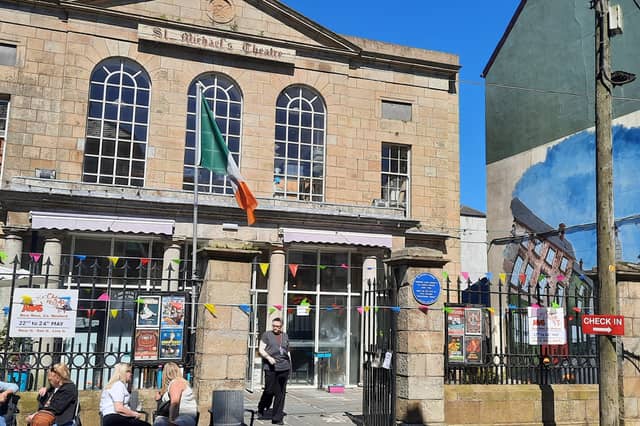
New Ross has a lot of fascinating history and we very happily pootled around some of its sights. However the primary reason we were in New Ross was that I was singing with my choir in the town’s choral festival. The first competition was in St Michael’s Theatre. St Michael’s is an elegant building. Built in 1806, it was previously a parish church. It was converted into a theatre in 1902 and served the town's dramatic and musical traditions well for several decades. In the late 1990s it was sensitively revitalised into “one of the finest multi-purpose arts venues in the south-east.” We sang two songs here, including a cheery piece with a great tune called “Nelly Bly”, which was written by the great American songwriter Stephen Foster in 1850. When writing the song Foster was inspired by a black servant called Nellie Brown. He admired her qualities as a person and he also liked the word “Nelly”.
Our second choral competition was in the Roman Catholic Parish Church of St. Mary and St. Michael's. This fine, imposing Gothic Revival structure officially opened in 1902. The interior features a high altar crafted by James Pearse, father of the 1916 Easter Rising leaders Patrick and William Pearse. James Pearse was a gifted sculptor who, in the early 1870s, formed a partnership with Patrick J. O'Neill specialising in monumental works which had its workshop in Dublin. Here we sang Francis Poulenc’s setting of O Magnum Mysterium, a haunting, celebrated piece which positions a sense of quiet, traditional reverence alongside striking 20th-century harmonies. O Magnum Mysterium is considered a masterpiece of modern choral music and creates a sense of mystery and awe. We also performed a song by the great African American composer Moses Hogan, who is celebrated for imbuing the excitement and energy of spirituals with a sophisticated classical mood.
After the competitions Rosalind and I strolled down to the Dunbrody Famine Ship, an authentic replica of an 1845 three-masted barque that serves as an interactive maritime museum. The original ship was built in Quebec and used by Irish merchants, the Graves family, to transport thousands of emigrants fleeing the Great Famine.
The Graves fleet, including the Dunbrody, is historically celebrated for having exceptionally low mortality rates. While many vessels of the era were called "coffin ships" because they had death rates reaching 20% to 30% or more, the Graves company had a much lower death rate. This was because they employed surgeons and humane Captains. The Captains prioritized the health and safety of their passengers.
Near the Dunbrody Famine Ship is a statue of President John F Kennedy marking the spot where he gave an emotional speech on June 27, 1963, at the spot where his great-grandfather, carrying “a strong religious faith”, emigrated. "It took 115 years to make this trip,” said the President, “and 6,000 miles, and three generations."