

An Colún: A Birr man's dramatic break for freedom

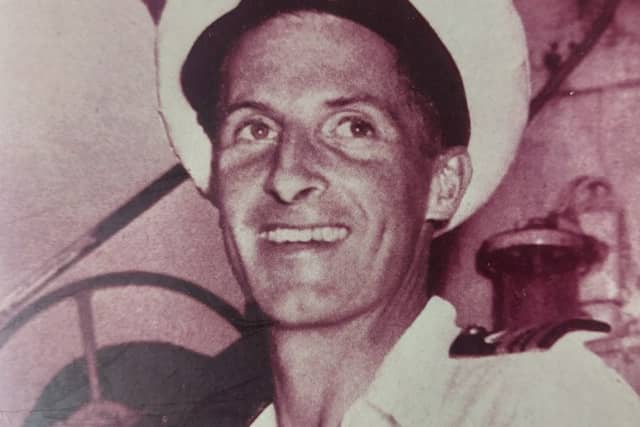

Imperfect hero was widely feted
THE story of a Birr man’s involvement in a very famous naval warfare incident makes for gripping reading. This week I’ve massively enjoyed a short book about the life of John Kerans and his involvement in what became known as The Yangtse Incident.
Unfortunately, we know very little about Kerans’ life in Birr. His father Edward was a Major in Crinkle Barracks and John was born in Crinkle on June 30, 1915. It’s believed he lived in a fine house called St Kilda’s, in Crinkle. The house still stands today.
John had a mixed character. He could be incredibly brave and just the person you needed when the s*** was hitting the fan, but he was also known for sometimes being mercurial, moody, and prone to heavy drinking. Unfortunately, some of his shipmates explained his less attractive features by offering the explanation of the stereotype of the hard-drinking, moody Irish man; a stereotype which falls apart when you examine it in any detail. I have met plenty of French or Germans or English who were also overly fond of a drop and were difficult personalities. It’s impossible to say which of these nationalities have the greater percentage of these personality types.
There were a number of men in John’s family who showed great courage in the heat of war. His father and uncle won medals during the First World War and his brother won medals posthumously after he was killed fighting the Italians in the Second World War.
His father had been gassed during World War One and his health never recovered. He died when John was 11 years of age. At an early age John was sent to boarding school in Gloucestershire and at the age of 13, fuelled by gripping tales of bravery in the Boy’s Own magazine, he applied for a cadetship at the Royal Naval College in Dartmouth, south-west England. The regime here was harsh and there were frequent canings for minor infringements. One of these infringements was called showing a lack of “Team Spirit”. The idea behind the harshness was to prepare the cadets for the trials of war.
After graduating from the College, Kerans rose to the rank of Lieutenant and when World War II broke out he was determined not to miss the action. During 1940, 1941 and 1942 he served on the Cruiser HMS Naiad. During the evacuation of Crete in May 1941 the Naiad’s sister ship the Orion suffered 300 casualties and it was Kerans’ task to oversee the party which removed the dismembered remains of the bodies on the Orion. This traumatic experience deeply affected him.
As a leader Kerans was known for his calmness under pressure and an engineer who worked with him pointed out that “when the rest of the crew were becoming hysterical” John was still calm. The engineer said John could “keep his head while all about him were losing theirs” and he was a “very brave” man.
By mid 1942 the strain of war was beginning to tell though and one biographer pointed out that Kerans had become “emotionally atrophied; almost autistic.” He was probably suffering from PTSD. In 1942 the advocated remedy was alcohol. He was given command of a Destroyer but between his heavy drinking and his poor handling of those in his charge, the ship was not a happy place.
After the war, because of his drinking and poor behaviour he was effectively demoted and appointed by the Navy to a dead-end job in Nanking, China. Then destiny intervened. On Wednesday April 20, 1949, during the Chinese Civil War, the Communists fired upon the British frigate HMS Amethyst sailing on the Yangtse River. Amethyst came under heavy fire, there were a large number of casualties and the ship ran aground. One of the casualties was the Captain of the ship. Three British battleships went to the rescue but came under withering fire and had to retreat. It was a diplomatic crisis and the Chinese Communists were milking it for all its propaganda value. The admiralty decided to send Kerans to make contact with the ship. He became Captain of the Amethyst and for three months a stalemate ensued where the ship remained trapped under the watchful gaze of the Communist artillery. During this period Kerans had to endure a number of humiliating meetings with Communist leaders who mocked him and treated him with contempt. On one occasion a Commissar Kang berated Kerans for 40 minutes, and called him a wretched failure. The Amethyst’s Captain remained stoical.
After three months or so the living conditions on the Amethyst had become intolerable. Kerans decided to make a dash for the open sea, which was 150 miles away. At 10pm on Saturday July 30, 1949 he gave the order to slip anchor and follow, under cover of darkness, in the wake of a Chinese passenger ship. He had half a crew, a shell-damaged ship with inadequate navigational ability, and had to sail through potentially hazardous shoals, in a river lined with artillery. To try and improve the Amethyst’s odds he tried to disguise it, so its silhouette might be taken in the darkness for a local vessel. He thought the ship’s odds of making it to safety were 50/50.
During the seven and a half hour dash to safety the ship came under heavy fire and was hit; the ship heeled over, taking in water, but eventually righted itself; a number of obstacles were passed, including a river boom.
When news of the Amethyst’s successful breakout became known, its Captain was feted everywhere he went. The Yangste incident served as a morale-booster in post-war, austerity Britain.