

Offaly Wind Farm opponents attend Dáil Leaders' Questions

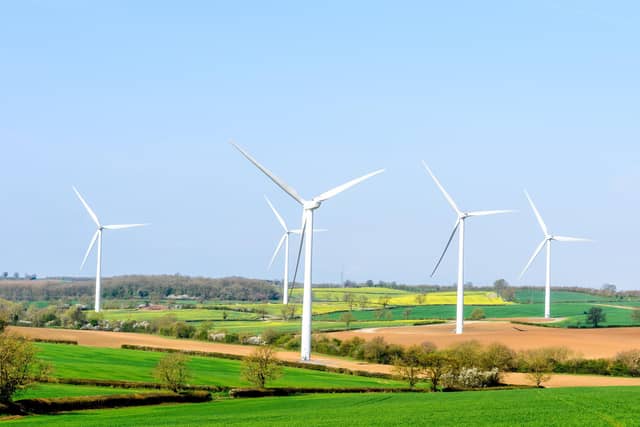

‘it has been proven beyond doubt that wind farms have health implications in certain locations’
A NUMBER of wind farm opponents from Offaly attended Leaders' Questions in the Dáil on Thursday July 2.
Members of the groups from Lemanaghan and Stonestown (Cloghan) were watching on from the public gallery as Deputy Richard O'Donoghue raised with the Tánaiste Simon Harris the topic of wind farms “and the serious health implications they can have on people.”
Also in the public gallery were wind farm opponents from Limerick, Mayo, Kilkenny and Wicklow.
Deputy O'Donoghue said the people of Stonestown had, for the last three years, contacted Offaly County Council, the HSE and the EPA with noise complaints about Cloghan Wind Farm.
He said CEPA (the Communities & Environmental Protection Alliance), on June 12, sent a letter to the Minister for Health and the Minister of State for Public Health and Wellbeing but hadn't received a reply or an acknowledgement.
The letter pointed out that when the residents of Stonestown brought their significant health concerns to HSE Public Health they were told by HSE Public Health that it had “no role in the matter” and that the matter should be referred to the local authority. The letter pointed out that this “no role” stance leaves affected residents “without any defined public-health pathway within the HSE.”
CEPA's letter said there's a contradiction in the HSE. “One part of the HSE recognises wind turbine noise as a public-health issue, contributes health-based planning submissions, and references WHO health-protection standards. Another part indicates that it cannot act when communities report harm, that it is not within their role, and decline assistance due to an absence of national guidance or defined triggers.”
Deputy O'Donoghue told the Dáil that it had been proven beyond doubt that wind farms have health implications in certain locations. He said he is not completely against wind farms but that they are inappropriate in some locations (where they have health implications). Directly addressing the Tánaiste he said two young children were in the public gallery, a 12 year old and a ten year old, sitting with their parents, and was the Tánaiste going to tell them that he wasn't going to investigate the issues, “and hide things until 2030?” He said the children are falling asleep in class because of a lack of sleep due to the noise pollution from the wind turbines.
The Tánaiste said he is a believer in the publication of new, clear guidelines, which are evidence based, for wind farms. "We need clarity regarding what is an appropriate distance and what is not an appropriate distance." He said Ireland is “still addicted to fossil fuels” which leaves it vulnerable during crises such as the Iran / US war.
On Monday June 29 Deputy Carol Nolan released a press statement pointing out that “Stonestown / Cloghan families are living through mental torture caused by wind turbines.” Deputy Nolan commented that the families in the Stonestown / Cloghan area are being subjected to “a prolonged form of mental and physical torture arising from excessive wind turbine noise, vibration, and operational practices that are clearly incompatible with basic public health standards.”
The Deputy said she has reviewed the detailed noise diaries that have been shared with her by affected households. She described them as “a harrowing record of suffering and a diary of relentless physical and emotional strain that no family should ever have to endure.”
The diaries, which span months of daily entries, reveal “a disturbing pattern of sleep deprivation, physical pain, emotional distress, and severe disruption to family life. Families report being awake for hours every night due to loud turbine noise, describing constant humming, heavy vibration through the house, and intensified noise during certain wind conditions. Parents recount children missing school because they are too exhausted to attend, and entire households struggling to function under the cumulative weight of nightly disturbance.”
She pointed out that the diaries also highlight a “deeply troubling issue where the turbines appear to slow down or stop during official monitoring periods, only to return to full speed immediately afterwards. Families describe nights of relative quiet while testing equipment is present, followed by a sudden return to 'roaring' noise once the equipment is removed. This pattern raises serious questions about the integrity of monitoring processes and whether they accurately reflect normal operating conditions.”
She pointed out that the residents have been left waiting almost six months for “meaningful engagement with Statkraft’s contractors, despite being fully cooperative throughout. It is beyond comprehension that families who are reporting nightly suffering are left waiting for effective mitigation. This is not acceptable by any standard.”
She said the evidence provided by constituents is overwhelming and demonstrates that the turbines are not operating in “a manner consistent with public health protection or planning compliance.” She described the situation as a serious “public health failure that I will not allow to be ignored. The State has a duty to protect people from harm, especially when multinational operators clearly have an entirely different set of priorities.”
Brenda Dowling of CEPA told The Midland Tribune that the 2006 Guidelines are 43 dB (decibels) LA90 at night time whereas the WHO 2018 guidelines are 37 dB LA90, which is a drop of six decibels. “To drop 6 decibels you must double the setback distance,” she said. “The EPA is clear: the 2018 WHO wind turbine noise thresholds mark the point where health and sleep are affected. Those standards are already in Offaly’s Development Plan, and Councillors were right to insist a few months ago that they were taken seriously at the highest level, by the County's most senior planner, the Chief Executive. At a time when public health evidence is strengthening, it is deeply concerning that Wind Energy Ireland previously sought to remove any reference to WHO guidelines — because for communities living beside turbines, there is nothing ‘ambiguous’ about the impact on their sleep and wellbeing.”
A few months ago CEPA welcomed the decision by Offaly County Councillors to “reaffirm the County Development Plan requirement for a wind turbine noise limit aligned with the 2018 World Health Organisation guidelines. This is an important and responsible step in protecting public health. It is worth noting that these WHO guidelines are now eight years old. If anything, emerging research suggests that a more stringent standard would likely be recommended today. Indeed, jurisdictions such as New South Wales in Australia have already moved to adopt stricter noise limits for wind energy developments. In Ireland, the HSE’s Environmental Health Service has advised that developers should apply the 2018 WHO noise guidelines as the appropriate benchmark for assessing health impacts. This position is reinforced by the Environmental Protection Agency in its most recent State of the Environment Report, which highlights the 2018 WHO wind turbine noise thresholds as the levels above which adverse effects on health and sleep are considered to occur.”
Ms Dowling said Offaly’s County Councillors had shown leadership during one of their meetings a few months ago “in standing over clear, evidence-based standards that prioritise the wellbeing of residents. We commend their stance and urge that these protections be maintained and strengthened, not weakened.”
In 2025 CEPA engaged an independent acoustician to carry out noise monitoring at Stonestown. They claimed that the acoustician's findings confirmed "the inappropriateness of using the LA90 metric for assessing wind turbine noise, given its variable and modulating nature. As we know, the human ear perceives actual noise levels (Leq), not filtered averages — our ears cannot “average out” the louder fluctuations in turbine noise. Tonal noise and impulsive tones confirm the stress the turbine noise is causing its neighbours.”CEPA claimed that Offaly County Council had previously been at a similar juncture, when in February 2022, the Council issued an “enforcement warning letter to Statkraft in relation to Meenwaun Wind Farm near Banagher. However, Meenwaun continues to operate unabated.” CEPA this week told the Midland Tribune that a number of local residents are currently undertaking a High Court action against Meenwaun Wind Farm.CEPA added that the Offaly County Development Plan includes the following Development Management Standard for wind energy: “Impact on human health in relation to noise disturbance (including consistency with the World Health Organisation’s 2018 Environmental Noise Guidelines for the European Region), shadow flicker and air quality.”