

Offaly County Council has become more amenable to constructing ramps

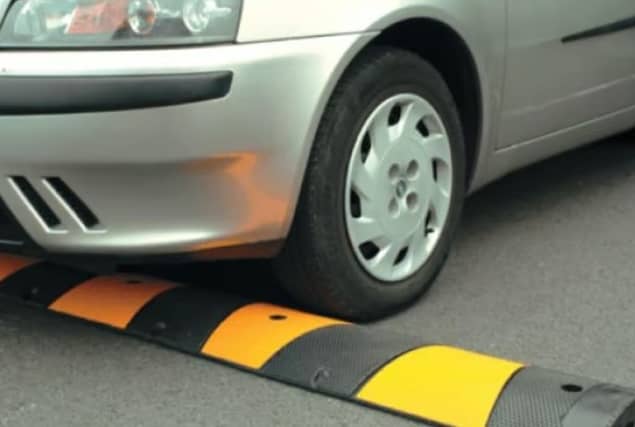

Support of 75% needed by local communities before works can begin
A RECENT meeting of Offaly County Council was told that the local authority has become more amenable to the introduction of ramps throughout the county following considerable pressure from members of the public.
For many years Councillors have often been rebuffed by the Executive when they have sought ramps as traffic calming measures.
A Council official told the meeting that in recent years the Council has “experienced a marked increase in submissions seeking the implementation of traffic calming measures at sites where excessive vehicle speeds are giving rise to safety concerns.”
The Council official said the Council is committed to creating safer, more comfortable and more attractive streets that support walking, cycling and other forms of sustainable travel. It's also committed to improving the liveability of residential areas by reducing traffic dominance, noise and perceived danger. “It is desirable,” he remarked, “that the layout of any new development is designed in such a way as to limit the speed of traffic to safe values." He added that the Council is now more amenable to introducing ramps.
The meeting was told that traffic pressure in villages, rural areas, housing estates, etc is at a very high level.
He said residential developments that have been taken in charge by the County Council will be eligible for the consideration of traffic calming measures.
Cllr Ollie Bryant told the meeting that the matter of speeding and safety had been discussed a lot during meetings of one of the Council's Strategic Policy Committees, which had fed into the new document before the Councillors, namely the “Offaly County Council Traffic Calming Policy 2026 in accordance with Section 38 Road Traffic Act 1994.” He pointed out that a strong level of community support, 75%, is required for a proposed scheme to progress to the assessment and design phase. Therefore, all traffic calming applications from residential developments must be accompanied by a signed petition. “To pass the initial screening phase,” Cllr Bryant remarked, “a minimum of three quarters of residential owners within the affected development must indicate for a traffic calming intervention.”
Cllr Shane Murray pointed out that he and a number of other Councillors “want a lot of ramps.” He said the Council's new traffic calming policy allows for the construction of a lot more ramps throughout the county. He said the Council's changed position on the matter of ramps was a “massively positive step.”
Cllr Neil Feighery pointed out that during the Local Elections of 2024 “when we were canvassing this matter was raised a lot on the doorsteps. I welcome this new policy. It's a very welcome document. However, for it to deliver it will need a proper funding stream. Speeding and safety is a massive issue throughout the county. It's obvious that we need more ramps, now. With these new updates and new attitude we now stand a good chance of seeing this getting done.”
Paul McLoughlin, Director of Services, pointed out that traffic calming measures are already being embedded into urban projects through raised crossings, chicanes, tightened junctions and pedestrian facilities, particularly in regeneration and active travel schemes.
Cllr Peter Ormond praised the Cathaoirleach John Leahy for his focus on traffic safety on our streets and for asking the executive for a new traffic calming policy. “Now whenever new residential or business developments are being built this new traffic calming policy will always be a part of the process. However, it should be pointed out as well that in South Offaly there are very few new housing developments taking place.”
Cllr Seán O'Brien commented that one of the unfortunate aspects of our modern age is speeding and dangerous driving, “in our housing estates, on main roads.” He welcomed the Council executive's more liberal approach to the building of ramps. “20 years ago I was told we couldn't have ramps in Arden View estate. I am certainly in favour of ramps. When they are introduced they are generally successful.” He said that when he visits a cousin in Dublin the high number of ramps on the streets is noticeable. “There are ramps everywhere in that part of Dublin.”
Cllr Ormond said getting 75% approval from estates will be hard. Paul McLoughlin pointed out that having it as high as 75% means you get less complaints from the general public. “It means you have less people who can complain they weren't consulted and less people who can complain when a development happens they don't like.”