

Open days at historic canal building during Heritage Week in town on Offaly border

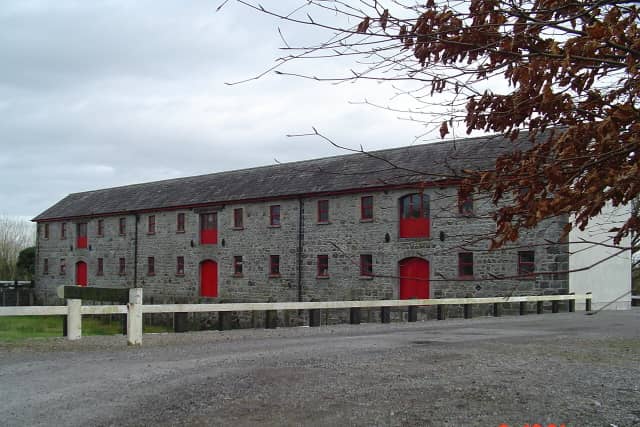

The harbour building in Kilbeggan, on the Grand Canal line to Ballycommon
OPEN days during Heritage Week will take place at Kilbeggan Harbour on August 21, August 22 and August 23 from 2-4 pm each day.
Huge work has taken place on the harbour building over the year and committee member Dan Scally here outlines the story of the legendary building and the Kilbeggan canal branch line.
This canal was constructed between 1832 and 1835 by a famous canal and railway contract engineer William Dargan. The original contract price was £12,850 with a final price of around £16,000.
Approval of the project was given after lengthy debate in the House of Commons to the merits and viability of the project with submissions by Lord Tullamore and featuring strong objections from the board of Royal Canal.
A comment on the land around Kilbeggan at the time that it was “surrounded by bog, red bog of the worst description and land of a similar kind”. The advent of the canals then was almost similar to the motorways of today but were quickly overtaken by the arrival of railways which adversely affected canal viability. The Kilbeggan branch line was one of the first to be affected. It never materialized into an economic project and traded with some difficulty until the branch line was finally closed in 1961 to boat traffic.
The Harbour building acted as a goods warehouse for inward and outward produce and was particularly important to Lockes Distillery importing coal and exporting whiskey.
From 1961, the condition of the canal and the building went into decline and decay. Then in 1989, it was proposed at a KPDA (Kilbeggan Preservation and Development Association) meeting that a committee be formed to look at the viability of restoring the building and rewatering the canal.
The founding members committee were Dan Scally Tom Lynam (RIP) and Tom Carberry (RIP). They negotiated and supported the purchase of the building by Westmeath County Council and agreed on a 21-year lease with the council. A company limited by guarantee was formed. New members joined, among them were Tom Cowley, May Fox, Anne Marie Rooney, Mary Kelly, Eamonn Heffernan, Brian Quinn, Noel McGuinness and Jack Duffy.
After considerable discussion with the then FAS approval was given to put a training course in place that would also include full renovation of the building.
The supervising team appointed was Donal Heffernan foreman with Sean Craig and Paddy Carton in support. The building was then at an advanced state of dereliction and no more than a shell. Even the original floor joists had been removed from the building and large sections of the roof had fallen in. The committee began fundraising with various ideas such as sponsored walks, public auctions, raffles, and dances. Lottery approved 10,000 and Leader gave 35,000 pounds.
The work and the training progressed but the combination of the much-needed expertise was in short supply. Cometh the hour, cometh the man and that man was Niall Murphy our then area engineer arrived upon the scene. His input, direction, and expertise were critical to the progress of the project. The building built on what was originally raised ground with very little to hold it together was a very delicate proposition to keep it standing and restore.
Today the building stands as a monument and testimony to the dedication expertise and commitment of that wonderful team of people. They even succeed in salvaging sufficient numbers of slates from the original roof of 1835 and reused them on the roof as it is today. All works on the building together with the Harbour basin were fully completed and ready for occupation by the year 2000.
Our first tenants in the building were I.O.F.G.A, the Irish organic farmers, who rented the building continuously for a rent of €10,000 per annum. This gave the committee a chance to clear debts, bank loans and bills outstanding.
We continued to have an excellent working relationship with Waterways Ireland and they were most helpful with
(1) reclaiming overgrowth from the canal banks which had become very overgrown over a period of 50 years.
(2)Supporting Fas workers with restoration works on bridges, culverts and overflows.
(3)Stock proofing boundary fences.
(4)Inserting stone at Skeanagh bridge originally carved by Mann Stonemasons who were bridge builders and local farmers. They were refused permission to put stone in the bridge at the time of construction and it remained in a farm outbuilding for 173 finally finding its home by the year 2000.
Due to the fact that Waterways Ireland had become a joint North South body requiring consent from both governments and most of their funding was spent in border area, and funding for the Kilbeggan branch line never materialized.
There was a period of reflection looking for further progress and around 2011 a new group called Renew Kilbeggan emerged. Their brief was to put together a locally agreed action plan in collaboration with the wider community. This was finally published in May 2014.
Leader approved funding for the project and Brady, Shipman Martin were appointed as consultants. Members of this committee included Dan Scally, Tp Ogorman, Geraldine Carwood, Rosemary Scally, Fintan Donaghy, Padraig Browne, Liam Daly, Paddy Dunican and Conall Ennis.
A key priority emerged from this being the opening of The Kilbeggan Branch Line to Ballycommon as a greenway. This was further enhanced with the proposal to link the Grand Canal Greenway to the Dublin-Galway Greenway creating a network of greenway with Kilbeggan as the hub. Offaly ,and Westmeath Co Councils together with Waterways were all consulted and gave their approval in principle for the project to go ahead.
Working with Westmeath Co Council Renew Kilbeggan agreed to employ Roughan O'Donavan Consulting Engineers to come up with an optimum link to Dublin -Galway greenway with Link to Streamstown becoming the preferred option.
However due to National Policy considerations this did not proceed and a review had to be considered. This has resulted in the preferred option to connect Kilbeggan Greenway close to Mullingar routed along the Brosna and on the east side of Lough Ennell.
Detailed plans are being developed on this route presently and it is expected to be completed in the next 3-5 years at an estimated total cost of €34 million.
The latest chapter of the Harbour Building was again in working with in conjunction with W Meath Co Council we were approved a grant of €500,000 from the JTF fund for a complete retrofit and energy upgrade of the building which was completed in 2024. This work greatly reduces its carbon footprint leaving it energy efficient as an important part of our history becoming a legacy for future generations to enjoy.
The proposal to restore the building in 1989 has become the mustard seed that led to the implementing of a project estimated at an overall cost of forty million euros and taking about forty years to complete creating an amenity, a facility, for future generations to enjoy, a facility that multiple generations of workers created and can be proud of.
It is an opportunity for us all to pause, remember, and honour these remarkable people, while looking forward to enjoying their legacy for years to come.