

HISTORY: The houses and street names of Birr in 1821 and 1855

So much for being able to trace back one’s family for 120 years when the opportunity is available as it is for Birr town and district for 205 years – it is a wonderful thing
While many are now familiar with the value of the 1901, 1911 and 1926 censuses for family history less use has been made of these documents for social history, population studies and street name studies. How much more excitement there is for some places where the 1821 census survives. This is the case with Birr and the entire barony of Ballybritt.
So much for being able to trace back one’s family for 120 years when the opportunity is available as it is for Birr town and district for 205 years – it is a wonderful thing. Family members of a great age in 1821 bring us back two to three generations and further. The oldest person in the town of Birr at the time seems to have been Ellen Egan of Graveyard Street.
Castle Street, for example, was then a crowded place with some 32 occupied houses and over 200 people. Probably the principal business there was the distillery of Arthur Robinson (later the Woods brewery and in the 1980s the Williams Waller business). But in the same street lived a horse breaker, comber, bakers, a chandler, a hatter, jeweller, a copper smith, publicans and labourers. The story of the street can be put together from that time and even back to the leases of the 1740s and earlier.
READ NEXT: Details finalised for auction of Offaly man's remarkable collection of sporting memorabilia
On the northern side of the town in Cumberland Street (now Emmet Street) lived the soon-to- be local historian then fresh from his controversies over Fr Crotty (who would later have a church in Castle Street), none other than Thomas Lalor Cooke. He published his first history of Birr in 1826. The reissue with a new introduction by Margaret Hogan will take place as part of Birr Vintage Week in early August. Cooke was then 31 years old and living on 28 May 1821 with his wife Lucinda (26) and sons William (1) and Richard (5). There were several other families in the town of the same surname. Lucinda was connected with the legal family of Antisell and her mother, also Lucinda (48) lived with them – at least on census night. Working in the house were a servant boy, cook, nurse and servant maid.
The streets of the town were densely populated. It was not until the 1900s that one saw the development of new suburban housing for the working classes. Prior to that people were crammed into the lanes and courts behind the bigger houses and paying 6d to 1s per week. In 1821 the details of the housing were provided for each street in a Dublin newspaper along with that of Tullamore. This is all that Tullamore has of the 1821 census.
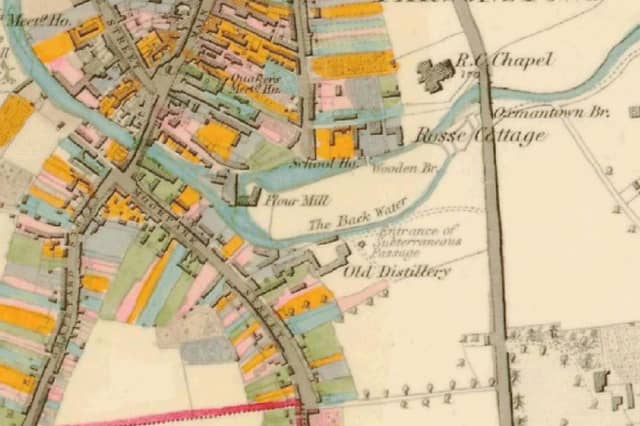
The street names, number of houses in each street and total population for each street will be of interest to those studying urban history. The study of the urban history of Birr is greatly enhanced by the estate records, parish records and from the 1830s the mapping and valuation surveys. The atlas of Birr published some years ago by John Feehan and Alison, Lady Rosse, in 2005 must make the study of the town so much more enjoyable, not to mention the 10 ft scale map of 1879 in fifteen sheets online at UCD Digital Archives.
That said young Mr Cooke could be somewhat cantankerous even in the 1820s. By 1850s and 1860s he was much worse. He died in 1869 after a long illness. In 1826 in his book The Picture of Parsonstown he drew attention to local shortcomings as he saw it in the 1821 census for Birr town. Cooke wrote:
There were in Parsonstown in 1820, one thousand and seventy-three houses, which number has been considerably increased since: and it appears, by the Census taken in that year, to have then contained five thousand four hundred and twenty-seven souls. It is however to be remarked that this enumeration did not include the inhabitants of a considerable portion of the town in consequence of its standing upon different townlands. For instance, it did not comprise part of Graveyard Street, which is built upon the town land of Drumbawn, or part of Moorepark Street, which is on Seffin, the order for the Census requiring the population of each townland to be entered separately. There do not appear to be many of descendants of the original settlers now remaining here. [Cooke was referring here to the list of town tenants in the 1620s published in his 1826 volume at page 275.]
Graveyard Street and Moor Park Street had a high number of people similar to Tullamore where there were many houses to the west of the town in an ‘Irish town outside the walls’. In Birr’s case south of the narrow bridge at Bridge Street. Birr had its Connaught Street as did Tullamore, presumably named because it was the route of migrant workers from the west. Its Shambles Lane was the same as that in Tullamore in what became Dann’s or Bridge Lane.
A few of the Birr Streets were renamed in the 1850s following the issue of the printed map of 1838-40 and the valuation records published in 1854 street by street. A report of a town commissioners in 1855 noted that:
The Chairman said the first business of the day was Mr William Meara's motion to name the streets, and to number the houses. The Clerk then handed in a list of the streets as named in the Griffith's recent tenement valuation, when, after some conversation, it was agreed to continue the names of several of the streets as formerly, and that the names of the following streets should be altered, viz.:—That of New-road to Eden-row; Oxmantown-mall to Wilmer-road, as far as the Bridge and the Military road, thence to the town boundary; that of Connaught-street, from the end of John's-place and of Compton's-row to New Bridge-street; that of Back-lane to Mill-street; and that of Graveyard-street to High-street.
This was probably the William Meara, the principal of the old established firm of William Meara and Sons, and one of the oldest and most extensive merchants in Parsonstown, who died aged 75 in 1872. ‘He was the first Town Commissioner ever sworn in in Parsonstown.’