

Bank of Ireland branch celebrates a remarkable 190 years in Tullamore
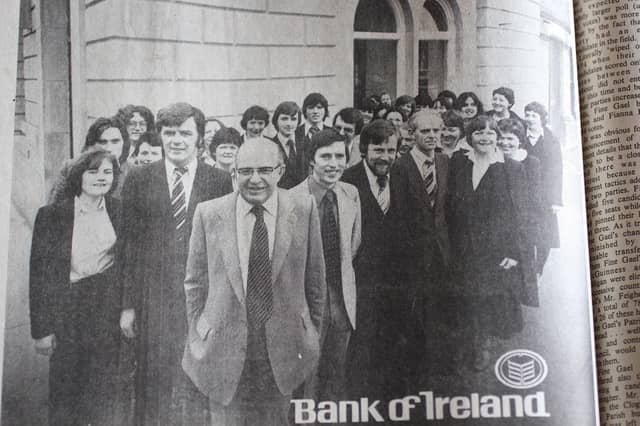

Bank of Ireland has made an economic, social and architectural contribution to Tullamore
THE Bank of Ireland was the first commercial bank to open in Tullamore and established a branch at High Street, Tullamore in what is now part of the Direction Provision houses and was formerly the McGinn family private residence in August 1836. That house and the one the bank moved to in 1841 were leased from the Slator family. The Bank was relocated to Bridge Street in 1979 to what had been an Hibernian Bank premises since 1864.
The new branch followed on from Mountmellick in January of the same year. In the years between 1825 and 1840 twenty-three branches of the bank were opened in the provinces. At the time applications from Birr and Mullingar were refused.
The former Bank of Ireland in High Street from 1841 to 1979) now Hoey & Denning, Solicitors, according to Garner ‘has a robust limestone facade of five bays and two storeys and is slightly set back from the street. The ground floor is channelled and has segmental-headed windows and a doorcase inset in an arch with a scroll keystone. Over the ground floor is a heavy cornice and a stringcourse on the first-floor sill-level. The first-floor windows have architraves and cornices supported by console brackets and the facade is topped by a frieze, cornice and blocking course. Fronting the building are heavy cast-iron railings.’ The building is a little bit of the Italian-style come to Tullamore, over twenty years after the first such building in Ireland, Kingsbridge (now Hueston Station) in 1846.
Managers living over the shop
The bank was first located in the former McGinn family home in 1836 and in 1841 had moved to what is now Hoey & Denning (since 1980). The two houses at this location were improved in 1870 and sold outright to the Bank in 1874 for a sum of £1,032. The manger in the 1840s was Bartholomew Maziere and in the mid-1850s Oliver Norris Birney. The building was provided with a new cut-stone front in 1870 to the plan of Sandham Symes, (1807-94), architect to the Bank of Ireland. The contractor was Mr John Molloy of Ballyduff.The work led to an increase in the valuation from £31 to £49 in 1871 when the rebuilt cut-stone front was commented on and it was increased again in 1879 to £60 as a ‘good cut-stone building in a good situation’.1 This appears to be the only work of Symes in Tullamore. A similar building with some of the same details can be seen in his Banagher branch of the Bank of Ireland (1874), now a private house. Many of the principal banks of the latter part of the nineteenth century (Kilkenny, Ship Quay Street Derry and Clones) were designed by Symes who also carried out work at Mount Jerome Cemetery and Ayesha Castle, Killiney. The valuer of 1843 noted that the dwelling was well furnished.
Frederick Benson Denning was the agent or manager of Bank of Ireland in the 1860s to the 1890s and was the father of James A. the solicitor and F.F. the barrister. F.B. later farmed in Geashill barony. The last of the Denning children married in New Zealand. F.B Denning died in 1903 and his wife Isabella in 1905. Oliver McDonagh, the distinguished historian, had provided an account of life as a child in the Roscommon branch of the bank in the 1930s. The last of a succession of managers to live over the bank was the late Claude Hill, in the 1970s.
The residential part of the High Street building on the upper floor was somewhat spoilt by the bank in the 1977–9 when staff from the former Hibernian Bank in Bridge Street moved to High Street as part of the amalgamation process in Tullamore. This bank in High Street was vacated on the completion of the refurbishment at O’Connor Square in 1979. Soon after the building in High Street was sold to Hoey & Denning, solicitors, who moved up from a 1750s building in Bridge Street. It is a curious thing that the live-in manager of the bank in the 1860s was none other than Frederick B. Denning, whose son James was the founding partner of the firm (with George Hoey in 1887) and his other son, F.F. Denning, a much in demand barrister. So the young Dennings played as children in the building that again associated with the family name after a break of 90 years.
In 1901 the manager or agent of the bank was Isaac Williams, who had a good singing voice and was a president of the Tullamore Golf Club where his name is on the board. Williams was Anglican (as was the tradition in Bank of Ireland) and lived there with his wife Elizabeth (aged 60, Antrim) and two servants in the 11-roomed apartment set aside for the manager. It was much the same in 1911 with only the English-born Roman Catholic manager, William Howard, his wife and one servant living in the house. The house had nine windows to the front. It had a stable, a coach house, a harness room, a fowl house, a store, a laundry and a coal house. The house had five out-offices which were a stable, a coach house and three sheds. The husband, wife and a female servant lived in the house over the bank.
The local merger of Bank of Ireland was in 1977 when all the staff of Hibernian and BOI came together in High Street. When the works on the old Hibernian were completed in 1979 High Street was closed. It was sold to Hoey & Denning Solicitors about 1980. The Bank of Ireland marked its 150th anniversary in Tullamore in 1986.
Claude Hill was the last manager to live over the bank. A native of County Wicklow he had a farming background, and came to Tullamore as manager in the 1960s, possibly in succession to a Mr Doherty. Others in the bank at that time included Peter Cooke and later Stephen McNeill. Claude Hill was an enthusiastic supporter of the Tullamore Rugby Club, Tullamore Lions and Friends of Tullamore General Hospital. He retired in the early 1980s and was succeeded by Christy Lennon. Mr Hill died in 1998 and Mr Lennon in 2026.
The Hibernian Bank opened in Tullamore’s Bridge Street on the corner with O’Connor Square in 1864 and is now the oldest surviving use on the northwest corner of the square.
The ‘main part of BOI, O’Connor Square Bridge Street, was described by Garner (1980) as a building having ‘a facade of five bays and three-storeys, plus an extension of four bays and two storeys, on the Bridge Street side. On the O'Connor Square side the facade has three bays with a pair of round-headed windows on the ground floor. It is built of Portland stone, channelled on the ground floor and ashlar above with chamfered raised coigns and a heavy limestone cornice. Further additions of adjoining premises (the four bay two-storey portions in white Portland stone, nos 11 and 12 Bridge Street) were made c. 1951–4 and 1977–9 (being the addition of the Berrill Woollen Store and Wakefield’s and in the 1970s the former Sunshine Café (in the brick house). The restoration of the façade of the brick house was an exemplar in Tullamore and was followed in 1992 by Acres Hall (the municipal council building).
We shall not look on their like again
Among more recent managers of Hibernian were Gerry Burke Kennedy and Des Power. Managers of the combined Hibernian and Bank of Ireland branch included Claude Hill, Christy Lennon and George Manzor. The three-storey part of the Bank on the corner side was remodelled in 1908 W. H. Byrne as architect. Further additions of adjoining premises at 11 and 12 Bridge Street (the four bay two-storey portions in white Portland stone, GV 11 and 12) were made c. 1940-51 and 1971–77.
The combined staff of Tullamore branch of the Bank of Ireland in 1979 was 37 staff members of whom about one-third were male with almost all of the senior managers men. By 2026 this had changed to 10 to 15 staff. The online banking has revolutionised the banking scene. We will not again see the wonderful buildings of the 1850s to the 1970s so we should appreciate what we have in Bridge Street, O’Connor Square and High Street.