

OPINION (AN COLÚN): The strange story of the Ark of the Covenant and the Hill of Tara


I WAS ten years of age when Raiders of the lost Ark hit the cinemas and like millions of young boys I was enthralled. The fedora wearing, whip cracking hero was wonderful and the story was riveting. It was also the first time I heard of the Ark of the Convenant. Some of my school friends thought it was Noah's Ark. No, I told them, it was a sacred chest in which were contained the sacred tablets, upon which were inscribed the Ten Commandments, as given to Moses by God on Mount Sinai.
The movie was also wonderful at expressing the idea of the power and magnificence of God, as contained in the Ark. This idea of a sacred box containing the Ten Commandments comes solely from the Bible. It is mentioned nowhere else. It is mentioned in several books in the Bible and is one of the most important objects / symbols in the Christian canon.
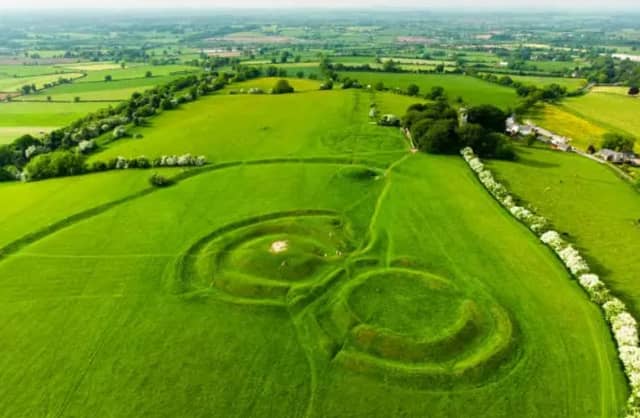
I was surprised and charmed to learn recently that one of the traditions associated with the Ark is linked with Ireland. According to this tradition an Egyptian princess brought the Stone of Scone and the Ark to Ireland. The Ark was conveyed to the Hill of Tara and buried there. At the end of the 19th Century a group called the British-Israel Association of London, who believed they were descended from the 10 tribes of Israel, came to Tara in a search for the Ark. Between 1899 and 1902 they excavated at the hill causing consternation for many. Irish nationalists were particularly incensed by this behaviour which they considered, rightly, to be vandalism. Arthur Griffith and Yeats were among those nationalists who went to the Hill to protest. Maud Gonne (dramatic, colourful, beautiful) also went. She famously lit a bonfire on Tara, danced around it and sang “A Nation Once Again.” Arthur Griffith, Editor of the United Irishman and future co-founder of Sinn Féin railed against the “destruction of a national monument”. Other protestors included George Moore and Douglas Hyde. Some were ordered off the site by a man wielding a rifle but this didn't deter them and they continued their protest.
Arthur Griffith and Maud Gonne visited the Hill to inspect the damage On Christmas Day 1900. Hyde, Yeats and George Moore sent an angry letter to the Irish Times. The nation's Press supported the nationalists in their protests, making this the first media campaign to save a national monument.
The British Israelites excavated at the Rath of the Synods on the Hill. They were founded by Edward Wheeler Bird, a retired Anglo-Indian judge. He claimed his movement could trace its roots back to the Lost Ten Tribes of Israel, the wandering biblical Hebrews.
The local landlord does not emerge well from this story. His name was Gustavus Villiers Briscoe and he was paid handsomely by the British Israelites to allow them to excavate the site. It was related that he sat nearby, looking on and drinking whiskey while the excavations took place.
Maud Gonne's bonfire had in fact been built by Briscoe to mark the coronation of Edward VII. When Maud Gonne arrived at Tara she opined that the bonfire “would serve a better purpose if burnt in honour of an independent Ireland.” She lit it, sang and danced.
The British Israelites saw Tara as a “powerfully symbolic site, their 'resuscitated' Jerusalem, and spiritual capital of the British Empire”. The Irish nationalists saw it as a potential capital of an independent Ireland.
One of those who witnessed the excavations taking place was the famous writer and cyclist William Bulfin, from Derrinlough just outside Birr. Bulfin was a close friend of Arthur Griffith. Witnessing the damage at Tara, Bulfin pointed out, “Men have been sent to prison for less. But in Ireland there is no plank bed and hard tack for such offenders. They sleep upon the safest mattresses in the country and feed on the fat of the land.”
An archaeologist called Macalister pointed out that the British-Israelite theory was “so utterly removed from normal sanity, that piety rather than ridicule should be accorded to those who have been infected with it.” He pointed out that they believed it was the “centre of a spiritual, religious or cultural conquest of the world. As Tara was regarded by them as an ancient royal site in the British Empire, the deposition of the Ark there would be evidence that Tara was indeed the spiritual birthplace of the Anglo-Saxon nation.” How different from the Irish nationalists' interpretation of the Hill. For them it was the sacred residence of the High Kings of Ireland. William Wilde (the father of Oscar) wrote, “the memories of Tara have remained a silver thread in the garment of sackcloth he (the Irishman) has worn for centuries.” For nationalists such as Hyde, Yeats and Moore, Tara was “probably the most consecrated spot in Ireland.”
One writer summed up the whole episode nicely when she referred to it as a “tale of cultural agendas”.
Tara was a place which inflamed the imaginations and emotions of both cultures. Maud Gonne recalled that she experienced a vision so vivid while on the Hill that she dropped to her knees and “seemed to see shuddering, misty forms gazing curiously at us. A weird procession wound round the great raths where the palaces had stood. Some tossed white arms as they moved in rhythmic circles.” It is easy for us to chuckle at Maud Gonne and her visions but she was a great actress who regularly trod the boards of the nation's finest theatres. Yeats, who was, famously, hopelessly in love with her, had written plays and poems where visionary events were a notable feature. These visionary moments in his works often served as the expression of the emotional states of the Irish people at the time, of a nation's desire to forge an independent and greater destiny; of a longing for an inspiring past which the people could aspire to as they strove to create an Ireland which would be free and independent; an Ireland that would be culturally noteworthy and would provide much to be proud of.