

OPINION (AN COLÚN): Shinrone audience finds out how the tick tock was restored to the clock


SHINRONE'S fascinating heritage was the subject of two special talks hosted by the village's Heritage Group last week.
In front of a large audience in Shinrone Community Centre, on Tuesday August 15th, Nigel Barnes, a fifth generation clock-maker, explored the history and development of timekeeping in Ireland. Nigel told the audience that Shinrone has Offaly’s oldest working turret clock. Dating from 1820, it was made by the famous Dublin horologist Christopher Sharp for the newly built St. Mary's Church of Ireland. For some two hundred years, it has overlooked the Village, regulating the social, economic and religious lives of generations of “Shinroners”.
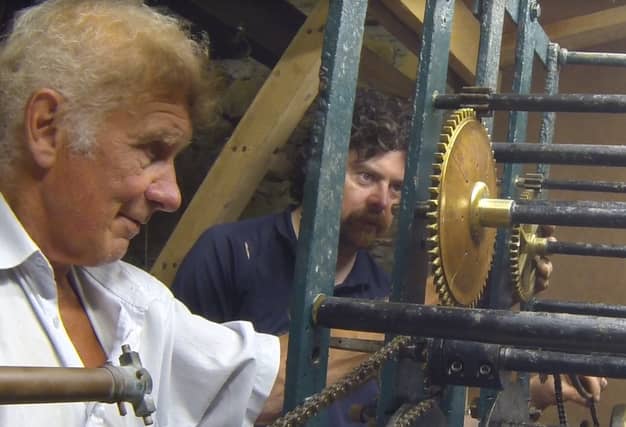
However, in 2019 it stopped working. This year the Church Vestry set about getting it fixed. A grant of €9,000 was secured from Offaly County Council and they were pointed in the direction of Nigel as being the right person for the job. Over two weeks he drove four hours daily to and from his Clare home, ascended the stairs of the church tower and set about solving the problem. Parts had to be replaced and some of the system had to be filed to the correct shape. The work could have been done in his Clare workshop but he decided it was better to work in situ because turret clocks don't travel very well. A great job was done and the venerable clock has now got its tick tock back. Many Shinroners are very happy to see it working once again.
Nigel said the St Mary's clock is a relatively simple device. It's large and consists of different parts made of wrought iron and brass. In 1820 it was made by hand and includes gear wheels, cogs, springs and moving parts working together to keep time. You can't but admire the engineering skills of clock-makers two centuries ago, using hand tools and craft skills to create these large mechanical wonders. Like his ancestors Nigel completed the works by hand.
During the talk he talked about pendulums and their inter-relationship with gravity. He told us about the isochronous nature of pendulums, something which Galileo discovered in 1602, which means that when the pendulum is given an initial push, it will swing back and forth at a constant amplitude. The two forces that act on the pendulum are the force of gravity, pulling straight down, and the force by the pivot, pulling along the string, towards the pivot. These two forces combine to produce a resultant force.
Nigel took us through a very interesting history of time-keeping. This included Hipparchus' Antikythera Device which dates to 130BC. It was an Orrery and is the earliest example we have of a clockwork device.
He said there are quite a few sun-dials in Ireland. We were shown a photo of one them, which is located in Kilmalkedar in Kerry. This sundial is standing on the western edge of the early ecclesiastical site of Kilmalkedar (Cill Maoilchéadair), on the Dingle peninsula. It comprises a rectangular shaft with a semicircular expanded head. The semicircular portion is the dial and in the centre is a hole. This was designed to hold a gnomon – a wooden or metal projecting pin – which would cast a shadow on the face of the sundial. The four roughly equal segments on the semicircular portion denote four ‘tides’ or three-hour time periods, and the five lines from left to right represent the canonical hours of Prime (6am), Terce (9am), Sext (12pm), Nones (3pm) and Vespers (6pm). These marked the times at which prescribed prayers would be recited.
Nigel told us that the word 'clock' comes from the medieval Latin word for 'bell'— 'clocca'. Contrary to what some people think, the word 'hour' does not come from the Egyptian God Horus. It comes from the Greek word 'Hora'.
The oldest working clock in the world is in Salisbury Cathedral, England, and dates from 1386. After having ticked more than 500 million times it was restored in 1956.
Until the advent of electricity, all turret clocks were wound by hand, and then the interplay between the pendulum and the pivot kept them going for several days. The clock in St Mary's Church was wound by hand once a week. For centuries, church clocks have been wound by dedicated local enthusiasts. Often the job was passed down from one generation to another in the same family, and it was a matter of pride that the clock always told the “right” time. However, it is becoming increasingly difficult to find these willing volunteers and many clocks have been converted to automatic winding. St Mary's Church has also made this change and automatic winding now powers the pendulum and the weights.