

OPINION (AN COLÚN): A special place in Kilcormac where people connect with peace

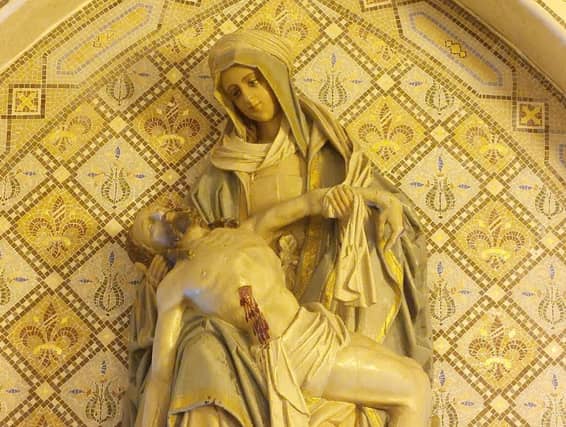

ON Thursday evening I attended the launch of an excellent short film about Kilcormac's Pietà. This striking and skilfully executed statue was carved from oak by a very talented craftsman in the 1500s and has been located in Kilcormac since at least the 1600s. The local people formed a very strong bond with it, a bond which remains to this day.
The launch took place in the Catholic Church of the Nativity of the Blessed Virgin Mary, a suitable location as this is where the Pietà is housed. The launch date was also well timed as we were on the cusp of Holy Week and the image of the Pietà is synonymous with the suffering and agony that is the Holy Week story. As we look on the dead Christ cradled in his grief-stricken mother's arms we think about the wonderful love which many people have for each other - mothers for sons, husbands for wives, and so on. This type of love is humanity at its best - forgiving, compassionate, willing to do anything for their loved one.
As we look at the mother holding her dead son, we also think about the ignorance, greed, stupidity and barbarism which humanity so often displays. We think about the horrific cruelty and the satanic viciousness of crucifixion, a means of execution conjured by depraved minds.
This is the incredible potency of the Pietà image and why it has attracted so many artists to depict it over the centuries. It represents the best and the worst of us. It represents the darkness and the suffering that is part of our human struggle, and it shows us the key to freeing ourselves from this lunatic imprisonment (or at least pointing us towards the way we should react to life's vicissitudes) - the forcefield of empathy which we call love.
The filmmaker of the Kilcormac Pietà film, Oliver Fallen, has done a fine job because he tells the story with unbiased detachment and also interviews several locals who tell us what the Pietà means for them. Oliver told the gathering that this particular style of Pietà in Kilcormac is unique in Ireland. He said that when he was making the documentary “I was amazed that a lot of the people that I talked to in Kilcormac didn't know about the Pietà. I told them about this important work of art in their village. I pointed out that they have something special in their midst which they should be proud of.”
One of the interviewees in Oliver's film, a woman, commented that she loves sitting in the church in front of the Pietà. “I love the peace and quiet of the church,” she remarked.
“Sometimes,” commented another woman, “I kneel in front of the Pietà and tell her about my story, about the challenges facing me.”
Another interviewee said the Kilcormac Pietà is one of Offaly's national treasures.
Agnes Gorman of the Kilcormac Historical Society told the camera that the statue speaks of “the relationship between a mother and her son and of the great suffering caused for her by his death.” She said the statue “unites us all no matter what our religion.”
A scholar, Brenda Richardson, said we don't know who carved the Pietà; adding that the story of it being buried in the bog for decades in the 1600s is probably apocryphal. “If it had been buried in the bog it would have been marked pretty badly by that,” she remarked. “It would have lost a lot of its colouration. It was probably brought from Catholic Spain to Ireland in the 1600s. Its form and colouring lead me to believe that its provenance is not Irish. The local McGawley family had a strong connection with Spain and I would guess it was they who brought the statue back”.
One man told the camera that when he's sitting in front of the statue he “takes the time to say a prayer of thanks. People often turn to religion in times of emergency, but I like to come here on my good days as well. I get a sense of great calmness and goodness when seated in front of it.”
Cllr John Leahy commented that it was interesting to hear that the statue might not have been buried in the bog. “Everyone in Kilcormac was always told it was buried in a bog to hide it from Cromwell's soldiers.” The Councillor added that “whenever you come into the Church here there is very often someone praying in front of the Pietà; they might be lighting a candle or kneeling in prayer. The reassurance, the sense of hope and peace which people get from the statue is very important.”
“The Kilcormac Pietà” will be one of five short films being shown in Birr Theatre on Friday April 25, starting at 7pm.