

THE LONG READ: New book on the urban heritage of Tullamore 1600-1960 launched
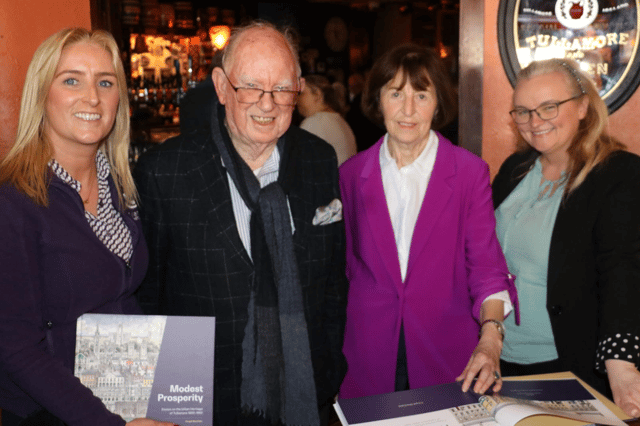

Great reception to well-researched publication by architect and town planner Fergal MacCabe at official launch in Tullamore by historian Michael Byrne
Fergal MacCabe’s new book is a singular contribution to an appreciation of the architectural heritage of Tullamore.
The new book called intriguingly Modest Prosperity is a series of essays on the story of Tullamore since the 1620s but concentrating on the 1780s to the 1960s period with over 100 watercolours of Tullamore depicting the architectural heritage of the town since building in earnest began in the 1740s.
Tullamore may be 400 years old in terms of the land grants to the Moore family from Kent in the 1620s, but the earliest surviving buildings (distinct from Srah Castle) are from the 1740s. In fact, some of the best houses are from the time of Charles Moore, first earl of Charleville who died in 1764, and not the time of his grand-nephew Charles William Bury who came of age in 1785 and was the lead landowner and initiator until his death in 1835.
Fergal MacCabe is an architect, town planner and a topographical artist. In the latter skill as a water colourist, he has managed to combine all three disciplines in his career. His watercolours are restful and calm and follow a pattern set by that great topographical artist George Petrie who first worked in Offaly in 1819–20 and made Clonmacnoise famous with his wonderful oils and sketches.
For Fergal’s jovial attitude to life we can probably thank Fergal’s mother Winifred, who was, by all accounts a character, till her early passing in 1960 when Fergal was only a student, or a rudiment in Jesuit parlance. Perhaps his returning to Tullamore so often in his work has a Joycean context of him coming back to the womb, a kind of homecoming, as was well known to his late friend the dramatist from Tuam, Tom Murphy.
Fergal was born in Tullamore in 1939 and went to school locally. By his own admission in his essays in Tullamore in the Sixties (2024) the 1950s were good to him and he enjoyed his time with local drama groups such as the Runners, and early on got experience of painting sets for their plays. His early promise was recognised in 1956 when the sixth earl of Rosse, himself prominent in the arts in Ireland and the UK, in opening an An Tostál art exhibition in the market house in Tullamore for the late Mrs Kennedy commended the young exhibitor.
Soon after that exhibition Fergal went to the College of Art, and in 1957 to UCD to study architecture and here he made colleagues for life while studying under Professor Desmond FitzGerald (brother of Garret FitGerald). After that it was the boat train to work in England like so many of his countrymen. For some it was out of dire necessity and for others it was the attraction of exciting adventures in a city one is never supposed to tire of. And, of course, there was the attraction of the removal of the supervisory restraints in his hometown.
Fergal’s artistic career began to develop in the early 1970s, and he spent more time visiting Offaly and taking in subjects in Tullamore, Birr, Clonony and Banagher. Surprisingly, there appears to be little from Ferbane town even though he spent a lot of time with family relations and their neighbours, including the Connollys. Sean Connolly is a life-long friend who with Power Design, Fitzwilliam Street, Dublin has designed some of the important publications exhibiting Fergal MacCabe’s work. Sean and Fergal worked closely on this book and on their previous books such as that on Frank Gibney and Tullamore: a Portrait.
In his architectural career locally Fergal designed housing schemes for the late James Spollen in the mid-1970s at Hop Hill and the delightful small scheme of Glenfircal, Tullamore for the late John Flanagan in the 1980s.
It was in the 1970s that he began to make submissions to the local authorities in regard to Development Plans and has continued to press for consultation and conservation of the historic core of Tullamore and special conservation areas. He now has his own page in the Tullamore Tribune in which to warn us of impending doom if new statutory plans are not soon adopted.
In 2002 he submitted a commissioned report on prospects for the old canal harbour, Tullamore. His proposals were in line with what was happening at Grand Canal Dock, Dublin. Thankfully, nothing came of this, and the area was not designated for tax relief to facilitate construction of apartments. Waterways Ireland, before it came under the North-South body, was exceedingly slow in doing anything and the recession saw proposals parked for over twenty years.
But now the Tullamore harbour is to be vacated this year or early next and we have a commissioned plan from Grafton Architects that plots a way without being prescriptive. Grafton’s study (2024) of the canal harbour leads the field and is strong on creating a public amenity without more buildings as the town park has shown.
Fergal MacCabe took a strong stand on the war memorial in O’Connor Square, Tullamore and has battled with the county council over removing the plinth from a listed structure and erecting rolling advertising in an area that should be a special conservation area.
The new Book: Modest Prosperity; essays on the urban heritage of Tullamore
Fergal MacCabe’s water colours and drawings are hugely popular and he has worked almost single-handedly to bring a change of heart to the general public and to local representatives in regard to the county’s conservation needs. He has used his planning and artistic skills in the service of his convictions and in the winning of hearts and minds he has the people with him. He has presented Tullamore’s prominent places in his water colours as looking really good and proud of its architectural heritage, but of course the reality can be different. He cannot be faulted for the increasing dereliction in the last eighteen years since shopping trends changed after 2000. Modest Prosperity will be valued for its over 100 water colours and for its way of seeing Tullamore as a town that emerged slowly over the past three centuries with periods of tremendous growth in the 1780s to the 1940s, and again since the mid-1990s.
Fergal MacCabe has made a lifetime study of Frank Gibney's work and in particular his 1950 plan for Tullamore and contrasts its proposals with the form of the town today. In terms of philosophy of architecture both Gibney and MacCabe are soulmates, as indeed would be Yvonne Farrell of Grafton Architects in her constant espousal of architecture for living.
MacCabe has been relentless in seeking to have the ‘Crawford building’ in High Street (the former Kilroy TV showrooms now owned by ‘Mr Price’) assessed for restoration and funded his 2014 exhibition catalogue in endeavouring to secure support for a building he considers one of the most important in Tullamore and that may be by Richard Castle.
To my mind he has made a considerable case for the architectural appreciation and conservation of Tullamore with this latest book. I hope it will encourage others to complete studies of as fine a quality for the other midland towns. Creativity, skill and focus should be appreciated if we want to promote the midlands for sustainable living for ourselves and our visitors. Fergal MacCabe’s new book will do its part.