

Global conservation leaders visit Tullamore Lions Club’s peatland project

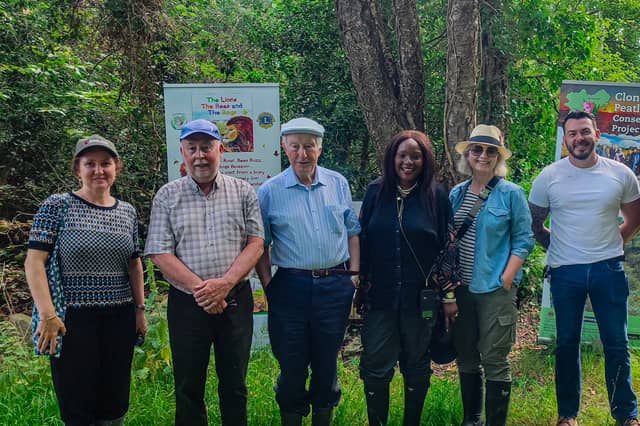

Among the distinguished international guests were Dr. Musonda Mumba, Secretary General of the World Ramsar Convention, and Flore Lafaye de Micheaux, Senior Advisor from theSecretariat of the Convention on Wetlands
Tullamore Lions Club was delighted to host the delegates at Clonbeale More and to present a progress update on this vital community-led initiative.
The Irish Ramsar Wetlands Committee (IRWC) is a national advisory group established in 2010 to help Ireland meet its obligations under the international Ramsar Convention. It
promotes the protection, appreciation, and sustainable management of wetlands across Ireland.
In June 2026, the IRWC hosted its national conference in Portlaoise, centred on the theme Voices and Vision for Ireland.
The landmark event brought together policymakers, environmental groups, and researchers to shape the next chapter of conservation for Ireland’s protected peatlands and fens.
Among the distinguished international guests were Dr. Musonda Mumba, Secretary General of the World Ramsar Convention, and Flore Lafaye de Micheaux, Senior Advisor from the
Secretariat of the Convention on Wetlands.
On June 24th, conference delegates embarked on a field trip across several key wetland sites in the Midlands to witness ongoing conservation efforts firsthand and meet local
stakeholders with a final stop at Clonbeale More.
The Tullamore Lions Club was delighted to host the delegates at Clonbeale More and to present a progress update on this vital community-led initiative.
The Ramsar delegates were interested to hear why a Lions Club became champions for peatland conservation.
Michael Carroll explained that the project was conceived in 2022 to address the global Lions Clubs mission: “to sustainably protect and restore our environment to improve the well-being of the communities we serve.” The ambitious project was made possible through a series of key milestones:
1. Generous Land Access: The Grennan family of Rath, Co. Offaly, generously made their portion of Clonbeale More available for restoration.
2. Scientific Foundations (2023): A detailed and comprehensive feasibility study was completed, and a conservation plan for the site was developed by Blackthorn Ecology and RPS.
3. Funding and Execution (2024): Funding was secured from the Community Climate Action Fund (administered by Offaly County Council), which financed Phase 1 of the project. In October 2024, contractor Brian Gorman and his team expertly implemented the plan, building peat dams and bunds and clearing invasive Rhododendron.
The results were immediate and impressive. By the end of 2024, the surface of Clonbeale More showed significant rewetting. Building on this success, the club was delighted to be invited into a partnership with Tóchar Wetlands Restoration. This secured dedicated funding for other Lions Clubs in the Just Transition Region, looking to follow the blueprint set out by Tullamore. To date, four other clubs have already launched wetland-related projects. The partnership also enabled Tullamore Lions Club to implement additional restoration measures at Clonbeale More in 2025 and to initiate a second project. Following the presentation, contractor Brian Gorman led the delegates on a guided walk across the restored bog. Brian detailed the unique engineering and ecological challenges the site presented, explaining the precise measures used to revive the degraded peatland.
Delegates engaged in a lively Q & A session, expressing a deep and positive impression of the visible ecological recovery and the rapid progress achieved. Clonbeale More is now
firmly on the road to recovery. Over time, carbon emissions will be reduced and local biodiversity improved. There will also be lasting ecosystem benefits to the local community.
Read more about the Clonbeale More project: Tullamore Lions Club Peatland Initiatives. Watch the restoration in action: Clonbeale Bog YouTube Channel