

Big turnout, perfect conditions, for Solar Eclipse in Birr Castle Demesne

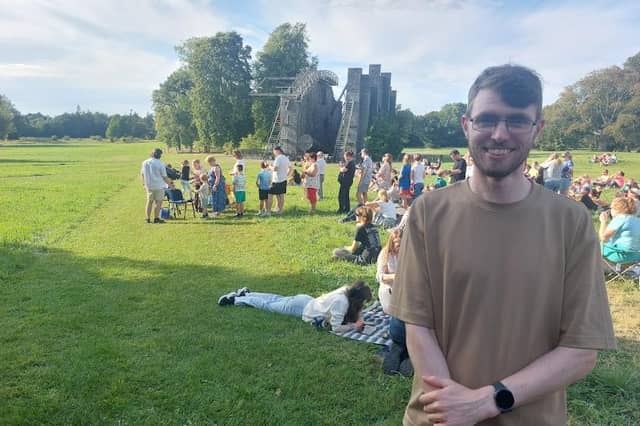

‘there is talk of getting the Telescope moving again (up and down, left and right) and even getting it operational so that visitors will be able to view the night sky through it.’
MEMBERS of the general public had a wonderful opportunity to experience the dramatic Solar Eclipse on August 12 in the grounds of Birr Castle Demesne.
The event was very popular with the public and was booked out well in advance. “Eclipse 26” ran from 5pm to 8pm and was a very special evening, offering attendees the opportunity to experience “a deep partial view of the 2026 Solar Eclipse”, with an incredible 92–98% of the Sun covered, a rare phenomenon which will not be seen again at this percentage level until 2090.
Appropriately set within one of Ireland’s most historic astronomical locations, this unique event combined live eclipse viewing, expert insights from the Belmont astrophysicist and solar expert Dr Jeremy Rigney, and family-friendly activities such as face painting and journeys on the Castle train. Solar eclipse glasses were provided for all attendees; as well as the opportunity to view the phenomenon through a solar telescope.
The last major deep partial solar eclipse visible in Ireland occurred on March 29, 2025. On that date the Moon covered roughly 51% of the Sun's diameter from the east, and up to nearly 50% across the rest of the country.
A solar eclipse occurs when the moon passes between the Earth and the Sun, and totally or partly obscures the view of the Sun for a viewer on Earth.
In some ancient cultures solar eclipses were attributed to supernatural causes or regarded as bad omens. The ancient Greeks used the word ekleípō (meaning "abandonment" or "disappearance") to name the phenomenon, seeing it as a sign that the gods were deeply angry with human behaviour. The Roman historian Livy recorded that sudden daytime darkness caused intense civic panic, requiring formal state days of ritual purification (“prodigia”) to appease the gods.
The weather was perfect for the August 12 event and the setting was ideal. Attendees sat on bean bags, chairs or the grass. Some had brought picnics. The Castle train ferried people from the entrance to the viewing site. Our viewing location was beside the Great Telescope, which was extremely apt. The Great Telescope, Jeremy told us, was the largest telescope in the world from 1845 to 1917. It stands at an impressive 72 feet long with a mirror measuring 6 feet in diameter.
Jeremy told the Tribune that he did a PhD in Solar and Stellar eruptions in the Dublin Institute for Advanced Studies, during which time he carried out research using the I-LOFAR radio telescope in Birr Castle. Currently living in Dublin, Jeremy told me he gives tours focussed on the Castle’s astronomical heritage from time to time. He reminded me that the Great Telescope was renovated in 1996 and contains an aluminium mirror. Jeremy said he and others have cleaned this mirror and, as part of the Castle’s UNESCO World Heritage Status bid, there is talk of getting the Telescope moving again (up and down, left and right) and even getting it operational so that visitors will be able to view the night sky through it.