


A lot of parenting stems from instinct – and that’s exactly how animals raise their young.
And while human parents like to think they look after their children better than any far-less intelligent animals could, there’s no doubt that there are lessons to be learned from parenting in the animal kingdom.
Helen Jukes, author of the new book Mother Animal, which tells stories of parenting, nesting and birthing from the natural world, says: “We tend to carry a particular image of what’s natural when it comes to parenting, but venture a little way into the animal world and an extraordinary diversity emerges when it comes to raising offspring.
“There are single mums and single dads, parenting couples and communal breeders, as well as offspring capable of fending for themselves from birth. For animals, motherhood isn’t about conforming to a particular type so much as finding a form and style of parenting that meets the needs of their niche – a live balancing act between parent, infant and the wider world.”
Here’s a few prime examples Jukes has selected from the wonderful world of animal parenting…
1. Polar bears
Polar bears are devoted mothers – but with a certain element of control. Jukes explains the bears mate in late spring as Arctic temperatures begin to rise, and females will suspend the pregnancy until autumn, when embryonic development will either continue or be terminated, depending on whether the mother’s built up enough fat reserves through the summer months.
“If all goes well, the pregnant mother will build herself a snow cave and crawl inside it to give birth in winter – she won’t leave the cave, or eat or drink, until the following spring,” says Jukes. “Her cubs will continue nursing until they’re at least 20 months old, and will stay with her for almost three years.”
2. Orangutans
“Orangutan mothers are nothing if not devoted,” says Jukes. “A female will provide the entirety of her infant’s food and transport for the first years of his life – she might continue nursing until they’re six or seven.”
“Such an intensive form of parenting might seem like a burden, but it also grants her considerable influence,” Jukes explains. “She defines many of the experiences of the next generation – she shapes their skills and habits. In this way, contrary to the stereotype of the mute and passive mother, she possesses important evolutionary significance.”
3. Malleefowl
As parenting goes, malleefowl (stocky ground-nesting birds with flecked, dust-coloured wings) are at the other extreme, and Jukes explains: “Unlike orangutans, they provide almost nothing in the way of parental care.”
The malleefowl nest is mostly built by the father, who scrapes dead leaves and sand into a large mound that may extend to over four metres in diameter and a metre in height, explains Jukes. “Neither parent sits on the eggs; they’re incubated through the heat generated by the process of decomposition,” she says.
And, in one of the animal kingdom’s most extreme examples of infant independence, she says: “Once hatched, the chicks will dig themselves out and make a dash for nearby undergrowth without ever seeing their parents.”
4. Smooth guardian frogs
Raising offspring isn’t all down to mother animals, and there are single dads in the animal kingdom, too.
“The male smooth guardian frog is one of nature’s single dads, and a remarkably devoted one too,” Jukes observes.
5. Flamingos
Jukes says around 90% of birds parent in couples, and some share tasks with a striking level of flexibility. “Captive flamingos have been observed forming same-sex pairs, and in such cases they appear to split the tasks as an opposite sex couple would – one spends more time away from the nest, while the other primarily looks after the eggs,” she says.
Flamingo parenting is fundamentally a shared task, and in opposite sex couples, both males and females produce a bright ‘crop milk’ from a sac in their throat, which they feed to newborn chicks. Jukes says: “This ‘milk’ is bright red in colour – both parents turn visibly paler through the course of feeding, as their white chicks turn pink.”
6. Giraffes
Parenting is a group effort for giraffes, who form communal creches for raising offspring and frequently feed each other’s calves, explains Jukes. She says: “We’ve all heard the expression ‘it takes a village to raise a child’, and this is certainly true when it comes to giraffes”.
7. Bats
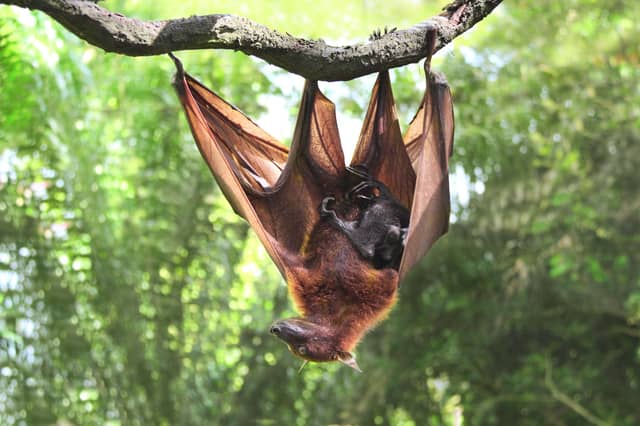
Bats don’t do solitary parenting either – Jukes says most bat species are highly social, and their offspring are raised in all-female roosts. And as with giraffes, mothers frequently feed each other’s pups.
1.
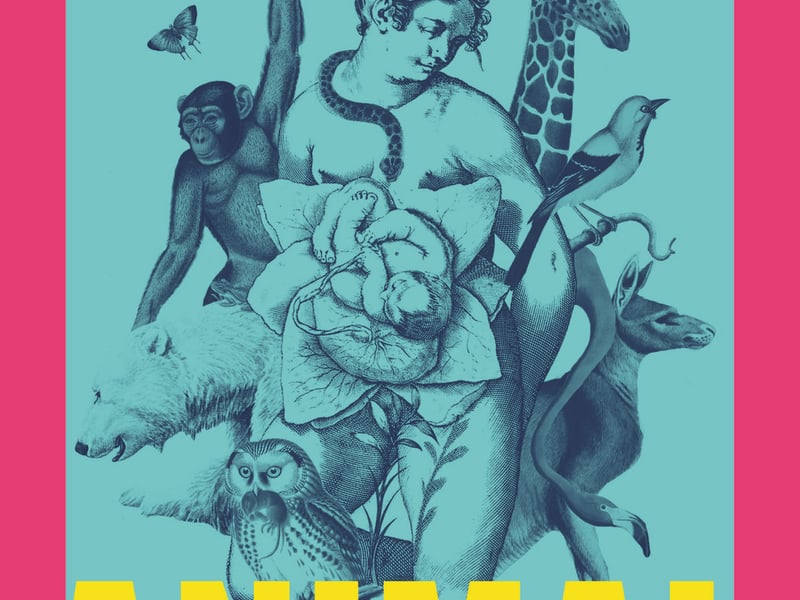
Mother Animal by Helen Jukes is published by Elliott & Thompson on February 27, priced £16.99.