

Blacksmith Festival in Offaly was a great success
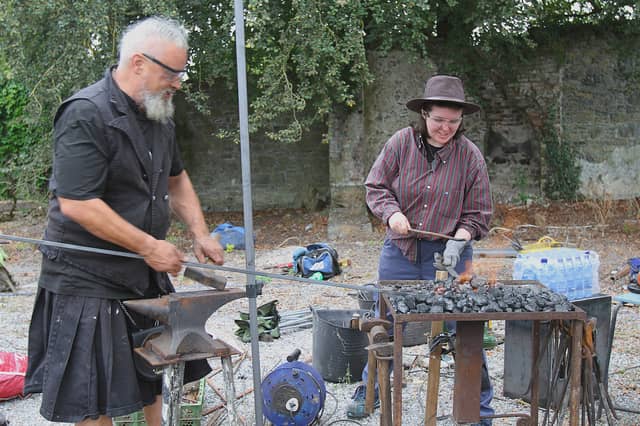

That Beats Banagher festival attracted large numbers of people over three days
RUNNING for three days, the That Beats Banagher festival attracted large numbers of families and interested people.
Jane Walsh and Brendan O Loughlin ensured it ran smoothly. “Forged in Ireland”, a unit of Blacksmith volunteers keep the heritage alive and encourage families to bring their children and engage.
On Friday there was a workshop of traditional blade making and the fundamentals of blacksmithing. A community exhibition launch “Feathered between the Cracks” in Banagher Library. Iron ore smelting was led by Keith Armstrong and team.
A Heritage Walk from Crank House to Eliza Lodge was led by James Scully. Towards the end of the 18th Century Britain and Ireland feared a French invasion. Wolfe Tone led 14,000 troops to Bantry Bay only to be thwarted by a fierce storm with the loss of both men and ships. The French landed a small force in Mayo but were halted in Co. Longford. So a network of defences were built to defend the Irish coast mainly round Dublin. 29 Martello towers protected the coast. The west coast was very exposed, so the River Shannon had defences built to protect the crossings at Athlone, Shannonbridge, Banagher and Meelick.
Britain and France were at war again so in 1803, so on the east bank of Co. Offaly, the existing barracks were strengthened for three 12 pounder cannons. Downstream an earthwork battery, Fort Eliza was built and fitted out with three 18 pounder guns.
On the west bank in Co. Galway, Cromwell’s Castle was remodelled to house two 12 pounders. Some years later seven guns safeguarded the east bank including four 24 pounders in Fort Eliza which now had extensive stonework and was made into a permanent battery.
On the Galway side a single 24 pounder was mounted on Cromwell’s Castle and by 1815 a new Martello tower was added a little to the North. Napoleon’s defeat at Waterloo ended the threat of a French Invasion, but the fortifications were manned, sometimes by invalided soldiers up to 1860.
In 1803 it was decided to call the earthworks after the Royal Family. Athlone and Shannon Bridge were named after the King and Queen and Banagher was named after the youngest daughter. I spoke to Teresa Ryan Feehan, Mary Hughes, Margaret Gallagher, Mary Reynolds and Mary Stephens. They all said that James Scully with his story telling and witty asides made history very interesting and enjoyable.
I met Mícheāl Potterton, “Fiach Rua Timbercraft” , Timber Hewing, Traditional Woodwork, Ogham Carving. He explained his craft and gave a display of his skills with an axe. Guy Urbain makes Ogham bangles and pendants and Jewellery. Blacksmiths of all ages and genders worked away, their tapping resonating in the air. Ramie, Betsy and young Logan came on the walk and enjoyed the blacksmiths' craft. Disenchanted with the US, they came here from Ohio six years ago.
Basket weaver Pairic Larkin was explaining his craft. Junior Blacksmiths had had a fun, cold forging experience. Ceramic crafts gave a workshop and there was a stone carving demonstration. Tom Faulkner from Fiealley and Vinny Fennell, Banagher, were busy bargaining over prices at James Scully’s Martello Bookshop. “That’s a lovely book, how much?”. “€20”. “I only have 10”. “ Ok, 15”. Search of pockets “Oh, I have a fiver in me back pocket, for a drink, eh, eh, of, of coffee!” “Deal, shake.”
Paul Rondelez, PHD UCC, on Medieval Iron Production in Ireland with the knowledge and help of the late Kieran Keenaghan collected the ore from Clonony Bog this time last year. Charcoal is heated in the furnace which forms Bloom. It’s converted in the forge to Iron.
The sharpest hard blade from thr competition to cut wood, a sponge, tennis ball, golf ball, six bottles of water, paper and a rope wins. The Iron Blades Sports organised by Jim Smith. Damien McNeely MC star. Winner was Nathan Fetherstone, 2nd Conor, 3rd Eric.
Jim Smith filmed the competition and supplied answers. I spotted Maebh Bagnal silversmith working on a piece. World class Farrier Jeremy Stanley sets “The Golden Anvil Challenge” for blacksmiths to make a horseshoe. Winner, Sean Dunwoody. The late Kieran Keenaghan’s family were presented a piece by the Blacksmiths as a thanks for his pioneering work for the festival. It’s two pieces of iron linked by a bridge with Kieran’s name on it. Well done.
Thanks to all for the organisation and the excellent craft skills on show.